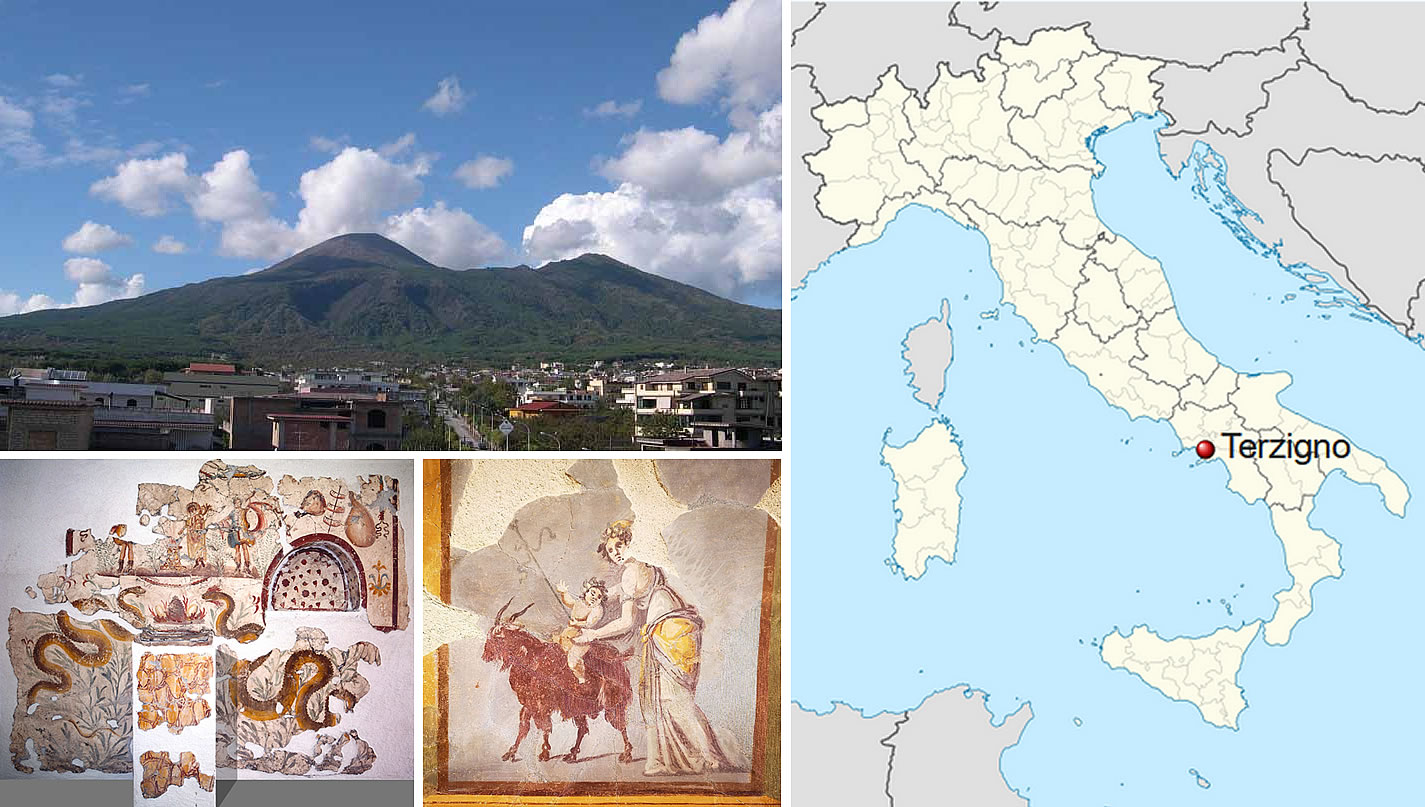
Terzigno (Naples, Italy)

Today, Terzigno is a small town at the foot of Mount Vesuvius, but it was once the outskirts of Pompeii: an area devoted to viticulture, with lush countryside where olive oil was also produced, and a cluster of villas that functioned as farms. Here, people lived a rustic life, yet each villa also had a master's area reserved for the owner's otium (leisure). These farmhouses, dating back to as early as the 3rd century BC, were small, self-sufficient worlds. In addition to their main commercial product, they grew everything needed to sustain the inhabitants. Over the centuries, various eruptions buried numerous residential and agricultural structures beneath a blanket of ash and pumice, sealing this strip of land for almost two thousand years, about 20 meters below the current ground level.
Then, in 1981, in the area of the Ranieri quarry – where basalt was extracted for construction or for paving roads – once the extraction of more recent lava was exhausted, the layer of ash and lapilli from the catastrophic eruption of 79 AD began to emerge. Gradually, numerous archaeological features came to light: a cistern, a child’s tomb, cultivation furrows, and three villas. For safety and preservation reasons, the villas of the Ranieri quarry have been reburied. However, to appreciate the beauty and richness of their rooms, one need only visit the museum of Terzigno. It houses an invaluable archaeological heritage, including many artifacts of fine craftsmanship: silverware, gold jewelry, extraordinarily elegant pottery, frescoes, earthenware, various types of amphorae, antefixes, and agricultural tools used for cultivating the lands attached to the villas.
Numerous frescoes come from various rooms of the so-called "Villa 6", which covers about 2,600 square meters (the other two villas were half that size). The frescoes can be classified as Second Style paintings, featuring striking architectural perspectives and elements linked to the Dionysian world. In its large kitchen, there was an altar for the worship of the protective deities of the family – a family that was living there at the time of the eruption, as shown by the skeletons of six adults and one child found along their escape route. The painting of the Lararium found there depicts two Lares and the sacrificing Genius, as well as two snakes approaching a dish of offerings. The Lararium is a small shrine, either frescoed or set into the wall, where the Lares were honored: the protective spirits of the family, the hearth, and the boundaries of the property.
And it is precisely when thinking about the Lararium that a minor deity comes to my mind – often forgotten, yet essential for those who lived on these lands: the goddess Abeona. While the Lares watched over the house, Abeona was the goddess who watched over the journey beyond the house. Her name derives from the verb abire, "to go away." In ancient Rome, she was the one who accompanied children when they first crossed the domestic threshold to venture outside. She was the protector of the first step, of detachment, of the moment when one leaves a safe place to face the unknown. Imagine what it meant to invoke Abeona in a villa like that of Terzigno. Outside those walls, life was lush but uncertain. The soil was fertile thanks to the volcano, but its shadow was constant. Crossing beyond the Lararium, beyond the property's boundary, meant confronting the powerful and unpredictable nature of Vesuvius.
The ancient Romans sought the protection of a multitude of deities, each specialized in accompanying and nurturing them at various moments of the day. These gods and spirits belonged to the early Roman religion and mythology, distinct from those adopted from other cultures. Many of these deities were minor figures, often born from the personification of an abstract quality. Since Latin terms for qualities and abstract concepts were frequently feminine, the number of female deities exceeded that of male ones.
With high infant mortality rates in antiquity and medicine in its early stages, Romans often relied on spells and popular traditions in place of pediatric care. For example, they turned to the goddess Carna for relief from a baby’s stomach ache, to Cunina to prevent accidental falls, to Pontina to ward off choking, or to Abeona to assist a child in their first steps outside the home.
The goddess Abeona derived her name from the Latin verb abire, meaning "to go away," and was seen as a guardian of departures. Romans invoked her for protection before any journey, whether it was a child’s first day at school, a child lost on their way home, or a young adult leaving the family home or marrying. Abeona was typically honored alongside Adeona, a related Roman deity. Adeona’s name came from adire, meaning "to return," and she was the protector of those coming home. Originally, these two deities represented one Italic, and later Roman, goddess associated with the natural process of coming and going in life. Over time, the singular goddess split into two – Abeona and Adeona – with more specific roles, as other deities absorbed their broader responsibilities.
Both goddesses were invoked for protection in the household shrine, known as the Lararium, where offerings were made without animal sacrifices. For young children, offerings typically included spelt cakes and milk; for older children or adults, offerings included cakes and wine.
The statues of these two goddesses stood alongside the statue of Libertas, commissioned on the Aventine Hill by Tiberius Gracchus, to symbolize that freedom could come and go as it wished.
Overall, Abeona and Adeona served as the deities of travelers and were part of a group of "minor" Roman deities known as the di indigetes.
Di indigetes was a name given collectively to these forebears, as well as to other deified powers or spirits who likewise controlled the destiny of Rome.
The Lares (from the Latin lares, lar – "hearth" of the home, derived from the Etruscan lar – "father") are figures in Roman religion representing the protective spirits of deceased ancestors. According to Roman tradition, they watched over the well-being of the family and of property or assets in general. The Lares were worshiped wherever properties adjoined, and inside every home their statuettes were placed in the domestic shrine (Lararium). Under state control, they moved from property boundaries to crossroads (where Augustus eventually associated his own genius with the cult) and were worshiped as the guardian spirits of the whole community (Lares Praestites).
The Romans had sacred formulas to invoke each deity for specific acts in private life, with a particular epithet for each. Approximately 150 such deities existed, with authors like Varro, Saint Augustine, Tertullian, and Arnobius recording these invocations.
This page was last edited on 21 March 2026
Terzigno (Naples, Italy)
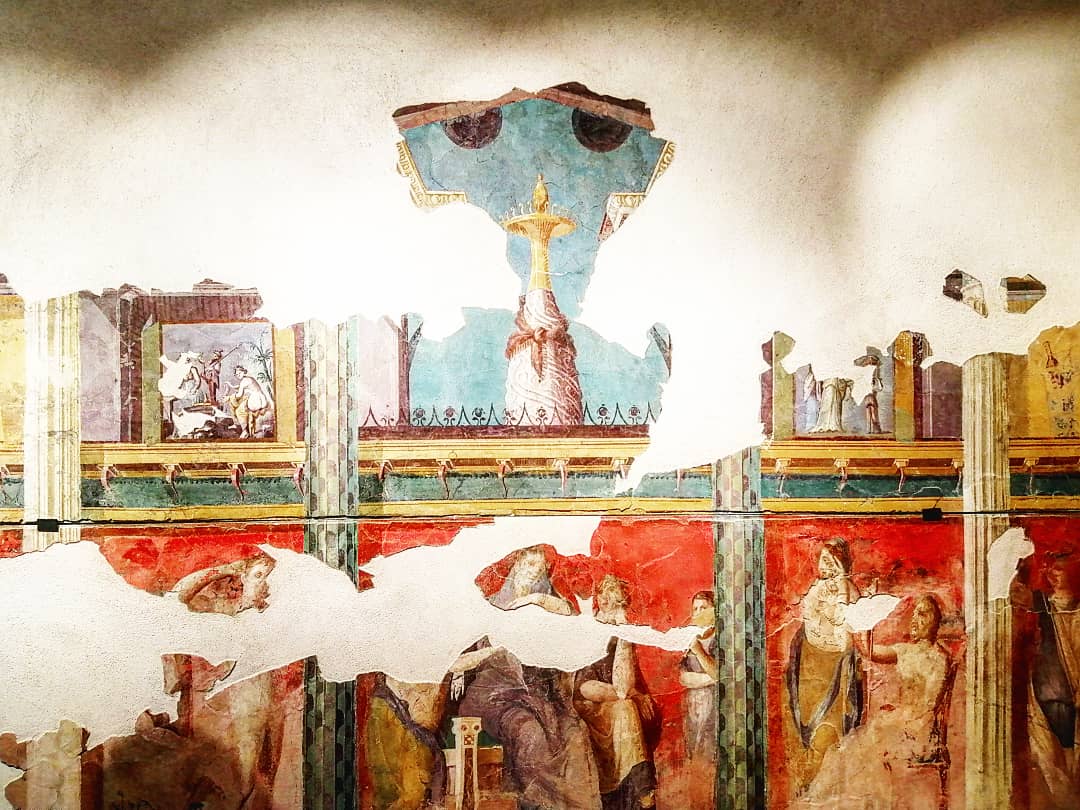
Side wall of the triclinium of villa 6
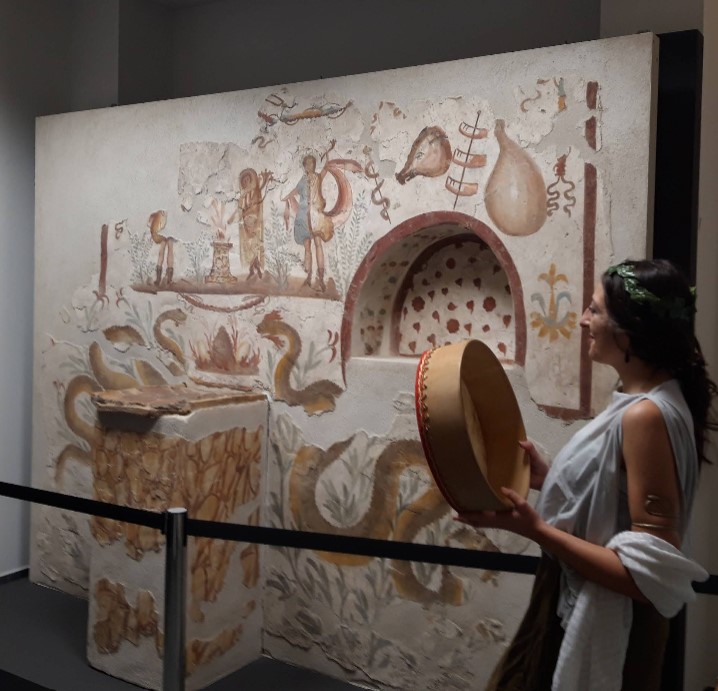
Fresco depicting a lararium (domestic shrine) with a niche and an altar Roman, Terzigno, Villa 6, kitchen, mid-1st century BC Fresco and terracotta Parco Archeologico di Pompel SAP 86755 THE HOUSEHOLD SHRINE The atrium often featured a shrine (lararium), which was named after the protective household gods, the Lares. It contained images of the Lares and other gods such as Bacchus, Venus, and Hercules and foreign deities such as the Egyptian Serapis. The master, as spiritual head of the family (pater familias), led its members in sacrifices at the shrine. He lit lamps and, on a small marble or terracotta altar, burned incense and offered food and drink that included milk, wine, fruit, eggs, pinecones, and, for special occasions, a blood sacrifice of a cock or even a piglet.
© andmorestory.eu - All right reserved