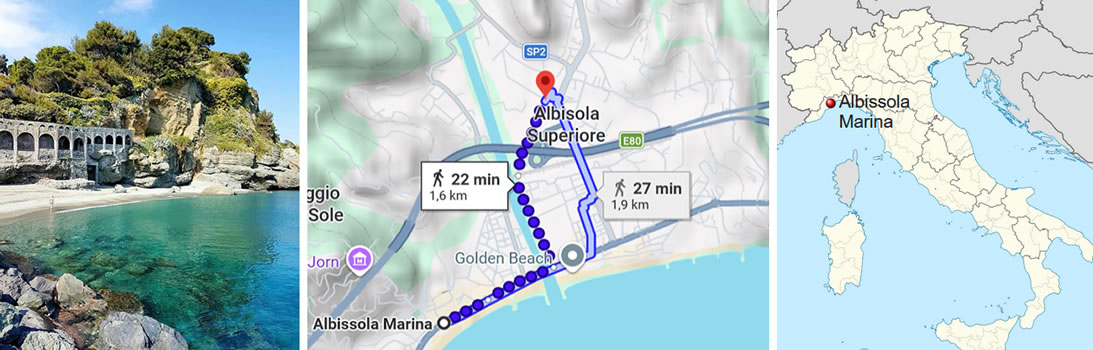
Albisola Superiore and Albissola Marina (Savona, Italia)

In Albisola Superiore lived a group of witches skilled in magical love rituals, so much so that in the small square in front of Villa Gavotti, they would often enliven the full moon nights with their sabbaths around a fire. The baroque-style villa was commissioned in 1744 by the Doge of Genoa, Francesco Maria della Rovere (1695-1768), and upon his death, it became the property of the Gavotti marquises.
Legend has it that one of the witches fell desperately in love with the Marquis Gavotti, and so her sisters attempted with all manner of spells and hexes to make the Marquis return her affection. Despite their magical arts, they failed. But the lovelorn witch, seized by a terrible rage, climbed the mountain and provoked an earthquake that split the summit in two. From that day on, the place has been called “Bricco Spaccato” (The Split Hill). The witch was never heard from again, though some locals claim she was sucked into the chasm created by her own power.
It is also said that near Bricco Spaccato, on the night of November 2nd, All Souls' Night, the souls of all those who died at sea and were buried in its waters gather: pirates, sailors, fishermen, cabin boys, and adventurers. They emerge from the sea as small, faint lights pushed by the waves and then by the wind toward the shore. Once they reach land, at the first stroke of midnight, these will-o'-the-wisps take on evanescent human shapes, and it is said they try to drag by the hair anyone they encounter on their path. At the first light of dawn, the spirits dissolve into the mist to return to the sea depths, only to reappear the following year.
Will-o'-the-wisps are, in fact, a simple biological phenomenon with rather disorienting features. The first scientific theory attempting to explain them dates back to 1776, when Alessandro Volta hypothesized that these gases interacted with lightning, giving rise to these "flickering lights." Today, science has largely explained the phenomenon: they are short-lived flames (hence the term "fatuous") produced during the decomposition of organic material, formed from hydrogen and phosphorus—two elements highly flammable upon contact with the oxygen in the air. Specifically, the main substance responsible for will-o'-the-wisps is phosphine, a colorless gas with a foul odor reminiscent of rotting fish. In its pure form, it does not ignite spontaneously in air; however, in the presence of even small traces of diphosphane, which can ignite spontaneously in air, the phosphine burns, forming faint flames and giving rise to the phenomenon known as the will-o'-the-wisp.
We often hear tales of these lights moving away as we approach, or quickly dispersing. The reason is simple: our approach creates a movement of air which, impacting the will-o'-the-wisp, disperses its core of gas.
Albisola Superiore and Albissola Marina (Savona, Italia)
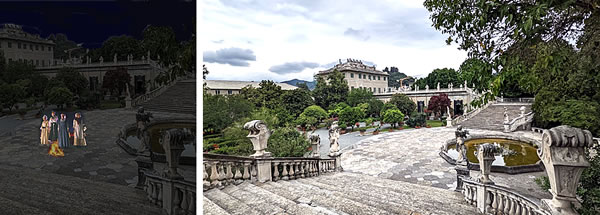
Witches at Villa Gavotti, Albisola Superiore (Savona, Italy)
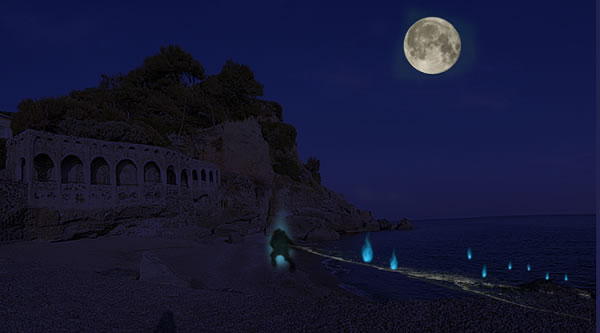
The souls of those lost at sea on November 2nd, Albissola Marina (Savona, Italy)
This page was last edited on 14 March 2026
© andmorestory.eu - All right reserved