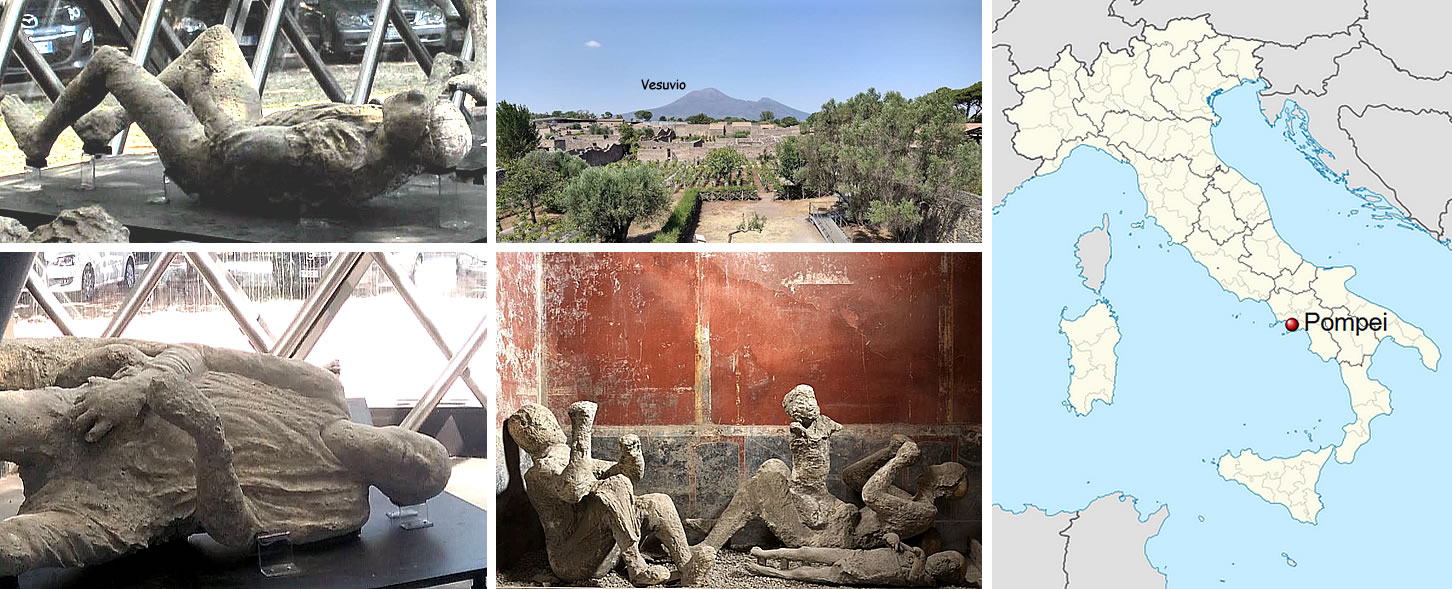
Some plaster casts found in Pompeii

Analyzing fourteen casts of victims found in 1975 at the Porta Nola necropolis, archaeologists observed that the individuals wore tunics and heavy woolen cloaks—the abolla—woven with a dense, durable fabric. Most victims wore two layers: a tunic and a cloak, both made of wool. This material was the most common in ancient Rome due to its low cost, resistance to harsh weather, and versatility.
The Latin term abolla derives from the Greek ambolē, anabolē, anabállō, meaning "thrown over." It was a practical woolen cloak used by Romans as a protective outer garment. Thanks to its double-layered, sturdy construction, it served as a warm cloak for soldiers, travelers, and laborers, fastened at the shoulder or chest for ease and functionality. Over time, the abolla evolved both in materials and cultural significance, especially during the Imperial period, when it began to be made from finer fabrics and was adopted in urban settings.
The cloak’s transformation from a utilitarian item into a philosophical symbol occurred when Stoic and Cynic philosophers in Rome adopted it as the pallium philosophicum. Following the model of Greek philosophers, this garment became a way for Roman thinkers to distinguish themselves. The abolla’s simplicity and functionality resonated with Stoic ideals of austerity and modesty, reinforcing their philosophical values. Roman satirists, including Juvenal, noted this association with the Stoics, famously coining the phrase facinus majoris abollae ("the crime of a very deep philosopher"), humorously implying a misdeed committed by a particularly committed follower.
Beyond its practical and symbolic functions, the abolla could also serve as a luxury item for the elite: the cloak of Ptolemy of Mauretania, for example, was an extravagant purple version. According to historical accounts, this lavish garment attracted the jealousy of Emperor Caligula, contributing to Ptolemy's downfall.
Today, it is possible to create more precise casts not only of the victims but also of the objects they had with them at the moment they were overwhelmed and killed by the eruption’s scorching vapors. In 2017, at the luxurious suburban villa of Civita Giuliana, dating to the Augustan era and featuring terraces overlooking the sea, archaeologists discovered the remains of three purebred horses in the stables. One was even outfitted with a refined saddle of wood and bronze and gleaming harnesses, as if prepared for the imminent departure of its owner—likely a military commander or high magistrate, perhaps a member of the Mummii family, a prestigious Roman lineage of the imperial age. In the same villa, the remains of a frescoed wall were also found, bearing the graffito of a child’s name: the little "Mummia."
The discovery of other Pompeians wearing heavy clothing at the time of the catastrophic 79 AD eruption shifts the date from summer—traditionally associated with August 24—to autumn, likely during the colder months of October or November. Some historians note that heavy wool could have been worn not so much for the cold, but as protection against gas and ash: a thick cloak, in fact, would have shielded against dust and pyroclastic material during escape, regardless of the season. Furthermore, ancient sources often describe heavier clothing than one might expect today, suggesting that aesthetic and social considerations could sometimes outweigh actual temperature. However, the presence of multiple layers worn while fleeing homes indicates protection against the lower temperatures typical of late autumn or, perhaps, against external agents generated by the eruption. The layered clothing, similar both inside and outside houses, suggests that people had no time to change, confirming the rapidity and unpredictability of the disaster.
On the other hand, there is the testimony of Pliny the Younger, a Roman magistrate, orator, and writer (living approximately from 62 to 114 AD), who witnessed the eruption as a teenager. He observed the tragedy firsthand from the shore of Misenum. In his later years, he described the eruption in two letters addressed to the historian Tacitus. Written around 108 AD, nearly thirty years after the event, they are considered the first documented account of a volcanic eruption:
The sun was shining and the air dry; many fled with only light tunics covering them, while others sought refuge near the sea.
These words have often been interpreted as confirmation of the summer season. Pliny also emphasizes the intensity of volcanic activity and the rapid accumulation of ash, elements consistent with August 24, a time when the summer heat may have made the citizens’ escape more difficult. However, since the original letter no longer exists, it is impossible to verify its actual content. Ancient manuscripts have been passed down through copies over centuries, a process known to involve transcription errors, inaccurate translations, and other mistakes. The most accredited translation of the letter gives a date equivalent to August 4, but Pliny’s text could also be interpreted as October 30, November 1, or November 23.
Contrasting translations and transcriptions have further complicated the matter: some surviving manuscripts reproducing the letters use the term Novembres, which, according to the Roman calendar system of the time, would indicate an eruption date in October. Another Roman historian, Cassius Dio, reports that the event occurred in autumn, although he wrote about it roughly a century and a half later.
Other archaeological evidence would seem to confirm a new date for the eruption: the second day of the event, the morning of October 25 in that fateful year of 79 AD. As early as the 19th century, archaeologists had been struck by findings such as a cast of a shrub with autumn berries, lit braziers inside houses, traces of pomegranates—a typically autumn fruit found intact—and wine fermenting in dolia in taverns.
Another intriguing clue is the latest coins discovered, minted in July or August of 79. If the August 24 date were correct, it would be remarkable that both coins entered circulation shortly after minting and reached Pompeii before the disaster. Furthermore, in 2018, during new excavations in Regio V, an inscription came to light. On the walls of a room in the "House with the Garden," a charcoal graffito was found bearing the date of the sixteenth day before the Kalends of November, i.e., October 17. This is a phrase written by a worker renovating the house, who used charcoal taken from a nearby brazier—a graffito that, under normal conditions, would not have survived more than seven days. Interpretations of the short Latin text vary, but all agree that the date indicated refers to the month of October in our calendar:
XVI (ante) K(alendas) Nov(embres) in olearia / proma sumserunt ...
On October 17, they took from the oil pantry …
A week later, the mountain, silent for millennia, began to rumble and tremble. The Pompeians did not flee: they had grown accustomed to its tremors over the past year, which they attributed to the gods' wrath. Moreover, Vesuvius was not the tall mountain it appears today, but little more than a harmless hill, covered with dense vegetation, vineyards, and woods where timber was gathered. Other clues from archaeological studies at Pompeii support the theory of an autumn eruption: the presence of autumn fruits such as pomegranates, figs, and nuts found at the site may indeed be an indication.
In 2025, analyzing the layers of pumice and ash deposited in the area surrounding the volcano, archaeologists concluded that the eruption was more complex and devastating than previously thought. After over thirty-two hours of hell, Vesuvius likely generated an eruptive column up to 34 kilometers high, which then turned into a rain of gray pumice beginning around 7:00 PM. Only after a day and a half did the fallout cease, when an "underestimated" magma flow buried Pompeii. The most destructive part of the eruption was caused by the final pyroclastic surge of magma and gas that flowed down the mountain’s flank shortly after 7:00 AM on the second day. Thus, there was never incandescent lava and most victims died of asphyxiation from ash and were buried beneath this layer. No human remains have been found above it, suggesting that the devastation of that morning left no survivors.
This page was last edited on 21 March 2026
Some plaster casts found in Pompeii
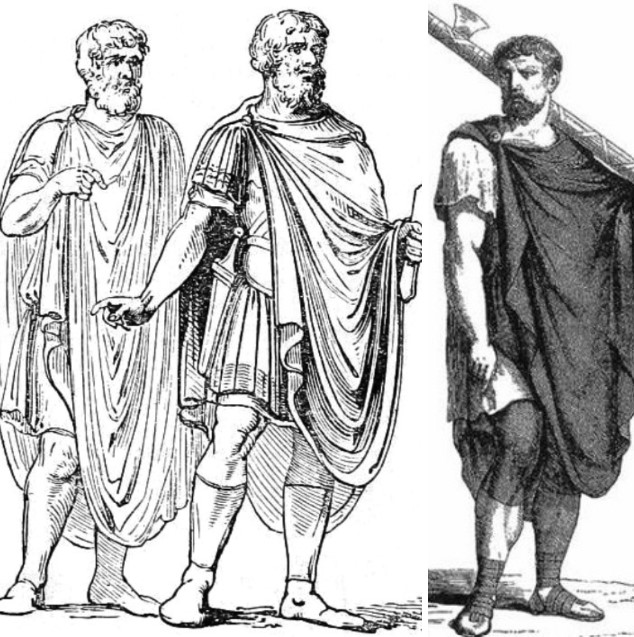
Two men and a Lictor with the fasces, wearing an abolla, a loose wollen cloak worn by ancient Romans.
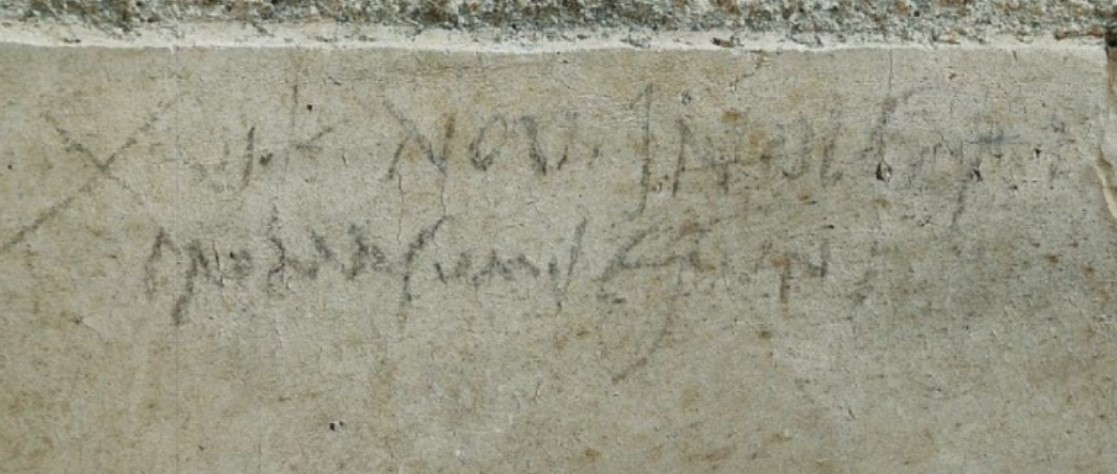
On October 17, they took from the oil pantry …
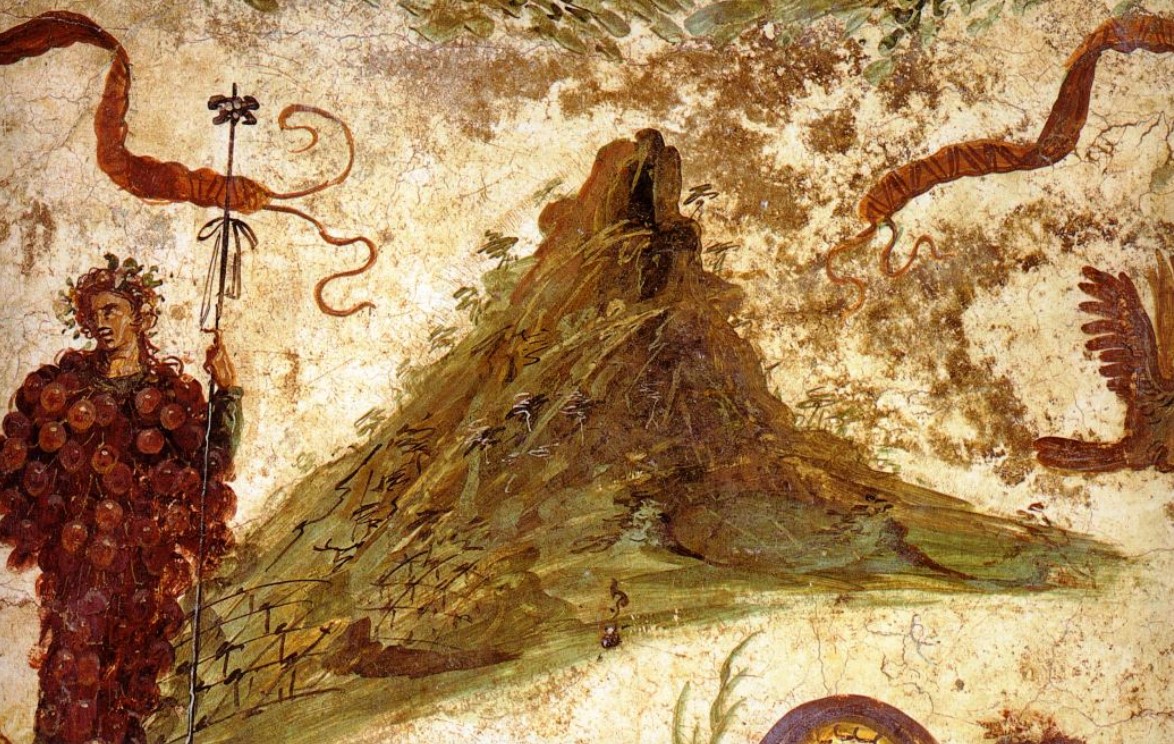
National Archaeological Museum of Naples (inv. no. 112286). From Pompeii, House of the Centenary (IX, 8, 3-6) – Fresco from the house’s lararium, depicting Bacchus in the form of a grape cluster, pouring wine for his favorite animal, the panther; above, a garland with ribbons and birds; below, the agathodaemon serpent, the genius loci, facing a cylindrical altar; the visible mountain is presumably Vesuvius as it appeared before the eruption of 79 AD, characterized by a single peak, and densely covered with vegetation.
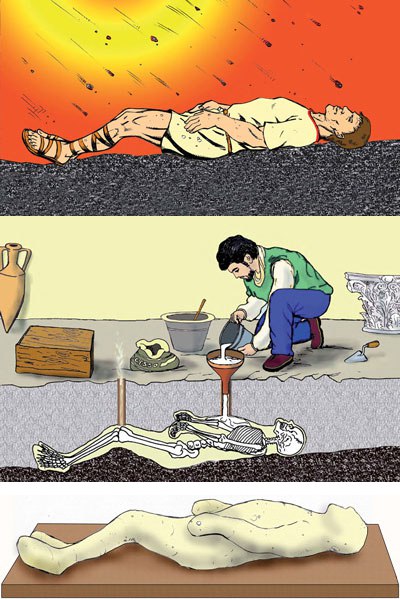
Making a cast (drawings by U. Cesino)
© andmorestory.eu - All right reserved