
Domus of surgeon, Rimini (Italy)

In the spring of 1989, during the uprooting of a tree, fragments of fresco were discovered trapped in its roots, along with a mosaic and ruins from the Roman era. This discovery was followed by an archaeological survey that revealed the first mosaics at a depth of about 2.5 meters below ground level, as well as stratified layers and various structures dating back to the late Republican age. It was a 1,000-square-meter domus from the 2nd century AD, nicknamed by archaeologists the "House of the Surgeon" due to the surgical kit found there. A bronze box had fallen from a shelf originally placed on the wall, spilling a set of iron and bronze instruments used by the physician for his procedures: forceps, scalpels, chisels, probes, and other tools, as well as bronze scales and measuring cups. There were also terracotta vials and a group of now-unrecognizable glass fragments belonging to small bottles and other containers used for pharmaceutical purposes.
The domus was located near the port basin at the mouth of the Marecchia River, before its course was diverted northward and before the coastline shifted 1.5 kilometers seaward. It is hypothesized that the physician's name was Eutyches, based on a graffito inscribed in a 3rd-century style of writing on the decorative plaster of the wall in the cubiculum, where the bed had been placed. It was likely carved by a patient to express gratitude for his care:
[---Eut]ych[es] [ho]mo bonus [hic h]abitat [Hic su]nt miseri
Eutyches, a good man, lives here; here are the afflicted.
From the finds, mosaics, decorations, and numerous Greek inscriptions discovered on the pottery, it is speculated that Eutyches came from the Greek-speaking Eastern Mediterranean, where he likely also studied, given that the largest medical schools of the time were located there. Furthermore, the surgical instruments found suggest that the physician had a military specialization, as they were primarily intended for treating trauma and wounds—such as the spoon of Diocles (a spoon-shaped tool for extracting arrowheads)—and were exclusively for men, not women, given the absence of obstetrical instruments. Originally, according to the sparse and fragmentary records that have come down to us from the Roman era, midwives were the ones authorized to perform abortions. Indeed, the first physicians, mostly Greeks who arrived in Rome in the 2nd century (thus contemporaries of Eutyches), only later learned the art of obstetrics. Until then, childbirth assistance was provided by women with no specific medical qualifications. It was not until the time of Celsus (1st century AD) that obstetrics began to be integrated into the broader field of medicine, since midwives themselves would call upon a surgeon to save a woman in labor. In such cases, the procedure left to perform was embryotomy—an operation widely practiced in Rome, even on live fetuses—due to the very low regard for the life of the unborn and the lack of means to otherwise free the woman. However, if a woman died as a result of an abortion performed through a failed surgical procedure, the physician could be charged with homicide. Moreover, it is highly likely that in the early days, women who assisted in childbirth often procured abortions themselves.
Abortion derives from Latin abortus, the past participle of the verb aboriri meaning "to perish, to miscarry", which itself is composed of ab, "away from," and oriri, "to be born". It is the voluntary termination of pregnancy, and has been practiced across various cultures and historical periods, shaped by differing motivations and societal roles.
An abortion may occur spontaneously (miscarriage), or it may be brought on purposefully (induced abortion). Its causes might stem from health conditions affecting the mother or fetus, or maternal-fetal incompatibility.
Abortion refers to the termination of pregnancy resulting in the expulsion of the fetus before the 22nd week (196th day) of gestation, according to the World Health Organization (WHO). For some Anglo-Saxon authors, the threshold is set at the 20th week, when fetal viability is sometimes possible.
Abortion has ancient roots, with early abortions performed in various civilizations through medicinal herbs, sharp tools, and abdominal pressure, often resulting in tragic outcomes. Induced abortion was recorded in China under Shennong (c. 2700 BCE), in Ancient Egypt through the Ebers Papyrus (c. 1550 BCE), and in the Roman Empire around Juvenal’s time (c. 200 CE).
Penalties varied according to the woman’s social class, as shown in the Code of Hammurabi. In Assyrian jurisprudence, the Code of Assura (1075 BCE) even prescribed the death penalty for a woman acting against her husband's wishes. Instead in Japan, evidence suggests abortion practices dating back to the 12th century, particularly among the elite and urban residents. The Edo period saw a rise in abortion, particularly among farmers affected by famine and high taxation, which made child-rearing financially challenging.
The Greek and Roman attitudes toward abortion are complex, partially due to limited historical records. In general, abortion was a common and fully accepted practice among the ancient Greeks and then among the Romans, only if the pregnant woman’s husband gave consent.
During the classical period, abortion was largely seen as an immoral act rather than a criminal offense, although it was subject to censura if permitted by the pater familias (the male head of the family). The prevailing sentiment held that abortion did not hold legal significance, as the fetus had not yet attained legal personhood.
Later, Roman emperors Antoninus Pius and Septimius Severus imposed penalties on violent abortions or those induced with abortive drugs, known as pocula abortionis. The underlying legal rationale for condemning abortion was rooted in protecting the paternal right to heirs, with abortion seen as an infringement upon this right.
Notably, the Hippocratic Oath, a foundational text in Western medicine, stipulated that doctors should refrain from providing abortive methods to women, a directive likely intended to protect women from the inherent risks of early abortive practices, which could inadvertently result in the woman’s death or serious injury due to the lack of modern surgical techniques.
However, additional Hippocratic writings contain descriptions of abortive practices, revealing nuanced views within medical thought at the time. Aristotle, in his treatise Politics (350 BCE), condemned infanticide as a population control method and suggested abortion as a preferable alternative, provided it occurred before the fetus was perceived as "alive," which he defined by the development of sensation.
The concept of "therapeutic abortion" was introduced in the 2nd century by Soranus of Ephesus, who argued that abortion could be justified if pregnancy posed a danger to the mother’s life.
In Roman society, the concept of patria potestas, or paternal authority, allowed fathers to reject unwanted children by simply not recognizing them. Abortion laws under the Roman Twelve Tables gave fathers authority over abortion decisions; if a woman procured an abortion without her husband’s consent, she risked repudiation. Additionally, physicians conducting abortions to conceal adultery could be penalized, and the death of a woman from abortion could lead to charges against the practitioner, though abortion itself was not criminalized.
Roman law’s first explicit penalty for abortion emerged in a rescript that imposed temporary exile on divorced or married women who had abortions against their husband’s wishes.
In the ancient world, abortion was largely considered a matter concerning women, with the fetus seen as an extension of the mother’s body. Thus, abortion was prosecutable primarily if it infringed upon male interests, such as the desire for an heir. With the end of the classical era and the fall of the Western Roman Empire, discussions on abortion gradually waned, leading to a long period of silence on the topic that lasted until modern times.
In the late 16th century, at the height of the Renaissance, the Church officially addressed abortion when Pope Sixtus V condemned the practice as murder, formally prohibiting it for all Christians—a stance that would remain unchanged for centuries. Despite this prohibition, many disregarded the ban; abortions were often carried out either by unqualified practitioners or by women themselves, using risky, clandestine methods in their homes or secret locations. These unsafe practices frequently increased the risk of death for the woman as well as the fetus.
Christian doctrine was the first to equate abortion with homicide, yet it took centuries to attempt to define the point at which fetal "ensoulment" or life was believed to begin. This perspective began to shift significantly with advancements in scientific understanding, a process that accelerated after the French Revolution in 1789.
Today, with advances in medical science and preventative care, increased social awareness of the risks associated with non-hospital abortions, and the recognition of women’s and social rights, many signs indicate that perspectives are evolving: abortion is now a matter of concern for both women and men alike. Consequently, abortion is no longer solely a matter of private decision-making but one of public health and individual rights. This historical journey reflects an ongoing debate, revealing abortion as an enduring, multifaceted issue woven deeply into the fabric of human civilization.
This page was last edited on 21 March 2026
Domus of surgeon, Rimini (Italy)

Eutyches, a good man, lives here; here are the afflicted

The collection of surgical instruments of the doctor Eutyches Greek origin: 150 pieces in bronze and iron, some of which still in their cylindrical iron cases others instead in wooden boxes or in leather rolls. It is the richest in the world for completeness and number of objects. - Domus of surgeon, Rimini

The earliest written about abortion evidence is from Ancient Egypt, around 1550 BCE, and precisely to the pages of the 'Papyrus Ebers'. The document is now in the library of the University of Leipzig, and contains a whole chapter on abortion and many other pages ranging from cancer care to burns, gynecology and contraceptive methods

Bas-relief in the temple of Angkor Wat in Cambodia, depicting an abdominal abortion performed by a demon; circal 1150 BCE. It is one of the earliest known artistic representations of abortion
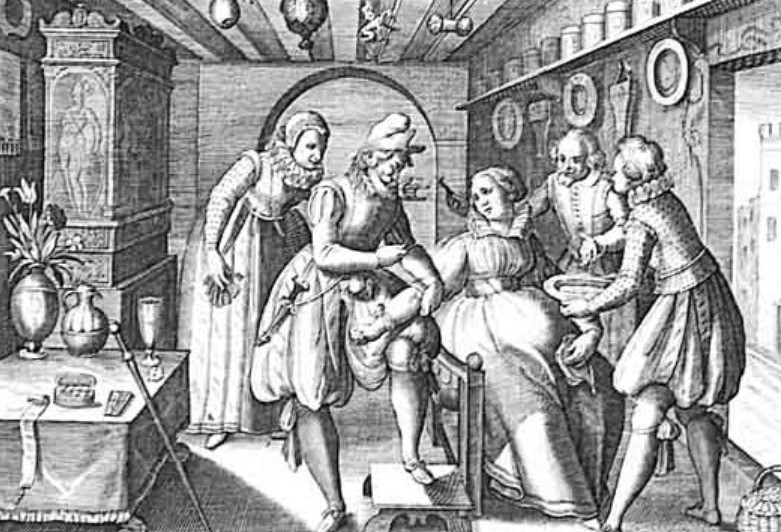
Eigene Schuldbekäntnüß Einer So genandten und vermeinten Jungfraw Aderlässerin
© andmorestory.eu - All right reserved