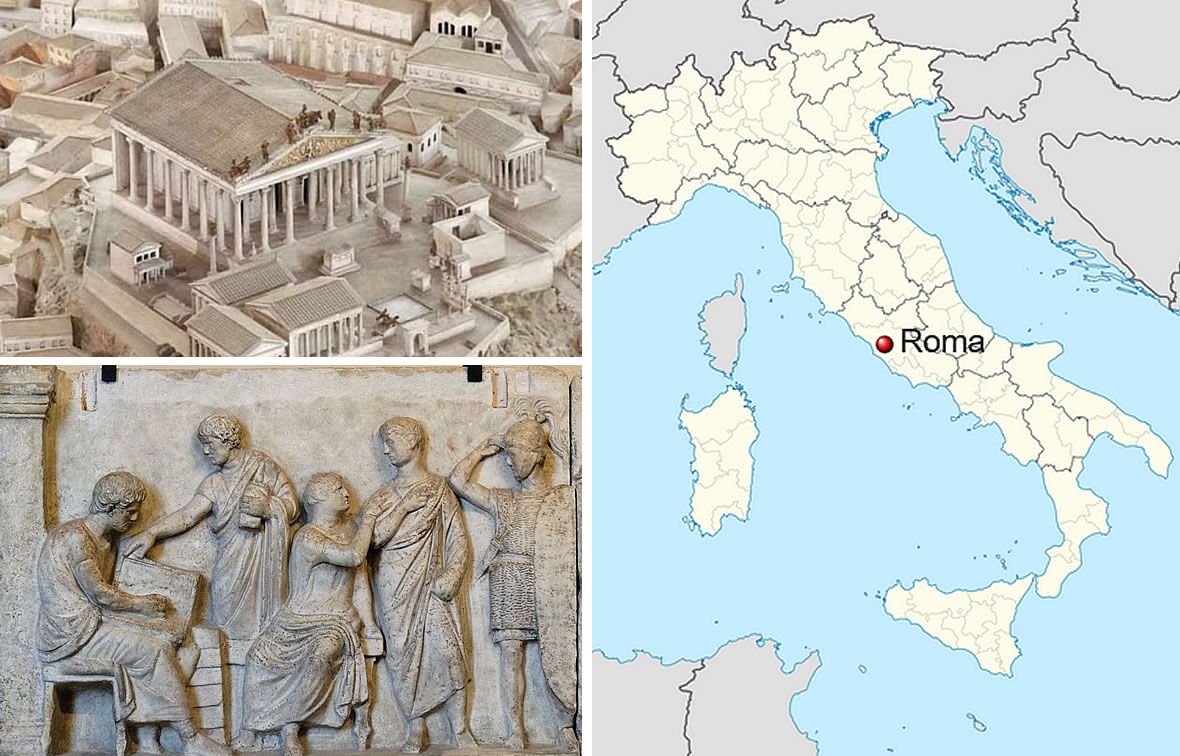
Temple of Jupiter Optimus Maximus and Roman consuls

Cornelius (feminine Cornelia) was the nomen of one of the most important patrician families in ancient Rome, a lineage that traces its origins back to the very dawn of Roman history. The family reached the height of its influence during the Republican era. Livy mentions the gens Cornelia as one of the original hundred clans—the first family units that were brought together at the time of Rome’s foundation by Romulus. The patres familias (fathers of these families) became the first members of the Senate. It is from this tradition that the term "patrician" derives, stemming precisely from the word patres (fathers).
The gens Cornelia was divided into several branches, most of which were of patrician rank. Notable branches included the Scipios and the Merulae, among the most distinguished families. With the onset of the Imperial era, the family fell into decline and disappeared definitively during the reigns of Elagabalus (218–222 AD) or possibly Gallienus (253–268 AD).
Among the many prominent figures of the Cornelian family was Lucius Cornelius Merula, a Roman military commander and politician. He was elected Flamen Dialis—the high priest of Jupiter—and always wore the flamen’s cap, unlike other priests who donned it only during sacrifices. In ancient Roman religion, the Flamen Dialis was the high priest of Jupiter. The term Dialis is related to Diespiter, an Old Latin form of the name Jupiter. There were fifteen flamines, of whom three were flamines maiores, serving the three gods of the Archaic Triad. According to tradition, the flamines were forbidden to touch metal, ride a horse, or see a corpse. The Flamen Dialis ranked second in the hierarchy of Roman priests (ordo sacerdotum), after only the rex sacrorum and before the other flamines maiores (Flamen Martialis, Flamen Quirinalis) and the pontifex maximus. The office of the Flamen Dialis and the other flamines maiores was traditionally said to have been created by Numa Pompilius, the second king of Rome, although Numa himself performed many of the rites of the Flamen Dialis.
During the turbulent years of conflict between the factions of Marius and Sulla, Lucius Cornelius Merula was appointed consul in 87 BCE in absentia—that is, in the absence of Cinna, who had been driven out of the city. The Roman consulship was the highest office of the Republic, which came to an end with the rise of the empire under Augustus.
Merula negotiated the return of Cinna and Marius from exile and abdicated his consulship. He was falsely accused during the purges conducted by Marius against his political enemies and, as a result, decided to take his own life. He removed his flamen’s cap (which was not to be worn at the moment of death), ascended the Capitoline Hill, entered the Temple of Jupiter Optimus Maximus, sat down on the pontifical chair, and slit his veins. He stained the altars and the statue of the god with his own blood—a sacrilege that caused great outrage—and implored the gods to avenge him against Cinna and his allies. He bled to death on the pontifical chair, a seat that no Roman would occupy again until 77 years later. Indeed, the position of Flamen Dialis remained vacant until Marius’s seventeen-year-old nephew, Julius Caesar, was appointed to fill it in 86 BCE by Marius and Cinna. However, this appointment was later annulled by Sulla, and the office remained vacant until the time of Augustus—according to Dionysius, until 11 BCE, while Tacitus places the end of the vacancy in 15 BCE.
This case illustrates the risks and religious conflicts that arose when individuals tried to navigate both political duties and sacred obligations, especially in times of civil strife. The flaminatus (priestly office) remained unfilled for seventy years, signifying the deep impact of Merula’s tragic fate on religious practices. This is a vivid case of the implications of absentia in Roman political and religious life.
Absentia, a Latin term meaning "in absence," was commonly used in Roman law, government, and administrative contexts to indicate a person’s absence from a location where they were typically expected. This concept played a significant role in shaping policies and procedures in the Roman Republic and Empire, especially in cases where high-ranking officials or military leaders needed to maintain authority or govern without being physically present. Additionally, the principle of absentiaaffected religious and social customs.
In the Roman Republic, the concept of absentia was flexible and allowed for unique political maneuvers. One example occurred in 217 BCE, when a senatus consultum allowed certain absent individuals—typically those engaged in military duties—to be elected to public office despite their absence. However, a change occurred in 62 BCE, requiring that candidates appear in person, thereby reinforcing the importance of physical presence in the electoral process. This legal standard was briefly relaxed in 52 BCE with Pompey’s enactment of the lex de magistratibus, which allowed Julius Caesar to run for consul in absentia, enabling him to pursue political power without returning to Rome.
The Roman military and administrative systems relied on deputies who governed on behalf of absent leaders, a practice exemplified by the legatus pro praetore or legatus. These appointed officials represented the authority of a Roman consul when the latter was absent, typically during wartime or in distant provinces. For instance, Julius Caesar had multiple legati and a quaestor overseeing his legions. The legatus not only commanded military units but also held diplomatic responsibilities, which were crucial for conveying messages and negotiating between armies or leaders. This arrangement ensured continuity in governance and decision-making despite the physical absence of the primary leader.
This page was last edited on 21 March 2026
Temple of Jupiter Optimus Maximus and Roman consuls
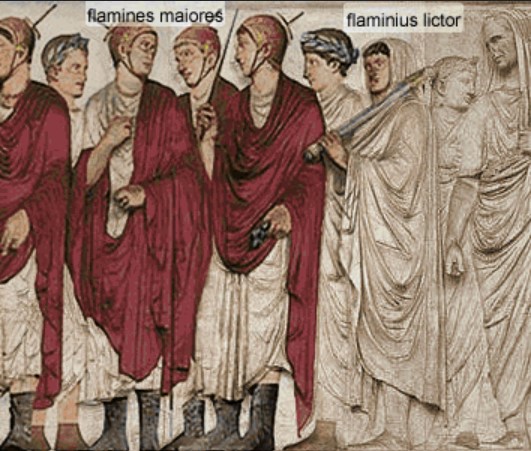
Flamines, Ara Pacis, west side 2 in Rome, Italy.

Temple of Jupiter Optimus Maximus
© andmorestory.eu - All right reserved