Ulysses, Achaemenides and the Cyclops of Aci Trezza
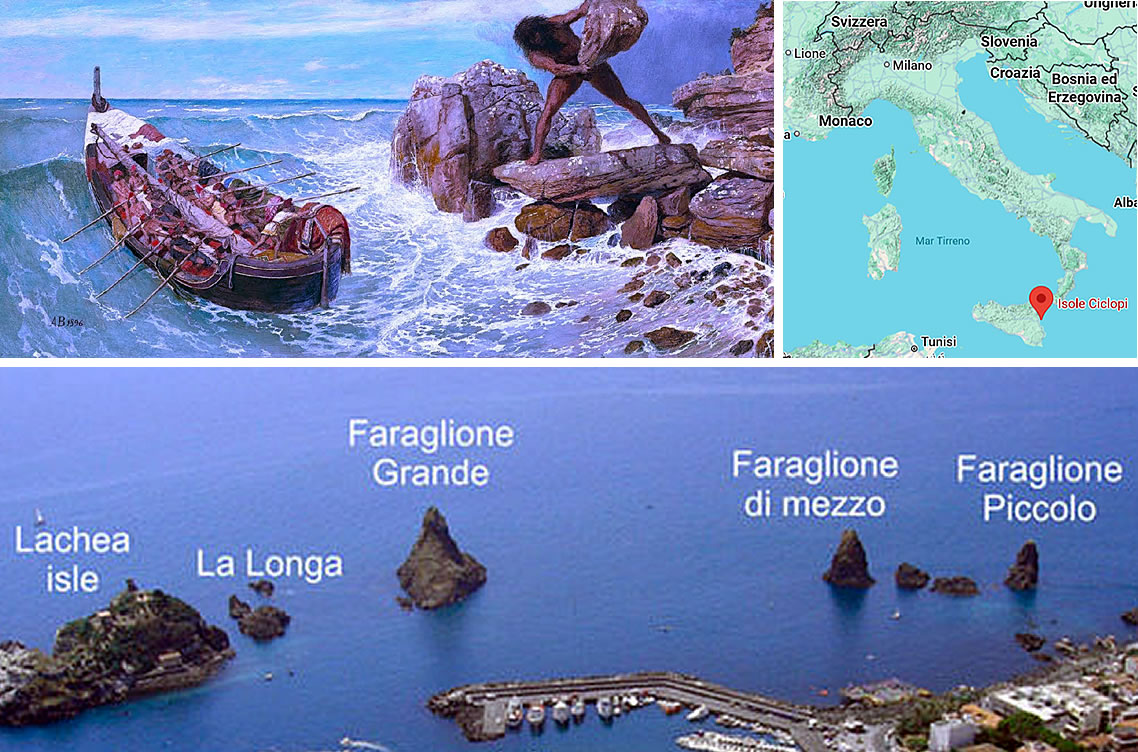
The Islands of the Cyclopes, also known as the Faraglioni of Aci Trezza, are towering natural pillars of solidified lava, formed about half a million years ago by intense volcanic activity. These rock formations uniquely define the landscape of the coastal village of Aci Trezza in Sicily. Their proximity to the majestic Mount Etna has for centuries fueled legends and myths connected to the subterranean fire and the giants once believed to inhabit those lands.
It is precisely here that the Greek poet Homer, in the ninth book of the Odyssey, sets the ill-fated encounter between Ulysses and the Cyclops Polyphemus. During his long journey back from Troy to Ithaca, the Greek hero and his sailors land on the shores of eastern Sicily, at the foot of Mount Etna, a territory then known as the "land of the Giants." Driven by curiositas — that thirst for knowledge typical of Greek heroes — Ulysses ventures into Polyphemus's cave. The Cyclops is a mighty, man-eating giant devoted to shepherding, famous for his single eye in the middle of his forehead. There, Ulysses and his men are imprisoned. Thanks to a clever ruse, Ulysses calls himself "Nobody," gets the giant drunk, and blinds him, thereby nullifying Polyphemus's cries for help and allowing his escape. But Polyphemus, enraged and blinded, hurls enormous boulders into the sea, trying to sink the Greek ship.
However, one of Ulysses's companions, a young man named Achaemenides, fails to board the ship in time. He is thus abandoned in Sicily, terrified and alone. For months, he survives hidden in the forest, eating berries and roots, evading the blind monster, and losing all hope of rescue. In Greek mythology, Achaemenides is the son of a certain Adamastus of Ithaca; his name derives from the Persian Achemene, meaning "he who waits in suffering" — an omen of his fate.
Three long months later, Achaemenides is discovered by Aeneas and his Trojan companions, who have landed on the island during their voyage to Italy. Desperate, the Greek begs the Trojans to take him with them or, failing that, to end his suffering by killing him. Moved by pity, Anchises, Aeneas's father, welcomes him into their group and consoles him. Achaemenides then tells the Trojans his terrible experience with Polyphemus and the harsh conditions of his survival on the island. Thanks to the generosity of Anchises and the Trojan refugees, Achaemenides finally escapes the cruel fate that seemed to await him.
A character who does not appear in Homer's work, Achaemenides is mentioned by Virgil in the *Aeneid* (Book III) and by Ovid in the Metamorphoses (Book XIV). In the famous passage from the Aeneid, Achaemenides himself recounts his nightmare in the first person:
My home was Ithaca, and I shared the fate of Ulysses, marked by misfortune. My name is Achaemenides, my father was Adamastus, and I sailed for Troy, though I was so poor — oh, that I had never exchanged my lot! In the Cyclops's great cavern, my comrades, fleeing the horrible door, left me behind, forgotten. It is a dwelling of bloody feasts of flesh, deep and dark, with a vaulted ceiling. He towers as high as the sky… These eyes saw him seize two of our men, dash them against the rocks, and crunch their still-pulsing limbs between his hungry teeth. But Ulysses could not bear such a sight: as soon as the giant, dulled by wine and sleep, lay sprawled in the cave, we, praying to the gods, with a sharpened stake extinguished that single eye. Thus we avenged the shades of our lost companions. But flee, I beg you! A hundred other Cyclopes live on the island, bestial and accursed. For three moons I have lived in the lonely woods, feeding on berries and herbs, peering from the cliff and trembling at their step. Only today have I seen ships. I ran to you. Whoever you are, I beg you: take me away!
Later, as Ovid tells it, Macareus, another companion of Ulysses, unexpectedly finds Achaemenides among the Trojans. Achaemenides, now safe, declares: "If this ship were not dearer to me than Ithaca and my own home, if I revered Aeneas less than my own father, may I see Polyphemus again, drooling human blood. I can never thank him enough. It is thanks to Aeneas that I breathe, see the sun, and one day will have a tomb — not the entrails of a monster."
The significance of Achaemenides is remarkable: his abandonment and subsequent rescue by Aeneas's fleet make him — together with Macareus — one of only two known members of Ulysses's crew to survive the return to Ithaca. All the other ships, except the flagship, were destroyed by the Laestrygonian Giants, and even Ulysses's last companions drowned as punishment for killing the sacred cattle of Helios. This episode offers Virgil the perfect opportunity to celebrate Aeneas's magnanimity: the future founder of Rome saves a Greek enemy without bearing a grudge, even though Ulysses played a decisive role in the destruction of Troy, Aeneas's homeland. A gesture that, in the classical world, represents the superior sense of piety and destiny that characterizes Virgil's hero.
This page was last edited on 18 April 2026