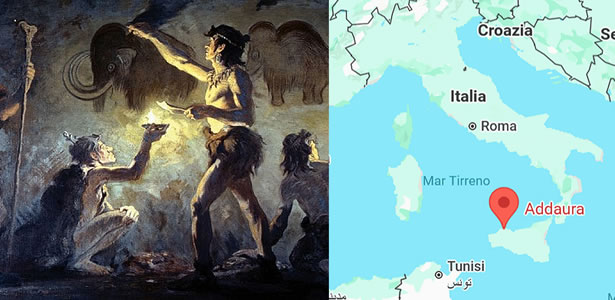
Paleolithic men paint inside a cave

Prehistoric rock art encompasses a series of artistic expressions—such as engravings, impressions, or paintings—created inside caves, rock shelters, or on outdoor rocky surfaces. Engravings represent the earliest examples of prehistoric art. In the absence of metal, the first tools used for carving were particularly hard stones. Later, sharp implements made of stone or bone were employed, likely to engrave figures onto bedrock or clayey walls. The incisions were sometimes enhanced by applying black pigment into the grooves of the drawings. Prehistoric humans obtained colors from natural elements readily available in their environment. Black pigment, for example, was derived from charcoal or soot. It was applied directly with fingers onto cave walls or mixed with fats and vegetable or animal oils to create a paint. This pigment was then spread using rudimentary brushes made from animal fur. Notable caves featuring famous rock engravings include Addaura (Palermo), Romanelli (Lecce), and Genovesi (Levanzo).
Addaura is a seaside village, or frazione, of Palermo. Historical evidence suggests that around the 13th century, the area was a fiefdom of the Church and that the caves were used as a place of spiritual retreat by hermit monks. Indeed, the oldest document mentioning the locality is a declaratio by Charles I of Anjou, dated August 20, 1270, which refers to the area by its ancient name, Daura, designating it as a hunting ground reserved for the Royal Curia. The term Daura may be a corruption of the Greek word laura, which denotes a community of religious individuals leading solitary lives in clusters of cells formed by small huts or caves, separated from one another. The discovery of ceramic fragments from the Middle Ages and the Renaissance in numerous caves and small cavities along the rocky front at the foot of the village further confirms that this locality once hosted communities of hermits. Thus, it is likely that the toponym Daura refers to the monastic order prevalent when the area was still a fiefdom owned by the Palermo church, rather than deriving from laurus (Laurus nobilis, the laurel plant), as some scholars have suggested. In a notarial deed from the late 16th century, the former feud or estate is, in fact, called Alaura, later transformed into Allaura and finally Sicilianized into Addaura. According to philologist Alberto Varvaro, the term Addaura derives from the Arabic word Id-dawra, meaning "the circuit."
The earliest evidence of human settlement in the Addaura area dates back to the Paleolithic era, when several prehistoric tribes of hunters colonized the caves of Monte Pellegrino. These caves form a complex of natural cavities overlooking the sea, originating from marine erosion. Some of these caves were used both as dwellings and burial sites. Burials were conducted in pits dug into the earth, often bordered by stones: the deceased was interred with a modest set of ornamental objects, mostly pierced shells and animal teeth.
As progressive environmental changes—characterized by an increase in average global temperatures—led to a different development of flora and fauna and a rise in sea levels, resulting in the thinning of emerged lands, the hunters adapted to the new environment. They learned to cultivate the land and domesticate certain animal species. The complex of caves, enlarged by the abrasive action of water, was reoccupied and exploited primarily during the winter period for fishing and gathering terrestrial and marine mollusks, while hunting was practiced inland during the summer. The artistic representations, many of a religious nature, discovered in the Addaura Cave (or Grotta delle Incisioni), which was perhaps used as a place of worship, can be traced back to this historical phase.
Since the late 19th century, the locality has been the site of significant paleontological discoveries, such as the skeleton of a dwarf elephant, less than a meter tall, which was widespread in Sicily between 500,000 and 120,000 years ago. This finding achieved considerable success in the international scientific community and initiated a lasting campaign of excavations and explorations that quickly extended to nearby promontories.
During the Second World War, the site served as a military arsenal for the German army. The presence of unexploded ordnance made it impossible to fully explore the cave during archaeological investigations carried out between 1946 and 1947. A few years later, an explosion—accidental according to some sources, or deliberately set off by Allied military authorities according to others—damaged a large portion of the mountain but, conversely, led to the discovery of the Cave of Engravings (Grotta delle Incisioni). Over time, concretions broke off, revealing the graffiti, which gained international renown in the early 1950s.
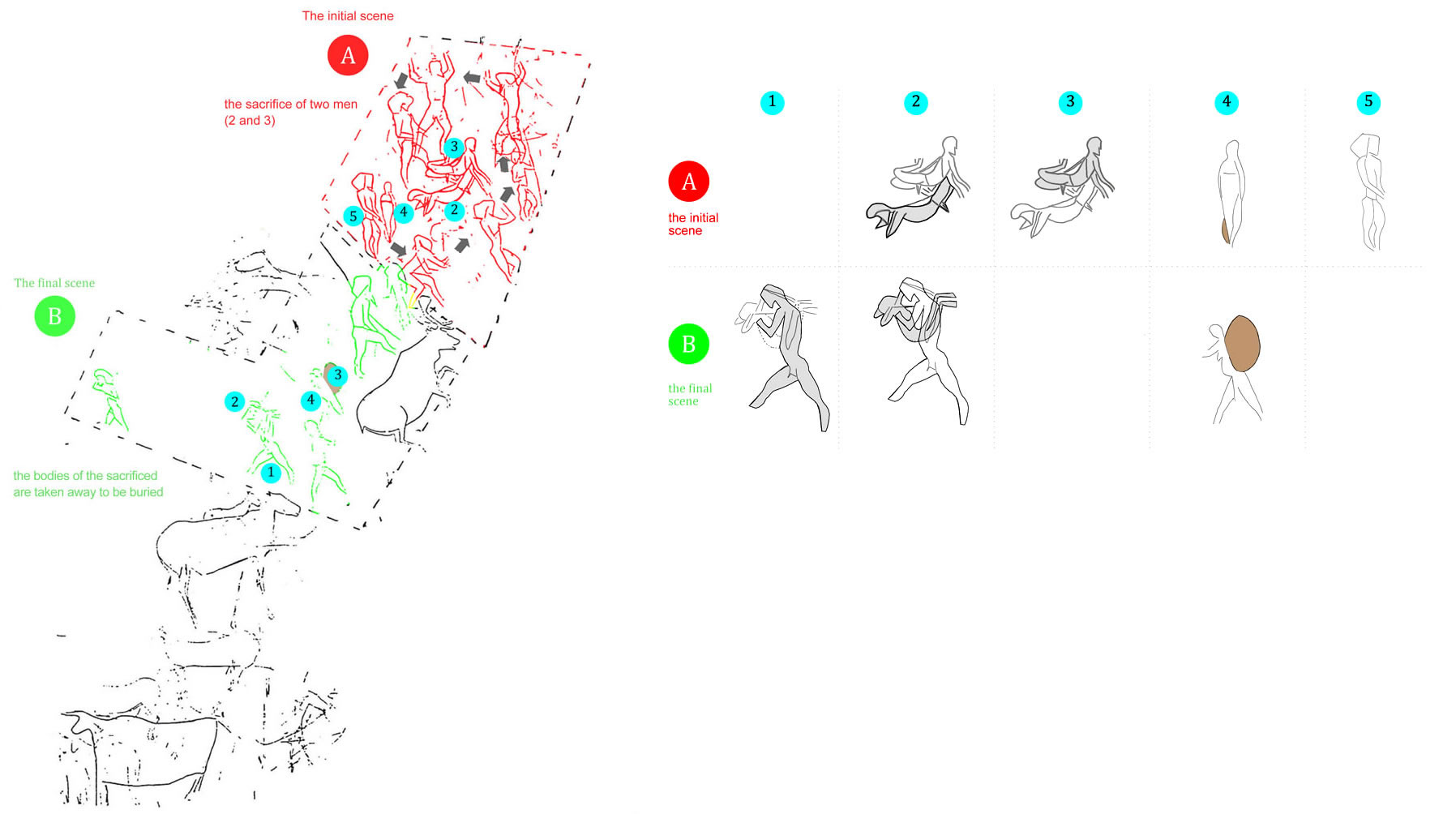
The Cave of Engravings is small and quite well-lit by natural light coming from outside. The engravings at Addaura form a figurative cycle of exceptional interest due to the unusual attention given to the depiction of the surrounding context, a rare case in all of Paleolithic art. Nearly all the cave walls are covered with rock engravings featuring zoomorphic and anthropomorphic figures, but the most famous are found on the left wall. Humans and animals are depicted across multiple scenes, representing two different moments of the same event: the sacrifice of a boy lying on the ground, bound with ropes.
An initial scene in the upper right shows the completion of a boy's sacrifice; a shaman dances around the boy—who may be experiencing a seizure or epileptic fit—while a woman observes, holding an empty bag.
In the final scene at the bottom left, a man carries away the body of the sacrificed figure for burial, while the same woman departs with the bag now full.
The engravings date back roughly 12,000 years, but over time, many were erased by Paleolithic people to create new ones on top. The oldest incisions can be identified by their deeper grooves.
Paleolithic men paint inside a cave
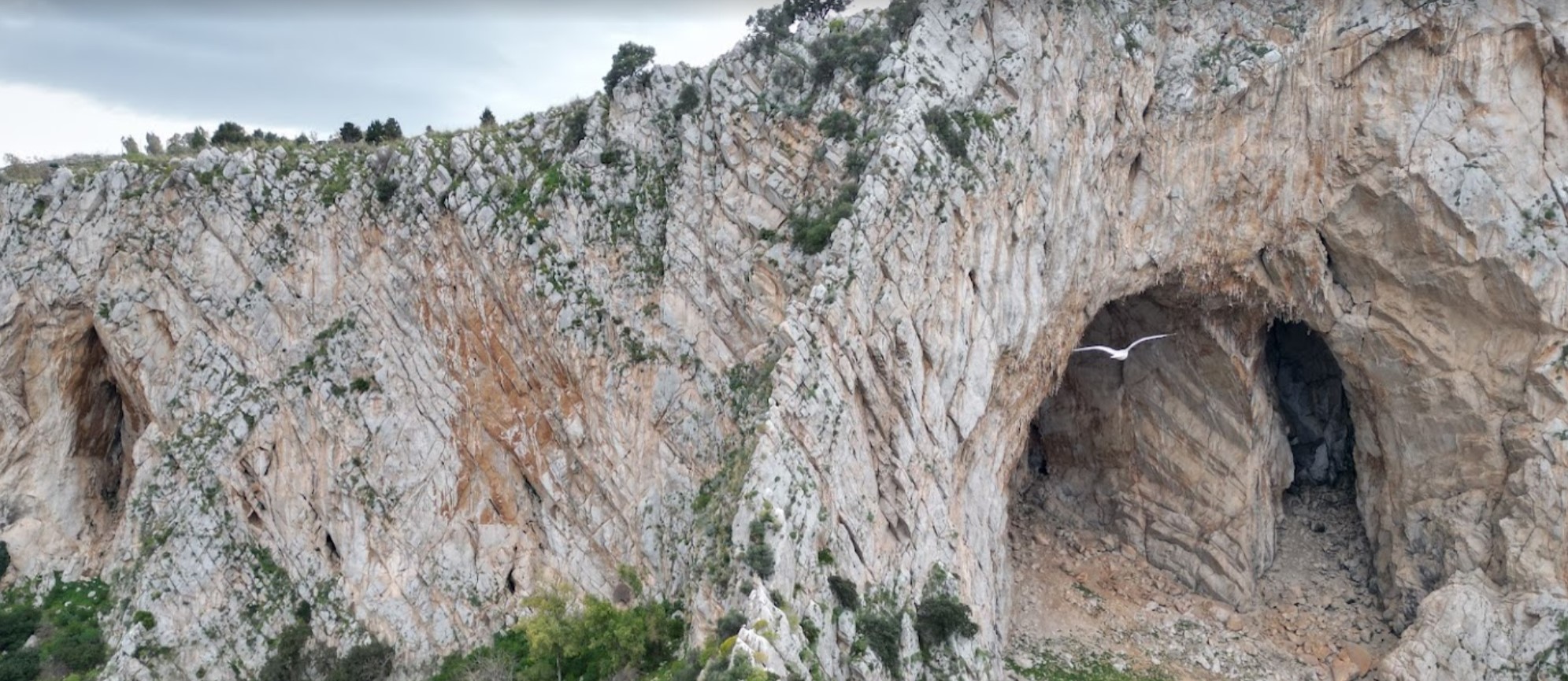
Addaura Caves, Palermo.
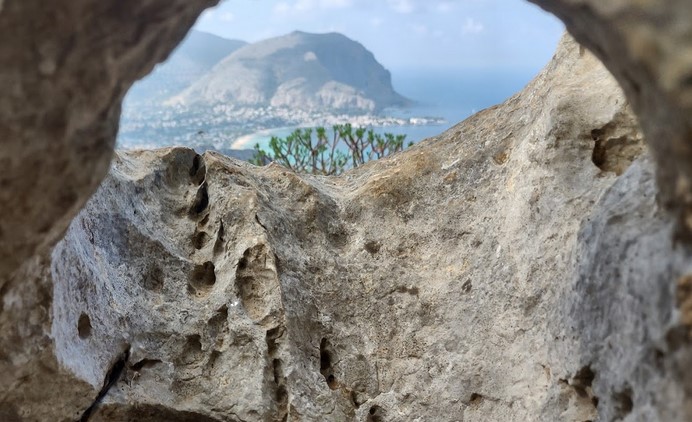
View of Mount Pellegrino from Addaura Caves, Palermo.
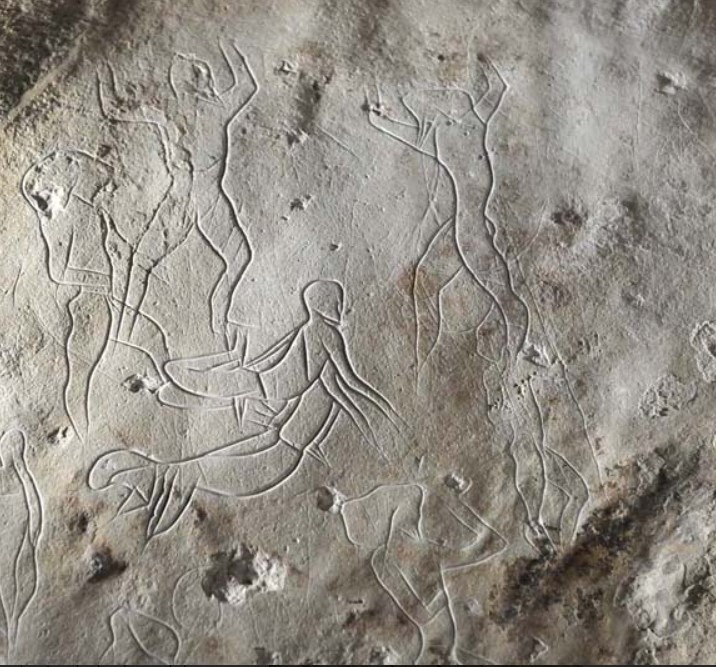
A detail of the Paleolithic engravings in the Addaura III cave, Palermo (photo: Vassallo, RM Cuco, 2015).
A reproduction of the carvings on the stone walls of the Addaura III cave (photo: G. Bolzoni, 1985).
1/ A man (1B) carries away the body of a sacrificed individual (2B). His forehead (1B) is marked by two ropes from which the feet and head of the victim are tied (2B).
2/ The sacrificed man (2B) appears dead, bound by his feet and neck. Visible are his head, arms folded with hands behind the neck, feet, part of his back, and the ropes that bind him, while the rest of his body is hidden behind the carrier (1B), who corresponds to figure 2A in the sacrifice scene.
3/ The second sacrificed man appears in the main scene (3A).
4/ In the initial scene, a visibly pregnant woman (4A) has an empty bag dangling behind her legs as she watches the sacrifice (4A). In the final scene, the same woman carries a full bag on her shoulders (4B), possibly containing the body of the second victim (3A).
5/ A shaman.
This page was last edited on 14 March 2026
© andmorestory.eu - All right reserved