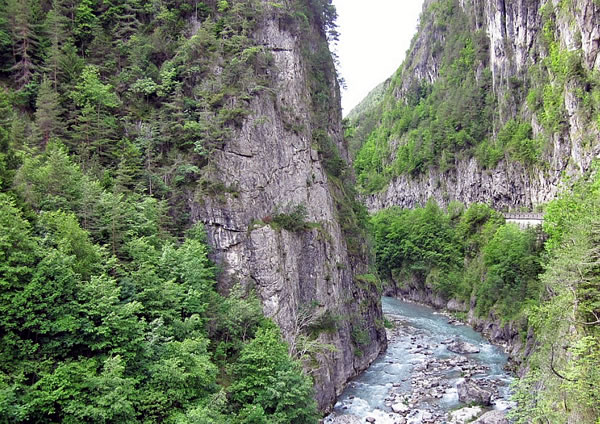
The cutting of Saint Martin Agordo (Belluno, Italy)

Long ago, the Cordevole Valley was blocked at its end by a massive rock that prevented the passage of water, forming a lake that stretched from where the town of Agordo now stands to Volpago (Conca Agordina). The inhabitants, having no land to cultivate nor pastures for their animals, lived in such poverty that Saint Martin took pity. He drew his great sword, planted his feet wide apart on either side of the river, and struck a mighty blow to the rock, splitting it in two and allowing the water to drain away. The place is still called Saint Martin’s Stone.
Another version of the legend tells of a boy named Agordo who lived in Conca Agordina long ago when the valley was mostly submerged by a lake. One day, the boy was fishing on the lake with his father when a sudden, violent wind overturned their boat. While the father managed to reach the shore, the boy and the boat vanished beneath the waters. In despair, the father looked around for help and saw a horseman approaching who had witnessed the scene. It was Saint Martin, who without hesitation drew his sword and cut through the mountain rock that enclosed the valley (at the height of the Galleria dei Castei). The powerful, precise stroke separated Monte Celo from the Monti del Sole, creating a channel through which the lake water rapidly drained. Finally, on the dried lakebed, the overturned boat appeared, and beneath it was Agordo, still alive.
Although these are legends, they contain a grain of truth in that an enormous lake once existed here. Indeed, alluvial terraces have been found at levels above the current course of the Cordevole stream, evidence that stagnant water once stood there. Geological research on the analyzed terrain shows that Lake Agordo existed between 3800 and 4000 B.C. and lasted about six or seven centuries. It is believed to have been formed by a landslide that fell at the Castei gorge, blocking the normal flow of the Cordevole. Over the centuries, the natural erosion of the rock eventually broke this barrier, and the water drained away, freeing the basin where the city now stands.
Whichever way it is told, the area affected by Saint Martin’s miracle—the deep channel between Monte Celo and the Monti del Sole—is commonly known as Saint Martin’s Cut. From that day on, the town took the boy’s name, Agordo. According to scholars, the name Agordo likely has Rhaeto-Romance origins, from the root Aga- (water) combined with the suffix -ort (place), meaning literally “place of water” in Ladin. This clearly references the historically alluvial and marshy nature of the plain where the town center arose, a condition that was largely resolved by medieval drainage works and definitively after the last great flood of 1748.
Born around 316 A.D. to pagan parents in Sabaria, a Roman outpost on the frontier with Pannonia (in today’s Hungarian plain). His father, a military tribune, named him Martinus in honor of Mars, the god of war. As a child, Martin moved with his parents to Ticinum (Pavia), where his father had received a land grant as a veteran, and he spent his childhood there. In 331, an imperial edict required all veterans’ sons to enlist in the Roman army. Thus, at 15, he was enrolled in the imperial cavalry guard (Schola), an elite corps of 5,000 fully equipped troops, which provided him with a horse and a slave.
He was quickly promoted to the rank of circitor and sent to Gaul near the border, where he spent most of his military life. Within the Imperial Guard, he served in non-combat troops responsible for public order, protecting imperial mail, transferring prisoners, and providing security for important figures.
The circitor’s duty was night patrols and inspecting guard posts, as well as night surveillance of garrisons. During one such patrol, the life-changing episode occurred: Martin met a beggar, half-naked. Seeing his suffering, Martin cut his military cloak in two and shared it with the beggar. The following night, he dreamed of Jesus clothed in half of his cloak. He heard Jesus say to his angels:
Here is Martin, the Roman soldier who is not baptized; he has clothed me.
When Martin awoke, his cloak was intact. The miraculous cloak was preserved as a relic and became part of the relic collection of the Merovingian Frankish kings. The Latin term for “short cloak” or chlamys (cappella, chapel) was extended to those entrusted with preserving Saint Martin’s cloak (cappellani, men of chapel), and from them was applied to the royal oratory, which was not a church, but a chapel.
The dream had such an impact on Martin that he, already a catechumen, was baptized in Amiens at the age of 18 or 22 and became a Christian. Martin remained an army officer for about twenty years, reaching the rank of officer in the alae scolares (an elite unit). Around the age of forty, he decided to leave the army and began the second part of his life.
Martin committed himself to fighting the Arian heresy, condemned at the Council of Nicaea (325), and for this he was even flogged (in his native Pannonia) and expelled, first from France and then from Milan, where Arian bishops had been appointed. Shortly thereafter, he left military service after refusing to take up arms against the barbarians (Julian’s campaign of 356). After leaving military service, he was consecrated an exorcist by Hilary and began theological studies. Martin later traveled in Pannonia and Italy (to Milan, Gallinaria near Albenga in the province of Savona—where he lived four years as a hermit—and Rome), always working against the dominant Arianism.
Returning from exile to Poitiers upon the return of the Catholic bishop, he was ordained a deacon and then a priest. Withdrawing to a hermit’s life in Ligugé, after ten years he was almost forcibly taken from his hermitage and elected bishop of Tours by popular acclamation (July 4, 371).
Martin died on November 8, 397 in Candes-Saint-Martin, where he had gone to make peace among the local clergy. His body was transported to Tours and buried there on November 11, the date of his commemoration. His death, occurring in fame of sanctity also due to numerous miracles, marked the beginning of a cult that associated the knight’s generosity, ascetic renunciation, and missionary activity. He was the most popular saint in France during antiquity and the Middle Ages. The spread of Christianity into the countryside, still almost entirely pagan, is perhaps his greatest merit. It is no coincidence that he also became a famous mythological figure in the Dolomites and the patron saint of the nearby city of Belluno.
The cutting of Saint Martin Agordo (Belluno, Italy)
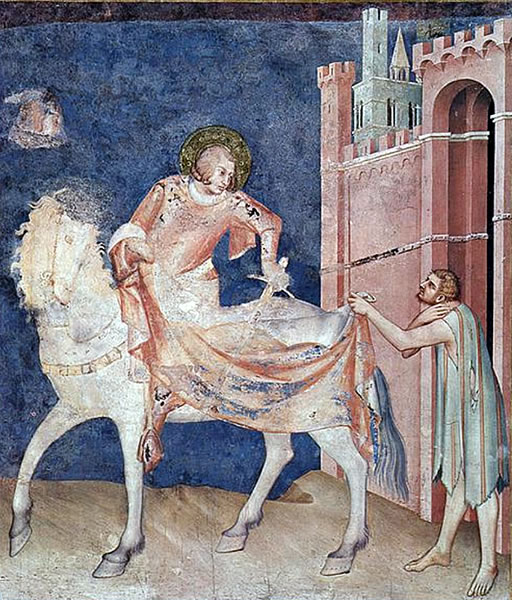
St. Martin sharing his cloak with the beggar, from the Life of St. Martin, 1326 - San Francesco, Lower Church, Assisi, Italy
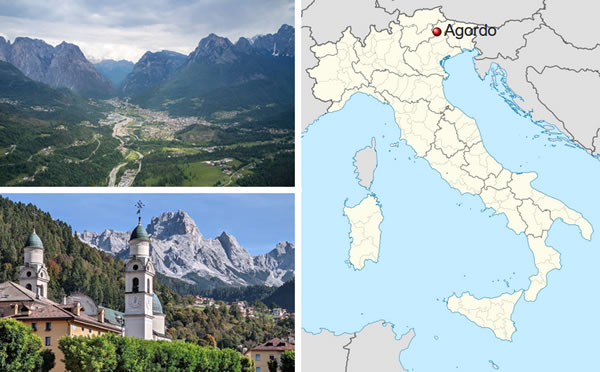
Agordo (Belluno, Italy)
This page was last edited on 14 March 2026
© andmorestory.eu - All right reserved