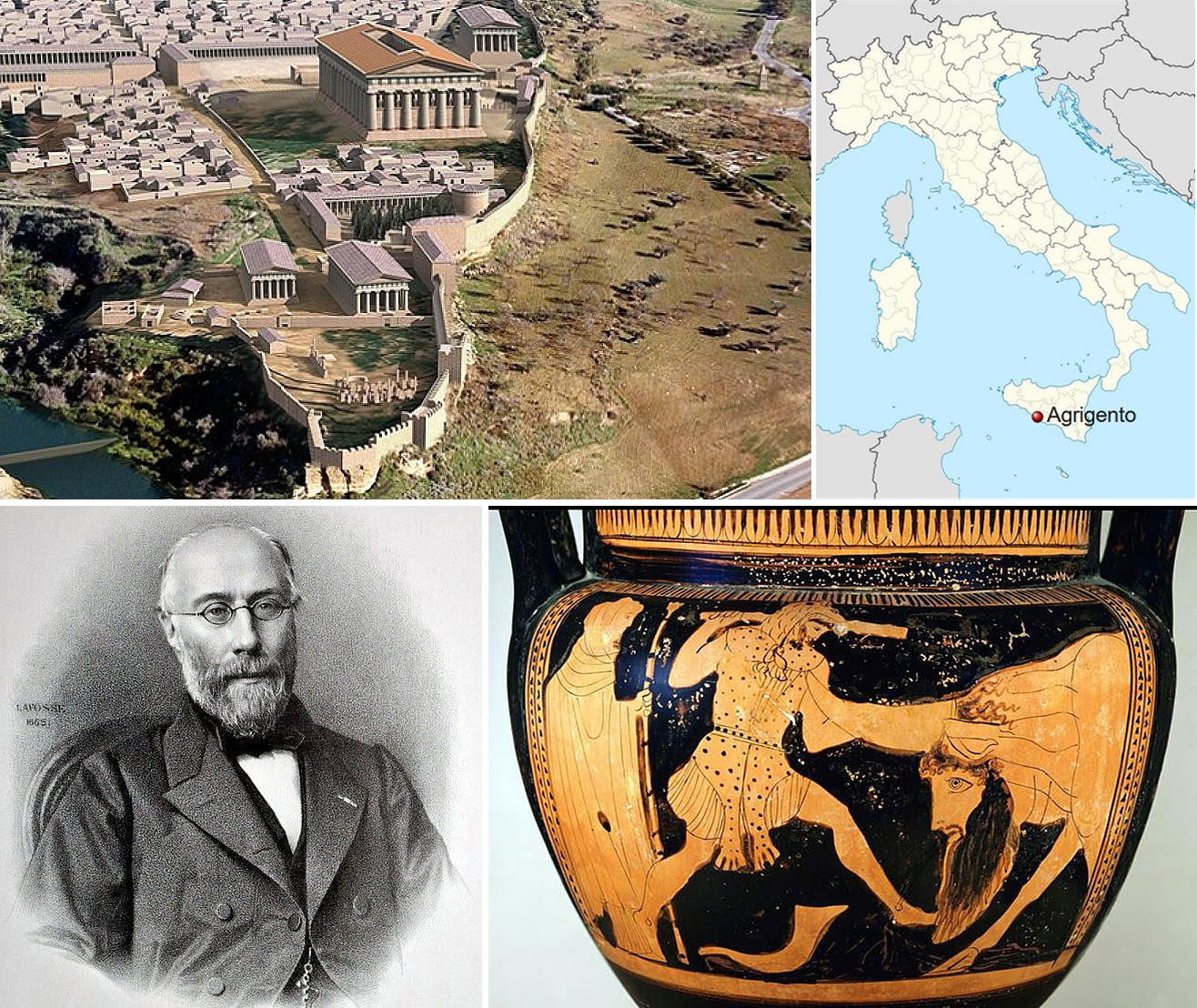
Akràgas, Baron Jean de Witte and the crater

The Belgian scholar Baron Jean de Witte (Jean Joseph Antoine Marie; 1808–1889) was an archaeologist, epigrapher, numismatist, and scientist. As a young archaeologist, he quickly drew the attention of the leading scholars of his day, and between 1830 and 1840 he traveled with them through Germany, Italy, and England. One year after his death, the Louvre Museum acquired from his family an ancient crater (mixing bowl) discovered at Agrigento (ancient Akràgas), dating to approximately 450 BC.
Akràgas was an important Greek polis founded around 581 BC by Rhodian and Cretan colonists coming from Gela, on the southern coast of Sicily – a coastline less frequented by Greeks than the island’s eastern shores. According to Polybius, its location about four kilometers from the sea, between two watercourses, gave it all the advantages of a maritime city. The vase dates to the period of Akragas’ greatest splendor, when the tyrant Theron ruled (488–471 BC). At that time, the city had some 300,000 inhabitants, and its dominion extended as far as Sicily’s northern coasts. It was a major military power that managed to confront and defeat Carthage at the Battle of Himera (480 BC) with decisive help from Syracuse. This era also witnessed an extraordinary architectural fervor, symbolized by the Temple of the Dioscuri (450 BC) in the Valley of the Temples; an artistic golden age, with refined sculptural masterpieces; and a cultural flourishing, attested by the welcome extended to poets such as Pindar (518–438 BC) and Simonides (556–468 BC).
The vase depicts Herakles fighting the river-god Acheloos for the hand of Deianeira, and Acheloos appears in the form of a bull with a human face.
Acheloos (modern-day Aspropotamos) is the name of a river in central-western Greece, spanning approximately 220 kilometers. It is the longest river in ancient Greece. It originates in the northern section of the Pindus mountain range (Mount Peristeri) and flows into the Ionian Sea after crossing Aetolia, where it separated Aetolia from Acarnania in its final stretch. But in mythology, Acheloos is the most prominent of the river gods, regarded as the eldest son of Oceanus and Tethys. Endowed with shapeshifting abilities, he was often depicted as a bull, a form frequently associated with river deities. Acheloos sought to marry Deianira, who was also courted by Heracles. During their fight, Acheloos transformed into various forms, from a serpent to a bull, but ultimately lost one of his horns. This horn, filled by a nymph with flowers and fruits, became the Horn of Plenty (cornu copiae). Acheloos’ bearded visage with bull horns held apotropaic (protective) significance throughout the ancient world.
Pausanias mentions Acheloos among the depictions on the throne at Amyclae (III, 18, 16) and as the subject of a cedarwood sculptural group in the treasury of the Megarians at Olympia (VI, 19, 12):
There is represented the fight between Heracles and Oreius the Centaur, and also that between Theseus and the Bull of Minos. There are also represented the wrestling of Heracles with Acheloos, the fabled binding of Hera by Hephaestus, the games Acastus held in honor of his father, and the story of Menelaus and the Egyptian Proteus from the Odyssey. Lastly there is Admetus yoking a boar and a lion to his chariot, and the Trojans are bringing libations to Hector.[...]
The Megarians who are neighbors of Attica built a treasury and dedicated in it offerings, small cedar-wood figures inlaid with gold, representing the fight of Heracles with Acheloos. The figures include Zeus, Deianeira, Acheloos, Heracles, and Ares helping Acheloos. There once stood here an image of Athena, as being an ally of Heracles, but it now stands by the Hesperides in the Heraeum.
– Pausanias, Description of Greece
When Heracles broke off one of Acheloos’ horns during their struggle, the river god admitted defeat and relinquished his claim to marry Deianira, granting Heracles the right instead. Acheloos requested the return of his horn, offering in exchange the horn of the goat Amalthea (or Amaltheia, from amalós, meaning "soft" or "tender") . Amalthea was the nurse of the infant Zeus on Mount Ida after his birth on Crete. Drops of blood from Acheloos’ wound gave life to his daughters, the Sirens. According to another tradition, the Sirens were born from his union with the Muse Melpomene. Acheloos was also considered the father of many freshwater springs, including the Pirene spring of Corinth, the Castalian spring at Delphi, and the Dirce spring of Thebes. Callirrhoe, who married Alcmaeon, is also thought to be his daughter, though the mother is unnamed in tradition. Acheloos was revered as a protector of fresh waters, and Virgil often referred to rivers in general as "Acheloian goblets" (Acheloia pocula).
This myth, symbolizing the fertility of the plains nourished by the Acheloos River and the efforts to contain its waters within its banks, was explained as early as Strabo. From ancient times, Acheloos was venerated for his proximity to the Oracle of Dodona, where sacrifices to him were mandated with every consultation. He was invoked in sacrifices, prayers, and oaths, which may explain why smaller rivers in Thessaly and Arcadia were also named after him. Acheloos frequently appeared in artistic depictions, including coinage and vase paintings. He was especially prominent in Attic black- and red-figure pottery, often depicted in combat with Heracles.
This page was last edited on 23 April 2026
Akràgas, Baron Jean de Witte and the crater
© andmorestory.eu - All right reserved