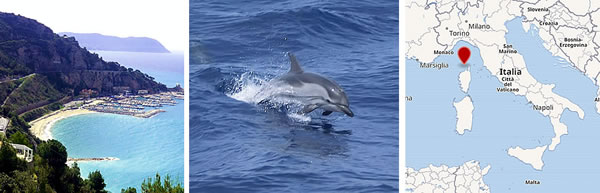
Small Port of Alassio and striped dolphin in the Mediterranean Cetacean Sanctuary (indicated in red on the map)

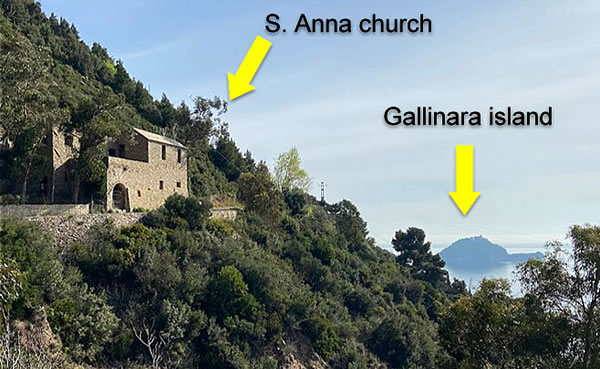
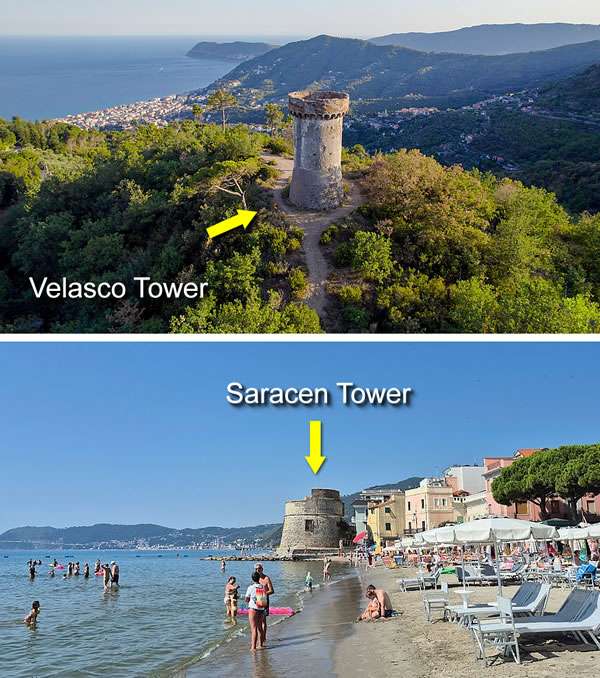
The history of Alassio is directly linked to the fate of nearby Albium Ingaunum ('the fortress of the Ingauni,' Albenga), a city founded between the 6th and 4th centuries BC by the Ingauni, the first inhabitants of the territory. The Ingauni were navigators dedicated to trade and piracy, possessing their own navy, which clashed with that of the Greeks of Massalia (Marseille) for control of the northern part of the Tyrrhenian Sea, engaging in piracy against them. We know of them through the testimonies of historians like Titus Livius (end of the 1st century BC), Strabo, and Pliny the Elder (1st century AD), and we know that, as with other coastal Ligurian populations, their wealth led to numerous clashes with inland peoples, who began plundering these richer coastal communities.The Ingauni of Alassio were an ancient Celtic-Ligurian population, the most powerful among the Ligurian peoples, likely refugees from Albenga, who settled on the hill called Castè or Castlè after the victorious Roman legions invaded the Albenga territory (181 BC). Their submission was not immediate; in fact, Rome continued to consider them a hostile population and sent ships to control the Ingauna Riviera. Alassio is surrounded everywhere by hills that were partly covered with oaks, pines, and firs, and partly with olive groves and vineyards. On the summit of the heights, an ancient Roman road is still discernible, the Via Julia Augusta. That stretch near Alassio was designated as "via de Alaxio" in 1288. In the Ligurian territory, few remains of the ancient route are identifiable: they are found between Albenga and Alassio and are only short stretches of the original pavement. It was built in 13 BC by the will of Octavian to connect Rome to southern Gaul; essentially, it was a branch of the Via Aurelia connecting Cisalpine Gaul to Transalpine Gaul. Once completed, the entire Aurelia-Aemilia-Augusta road was 962 km long. Alassio does not have its own medieval history except in function and union with that of Albenga. After the fall of the Western Roman Empire, Alassio suffered over time attacks and invasions by other populations, resulting in looting, killings, destruction of houses and buildings, and depopulation of the territory: the Goths in the 5th century; the dominion first of the Lombards and then of the Franks (up to the 10th century). The first human settlement in Alassio after the Roman era dates back to the 9th century—although the first official sources mentioning Adalaxia date to the 12th century—and it originated from pre-existing Ligurian nuclei who first settled in the Monti region (later called S. Anna) and subsequently at the Castle of the Madonna delle Grazie. Thus, some families from the inhabited centers surrounding Alassio gradually moved along the coast and formed the Burgum Alaxi, which lived for six centuries on fishing and vegetable gardens, and later on maritime trade throughout the Mediterranean. It is to this latter period that the legends giving origin to the city's name date back.Alassio is surrounded everywhere by hills that were partly covered with oaks, pines, and firs, and partly with olive groves and vineyards. On the summit of the heights, an ancient Roman road is still discernible, the Via Julia Augusta. That stretch near Alassio was designated as "via de Alaxio" in 1288. In the Ligurian territory, few remains of the ancient route are identifiable: they are found between Albenga and Alassio and are only short stretches of the original pavement. It was built in 13 BC by the will of Octavian to connect Rome to southern Gaul; essentially, it was a branch of the Via Aurelia connecting Cisalpine Gaul to Transalpine Gaul. Once completed, the entire Aurelia-Aemilia-Augusta road was 962 km long. Alassio does not have its own medieval history except in function and union with that of Albenga. After the fall of the Western Roman Empire, Alassio suffered over time attacks and invasions by other populations, resulting in looting, killings, destruction of houses and buildings, and depopulation of the territory: the Goths in the 5th century; the dominion first of the Lombards and then of the Franks (up to the 10th century). The first human settlement in Alassio after the Roman era dates back to the 9th century—although the first official sources mentioning Adalaxia date to the 12th century—and it originated from pre-existing Ligurian nuclei who first settled in the Monti region (later called S. Anna) and subsequently at the Castle of the Madonna delle Grazie. Thus, some families from the inhabited centers surrounding Alassio gradually moved along the coast and formed the Burgum Alaxi, which lived for six centuries on fishing and vegetable gardens, and later on maritime trade throughout the Mediterranean. It is to this latter period that the legends giving origin to the city's name date back. Numerous sources indicate that the territory of Alassio was subject to the control of the Benedictine monks of Gallinara Island. The Benedictines from Gallinara Island landed at the Lido di S. Anna (at the site of the current port of Alassio) and, halfway up the slope of Mount Bignone, built the small church of S. Anna to provide spiritual assistance to the inhabitants who had built the first cluster of houses there. The S. Anna complex quickly formed an "agricultural cell" dependent on the Abbey of S. Martino. The most vivid and best-preserved testimony of Benedictine possession over Alassio, on the border with Albenga, is the little Romanesque church of Santa Croce. Perched on the homonymous promontory and jutting out over the sea almost to keep watch and ideally touch Gallinaria Island, the motherhouse of all medieval monasticism in the western sector of the Diocese. It stands at a strategic point of the ancient Roman road, whose route is still entirely preserved between Alassio and Albenga, a hundred meters above the Aurelia, and is connected to a modest defensive wall that forms an arch over the road, recalling the ancient border with Albenga and the difficult times (the 16th and 17th centuries) of relations between the two centers, when Alassio, having grown compared to its mother city and come of age, fought fiercely to become completely autonomous. In contrast, the little church of S. Croce harks back to the idyllic centuries between the two cities, when the monks from the sea worked to unite and redeem the land agriculturally, continuously colonizing the territory from the western borders of Alassio to the mountain near Albenga, and reorganizing the roads and stops for pilgrims. One of the first mentions concerning the presence of the building is a papal bull by Pope Alexander III, dated 1169. The apse with paired small arches, and the masonry itself in unsquared stones, are a sure testimony of the 11th century, with a good part of the north wall also having paired arches. The south wall has undergone a radical renovation; two subsequent extensions, one from the 14th century, the other from the 16th century (to which the addition of the portico is due), are easily noticeable in the front part. The interior, with the roof, was restored and reopened for worship last century. From the church and the arch of S. Croce, Alassio and the Riviera gaze upon the plain of Albenga stretching into the sea, sometimes illuminated by the sun, while the harbor below renews and almost embraces in a single memory the maritime glories and common destinies of the two cities, already sealed in the Middle Ages by the sea and by Gallinaria. In the 14th century, Alassio held a position of political and jurisdictional prominence within the territory of Albenga, benefiting from the protection and patronage of the abbots of Gallinara. In 1303, this situation changed significantly when the Benedictine abbot Giovanni di Diano ceded all his properties in the territory of Alassio to the nearby municipality of Albenga. During the Benedictine period, between 1455 and 1507, thanks to the donations of the inhabitants, a parish church was built, exceptionally dedicated to S. Ambrogio. This suggests a much older connection with the capital of the Ligurian-Milanese Archdiocese: perhaps, as has also been supposed, a consequence of the Lombard invasion in the 6th century and the flight of Milanese notables and clergy to the Riviera (attested for Genoa) upon the descent of Alboino. Of Gothic architecture, with three naves and a dome, it was rebuilt and enlarged between the 17th and 19th centuries. The precious portal of the Church of Sant'Ambrogio was enriched by a representation of Christ and the Twelve Apostles, God the Father and S. Ambrogio on the keystone, and dated 1511 by an inscription on the architrave. In the 16th century, the people of Albenga availed themselves of the sale by Abbot Giovanni di Diano to impose heavy gabelles. The continuous struggles with the Albenganese and the frequent assaults by Turkish and Barbary pirates led the people of Alassio to surround their village with solid walls and massive bastions starting in 1521. For about 40 years, Alassio witnessed intense construction activity aimed at strengthening its defenses: robust walls 10 meters high, and bastions with cannons on the landward and seaward sides protecting the most vulnerable areas. Examples of these military defenses, still visible today, are the Torre del Velasco and the Torrione del Saraceno. The Torre del Velasco was perhaps built in the 15th century by Genoese builders. According to a legend, however, it dates back to the 10th century and hosted Adelasia, lover of Aleramo and daughter of Emperor Otto I of Saxony. For this reason, it is depicted on the town's coat of arms. The Torrione Saraceno (Torrione della Coscia, from the homonymous district where it is located) was built in the 16th century by the Republic of Genoa. Its circular masonry structure is typical of Ligurian defensive constructions, designed to maximize effectiveness in terms of resistance and visibility. In 1535, Alassio, with an act of loyalty, placed itself under the protection of the Republic of Genoa, hoping to find defense against the harassment of its enemies. Incorporated into the Genoese Republic, from which it obtained its own Podestà (chief magistrate), for over a century it faithfully followed its fortunes, and Genoa bestowed upon it the title of city. The Podestà enjoyed broad autonomy in civil matters, with the sole exception of cases involving citizens of Albenga. In criminal matters, he conducted investigations for the most serious crimes, but the final sentence rested with the Podestà of Albenga. This was the first time that Alassio was an "autonomous" municipality and not under the complete control of Albenga. Alassio's Golden Century was the period between 1600 and 1700, during which commerce (particularly in tuna) and navigation flourished; the profits from these activities also served to build new churches, restore or enlarge existing ones and oratories, as well as construct new and more beautiful houses. In 1600, a monastery for nuns of the order of Saint Clare was built thanks to various benefactors; while another for Dominican Fathers was established from 1651, with public schools teaching from primary levels up to philosophy. Southwestern Sardinia, where Cagliari is located, connects to the routes that bluefin tuna have followed for centuries from the Atlantic to the Mediterranean; the same routes sailed by various populations moving from east to west, reaching the Atlantic coasts, or who fished and traded tuna. About 2500 years ago, in the 5th century BC, when Ingauni pirates roamed the Tyrrhenian Sea, it was not difficult to encounter a Phoenician ship transporting a cargo of preserved tuna, having set sail from the area of present-day Cadiz towards the Greek city of Corinth. Although it may seem like a trivial anecdote, what we are witnessing is the birth of an industry that today moves millions of euros—canned tuna—and that uses the same routes as antiquity. Just consider that as late as the 17th century, every spring, about 800 sailors from Alassio departed for Sardinia to fish for tuna. It was in Cagliari that the sailors retrieved the bodies of the martyr saints discovered in the 1624 excavations in the Constantinian basilica of San Saturnino and in the chapel of Santo Stefano, and transported them to their city for veneration: Gregory, Archbishop of Cagliari; Paul, bishop who governed the Sulcis church; Cristina from Cagliari; Boniface; and Ludovico. These saints were chosen as protectors of the city. The theft of relics is something very ancient: possessing the remains of some famous Saint could contribute to the prestige of one's own city, and therefore merchants, sailors, and fishermen organized expeditions. It was so for Saint Mark (from Alexandria, Egypt to Venice); Saint Nicholas (from Myra to Bari). The main festivals celebrated in Alassio are those of Sant'Ambrogio, its particular patron; of the aforementioned Martyr Saints; and of Saint Catherine. Until the 19th century, the bay was uniquely rich in fish and beautiful coral. Today, off the coast of Alassio, it is still possible to spot dolphins and other species such as sperm whales, Cuvier's beaked whales, long-finned pilot whales, Risso's dolphins, bottlenose dolphins, striped dolphins, and sometimes, the fin whale, the second-largest animal ever to have existed on Earth, and specimens of sea turtles. For this reason, this place is called the "Cetacean Sanctuary." The bay has always been a natural harbor in the shape of a semicircle: safe; with easy landing; sheltered in the southern part from westerly and southwesterly winds (ponente and libeccio), and in the eastern part from southeasterly winds (scirocco); with good anchorage. Navigation and maritime commerce, which in the 16th-18th centuries had given this city a notable place among Ligurian cities, have completely declined. With the fall of the Genoese Republic, Alassio became part of the Democratic Republic of Liguria, then, in 1805, of the French Empire, followed by the Genoese Republic and the Kingdom of Sardinia, which in 1860 became the Kingdom of Italy.
Small Port of Alassio and striped dolphin in the Mediterranean Cetacean Sanctuary (indicated in red on the map)
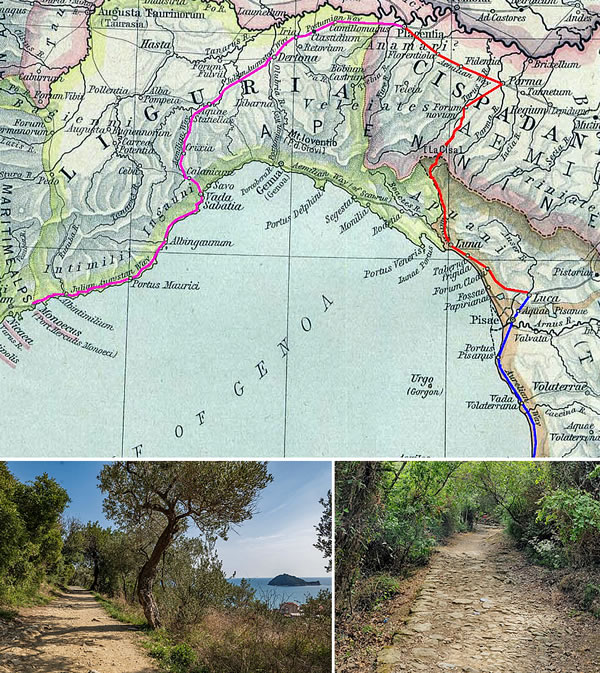
The initial route of the Via Julia Augusta (purple) in ancient Rome; the Via Aemilia-Scauri (red) and the final part of the Via Aurelia (blue) leading to Rome. Below, two stretches of the Via Julia Augusta or via de Alaxio.
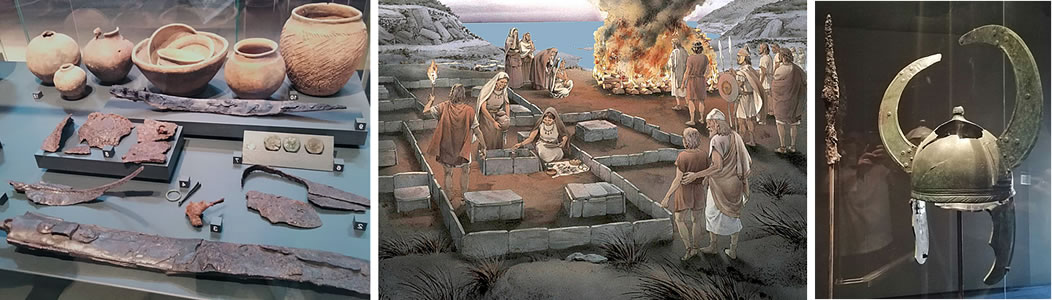
Ligurians: archaeological finds, hypothetical reconstruction of a necropolis, and a Ligurian helmet from Pulica
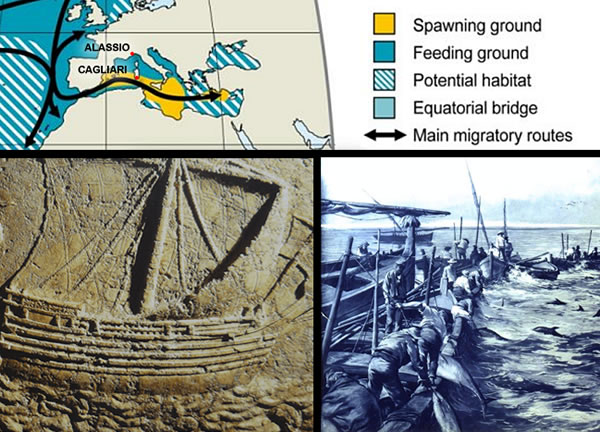
Routes that bluefin tuna have followed since ancient times from the Atlantic to the Mediterranean
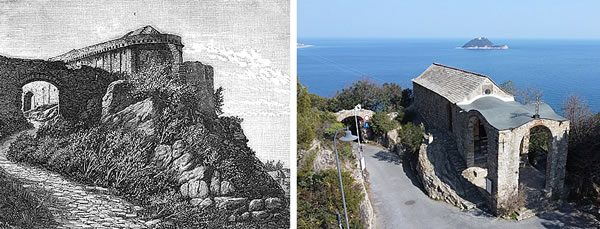
Holy Cross Church in a late 19th-century print and today
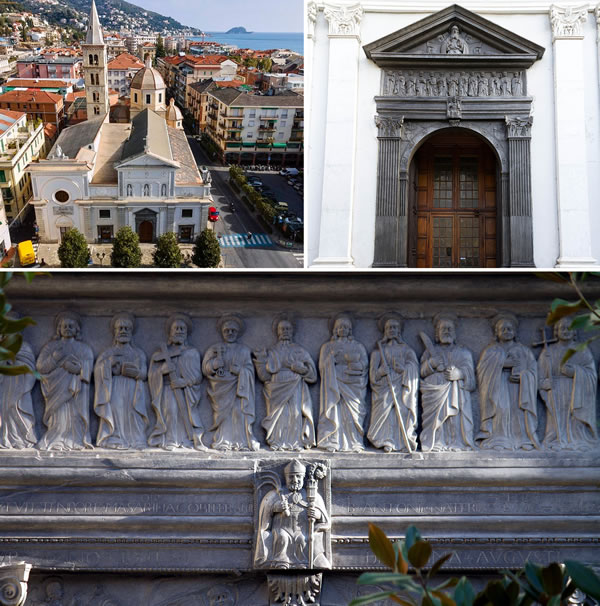
Church of Sant'Ambrogio, Alassio (Savona, Italy)
This page was last edited on 14 March 2026
© andmorestory.eu - All right reserved