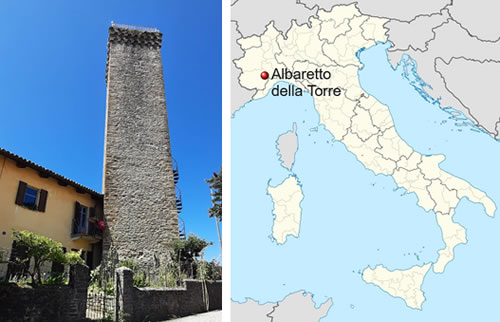
Albaretto della Torre (Cuneo, Italy)

Albaretto della Torre is a small village of just 200 inhabitants, perched on the hills of the Langhe region south of Alba, in the area traversed by the Talloria stream, a tributary of the Tanaro River. Little is known of its ancient history: archaeological finds testify to a settlement in Roman times, while the first historical document mentioning the community dates back to 1340, when the place was listed among the domains of the Del Carretto family.
The construction of a tower dates precisely to the 14th century. It was part of a fortification built by Marquis Manfredo del Carretto around 1324. The Del Carrettos were an ancient Ligurian and Piedmontese noble family, belonging to the Frankish Aleramici lineage. They emerged in the 12th century as lords of the March of Savona, granted by Marquis Bonifacio to his son Enrico I, known as "the One-Eyed," founder of the house. Several hypotheses exist regarding the origin of the distinctive surname "del Carretto," which may derive from:
• the cart in which the legendary founder Aleramo fled with his companion Adelasia;
• the triumphal chariot that carried the turban conquered in Palestine by Enrico I;
• or, finally, from a cart depicted in a Saxon imperial coat of arms, suggesting a possible Germanic ancestry.
For about three centuries, the family's castle lived in relative peace, until 1630, during the War of the Mantuan Succession, when it was demolished by French artillery and never rebuilt. Today, all that remains of the entire complex is the tower, once the castle's keep, which has given the village its name since 1862.
Albaretto is linked to a captivating legend centered on the controversial figure of "Queen Joanna." Every Sunday, after High Mass, the eldest among the faithful begins, followed by the others, a prayer called "The Six Paters of Queen Joanna." The legend tells of a queen fleeing from cruel knights who, after many tribulations, found refuge and rest for three days in Albaretto, welcomed with great warmth by the people. Deeply moved by their kindness, upon her departure she prayed to God to reward them with abundant harvests, protection from hail, and gentle waters. In gratitude, they promised to remember her by reciting a Pater noster every Sunday.
The pious and generous queen of folk tradition, however, clashes with a very different historical reality. "Reina Jana" is a legendary figure from the valleys of the Cuneo area, born from the fusion of the memory of historical sovereigns with ancestral beliefs about fairy-like creatures (the Janas or Jankas), guardians of sacred places and springs.
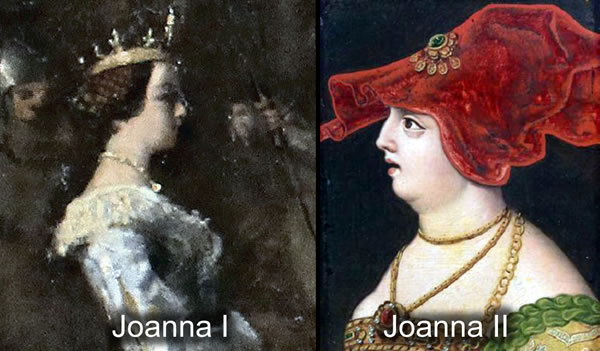
The fantastical character stems from the confusion between two real sovereigns:
• Joanna I of Anjou (1326-1382), Queen of Naples, who did travel to her Provençal possessions around 1346, making her passage through the area remotely possible, though undocumented.
• Joanna II of Anjou-Durazzo (1373-1435), her niece, who almost certainly never set foot in Piedmont, but tales of her scandalous and libertine behavior reached the Alpine regions.
The two figures, united by turbulent destinies and a reputation for strong sensuality, merged in the popular imagination of subsequent centuries. From this amalgam was born the lurid tale of "Queen Joanna," a lustful hunter of men whom she would seduce and then have fall into deadly trapdoors.
Albaretto della Torre (Cuneo, Italy)
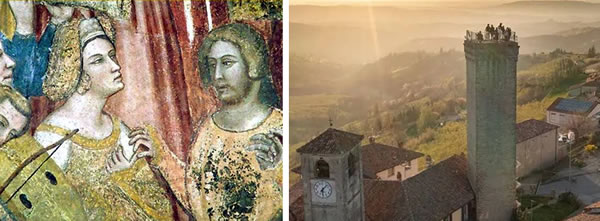
Queen Joanna e Albaretto della Torre
This page was last edited on 14 March 2026
© andmorestory.eu - All right reserved