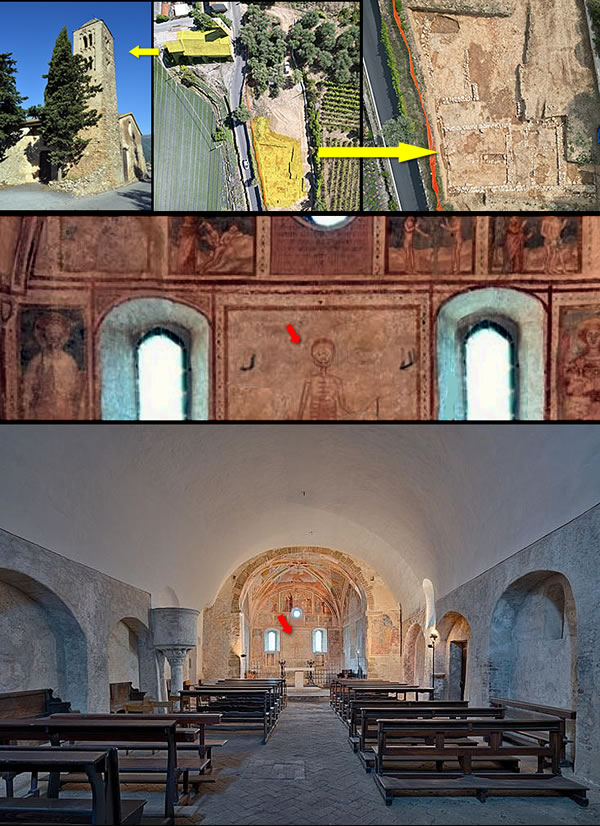
Church of Santo Stefano in Massaro: adjacent archaeological excavation area (yellow arrow) and interior with fresco depicting death (red arrow)

In the locality of Massaro, within the hamlet of Bastia d'Albenga (Savona), stands the small church of Santo Stefano, dedicated to the first martyr of Christianity who lived in the 1st century AD (5-36). This ancient Romanesque building, first mentioned in a document from 1271, is a silent guardian of centuries of history, art, and the transformations of a small community.
In 2024, some Roman-era wall remains were brought to light during works for laying a new aqueduct on land adjacent to the church, owned by the Institute for the Sustentation of the Clergy. Subsequent archaeological excavations revealed the remains of a rural building, following a well-known model of settlement in the Albenga plain attested by previous discoveries. Indeed, an ancient Roman-origin village with numerous farmsteads once stood here. Its elevated position, facing east towards the sea and situated along the connecting route to Albingaunum (Albenga) and its port, finds close parallels with the nearby Roman rustic villas identified in the Rusineo locality in Lusignano and in Miranda.
According to the 'Sacro e Vago Giardinello...', a 1624 manuscript work compiled by Canon Gio Ambrogio Paneri on behalf of the Bishop of the Diocese of Albenga, Monsignor Pier Francesco Costa, the inhabitants of Bastia decided to use the church of the Annunziata, located in the monastery of the Benedictine nuns (founded in 1532 by the lords of Avola in Badia), as their place of worship. The reason was that the small church of Santo Stefano was located outside the urban center (1.7 km away) and therefore inconvenient to reach. It was decided, however, to continue celebrating religious rites in the ancient chapel on the occasion of Easter, Pentecost, the feasts of the Saints and the Deceased, and for the patron saint, Stephen.
The oldest frescoes in the Romanesque chapel were created between 1383 and the early 15th century, and were restored after the end of the Second World War. They primarily narrate stories of faith through figures such as Saint Anthony the Abbot and Mary Magdalene. But there is also a curious 14th-century fresco, offering a singular depiction of death, represented as a skeleton armed with a bow and arrow.
In the collective imagination, the skeleton is closely linked to death, but this concept did not exist before the late Middle Ages.
Early attempts to depict death in the Christian world did not contemplate the iconography of the skeleton at all:
• Towards the end of the 13th century, death was represented as a woman with common features, wielding a bow and arrows, later with a scythe, or while carrying a coffin.
• Until the early 14th century, death was conceived as a random event allowing entry into true life. From the mid-14th century onwards, through the practices of Ars Moriendi, consisting of the exercises of the 'Good Death', a meditation on the physical destiny of man began. Thus, through disgust and fear at the thought of one's own rotting body, the sense of the macabre was born.
• From the 15th century, the Danse Macabre adorned cemetery walls, becoming an increasingly widespread literary theme, also in engravings, particularly German and French. A new and autonomous representation imposed itself: that of Death, a furious horseman who slaughters, a depiction of a power that acts not so much in the service of God, but on its own initiative. A universal power exercised indiscriminately on all men. The most common image with which death was depicted is that of a skeleton armed with a scythe (an instrument connecting it to Chronos, the God of time), which becomes an auxiliary instrument of death. It can also be found holding a sword or with a bow nocking three arrows (plague, famine, war).
The chapel in Massaro also housed Roman-era funeral slabs, attesting to the area's use at that time and the typical medieval phenomenon of spolia (reuse of materials):
M. VALERIO
M. PRECTO
V. A. XXII
This slab was carved in honor of Marcus Valerius Messala, a Praetor who lived twenty-two years.
PUBLIUS GRANIUS
P. L. HYLA
AUGUSTALIS
V. F. SIRI ET
RETUTIAE IL
QUARTAE MATRI
A square marble slab, which the Costai family had transferred from the aforementioned Church of S. Stefano in Massaro to the Portico of their palace in Albenga. It appears to have been Publius Granius, son of Publius, Lucius Hyla Augustalis, that is, a Leader of the front lines of an army, who determined (Votum fecit) that it be carved to perpetuate the memory of himself and of Betusia, his second mother, surnamed 'Quarta'.
CASSIO VALERIANO
VIRO INNOCENTI
GUNITATIS PRINCIPALI
QUI VIXIT ANNO P. M. LXX.
B. M. UXOR ET FILII FIGER
D. P VI.IANCASSIO VALERIANO
VIRO INNOCENTI
GUNITATIS PRINCIPALI
QUI VIXIT ANNO P. M. LXX.
B. M. UXOR ET FILII FIGER
D. P VI.IAN
It is read walled on the outside of the Chapel's bell tower. The Wife and Sons of Cassius Valerianus, who lived about in the year 70 (Anno Plus Minus LXX), an innocent man and Prince of the Youth (Gunitatìs Principali), decreed that it be erected in testimony of their tenderness (Devotionis) to their Husband and Father respectively, on the sixth day of January. 'Prince of the Youth' (Princeps Iuventutis) was a title instituted by Augustus for the sons and grandsons of emperors. The first to use it were, according to Tacitus (Annals, I), Lucius and Gaius.
Church of Santo Stefano in Massaro: adjacent archaeological excavation area (yellow arrow) and interior with fresco depicting death (red arrow)
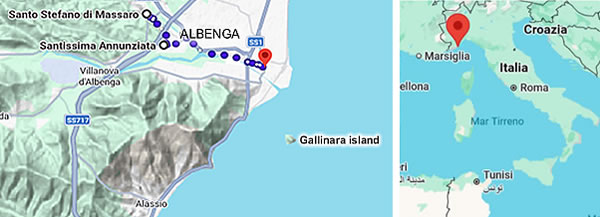
Albenga and Church of Santo Stefano at Massaro at Bastia
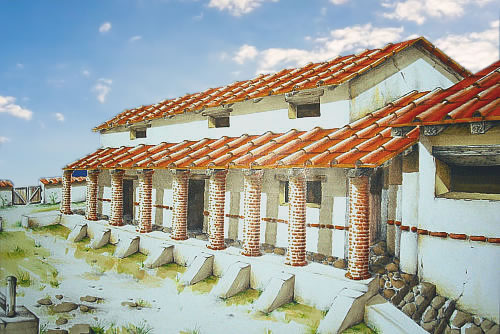
Graphic reconstruction of the Roman-era rustic villa in Caselette, Turin, Italy
This page was last edited on 14 March 2026
© andmorestory.eu - All right reserved