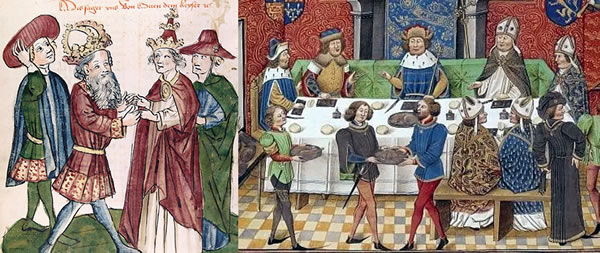
The meeting of Otto I and Pope John XII (drawing from c. 1450) and a scene from a Renaissance banquet.

The countryside around Albenga, more precisely the slopes of Mount Tirasso, was where Aleramo made his home. The legendary founder of the powerful Aleramici family, he was born and lived until his adolescence in Sezzadio, then moved to the German court, from which he fled with the young daughter of Emperor Otto I, Adelasia. The first refuge for the two spouses in Italy was Garessio; Albenga was the second. Settling among the ruins of an old house in a chestnut forest, Aleramo and Adelasia learned the trade of charcoal burners and lived off the proceeds from the charcoal and wood they brought to the market in Albenga, and from the spoils of the hunt.
Fifteen years had passed, and the marriage had been blessed with the birth of seven children, when Otto I happened to pass through those parts and was a guest of the Bishop of Albenga. In Albenga, according to one of the many versions of the legend, the reconciliation between the emperor and his son-in-law took place, and this is how: not knowing what to prepare for dinner for his guest, who was moreover in a bad mood, the bishop asked Aleramo for advice. Aleramo suggested a recipe he had already executed with great success for his former lord: a wild boar, slowly braised in oil, onion, carrot, and ham, served with a sweet and sour sauce of vinegar and sugar, and naturally, raisins and pine nuts, passed separately.
As soon as the sovereign tasted it, he regained his cheer; and having perfectly understood to whom he owed that delicious dinner, he wished to see Aleramo. He not only forgave him but also bestowed upon him the title of Marquis and promised as a gift all the territory he could encircle in a three-day ride. In this way, Aleramo became a great landowning lord.
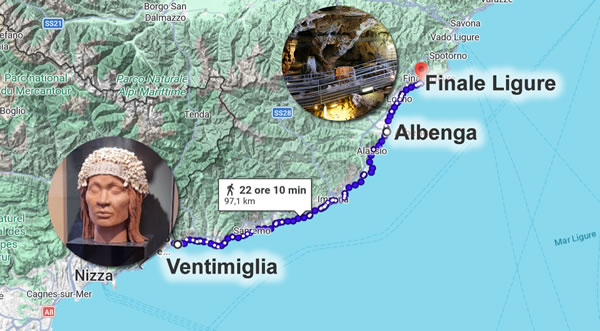
The wild boar has been hunted since prehistoric times: in Liguria, for example, its bones have been found among the remains of meals consumed in the nearby prehistoric caves of the Balzi Rossi (Ventimiglia) and the Arene Candide (Finale Ligure). However, although belonging to a single species, the domestic pig and the wild boar have been distinguished since antiquity by very different symbolic values. The former, prized for its meat, lives in herds and is considered the foolish animal par excellence, coarse and slow-witted. Its wild counterpart, however, represented one of the most feared and admired animals in archaic and classical eras. Sacred to Artemis and the god of war Ares, in the epic tales of ancient Greece the boar has a strongly "masculine" characterization and often appears as a term of comparison for a warrior's heroism, second only to the lion in this regard. The boar also presents itself as an "armed" animal, equipped with a short weapon and a shield: the first consists of its tusks, like sharp scimitars, which allow it to inflict deep and often lethal wounds on opponents; the second is the calloused "shield" or armor that males have on their shoulders, which forms during the mating season. In essence, the boar embodies the aristocratic and valiant hero who, driven by warrior fury, confronts his adversaries alone, slaughtering or terrifying them.
The Etruscans hunted it at night or at dawn, capturing it with nets, various traps, and the aid of fierce dogs. For Roman nobles, the boar hunt represented a beloved pastime. The drives, conducted on foot with the help of nets and dogs to flush out the prey, often concluded with a close-quarters confrontation, in which the man, armed with a spear, sought to fell the animal by striking its throat or between the eyes. If successful, the game often ended up on the lords' tables. While in the classical world the pig was an object of deep cultural disdain, among Germanic populations, and even earlier Celtic ones, the swine was instead a sacred animal, a symbol of abundance and fertility. Strabo reported that the Celts particularly loved fresh and salted pork, and that in Gaul pigs were large and fierce; archaeological evidence from Iron Age tombs found in Britain and continental Europe attests to the practice of funeral feasts based on pork. Pork also triumphed in the banquets of the Otherworld: Celtic mythology held that every bruidhen or "hostel of the afterlife" was ruled by a god presiding over the banquet, depicted as a man with a pig on his shoulder. At such banquets, pigs were killed and eaten every day in magical cauldrons, only to be reborn and consumed again the next day, like those of the god Manannán mac Lir. Celtic mythology has left us numerous episodes of kings or princes setting out to hunt a boar. In particular, a white boar, capable of leading noble hunters into fairy or even otherworldly realms.
In the Middle Ages, under the pressure of barbarian invasions, a profound modification of eating styles occurred, as Celtic-Germanic populations loved to eat meat. With the exploitation by the populace of uncultivated lands—the true habitat of the boar—a gradual reclamation for agriculture took its place, for which the presence of the boar represented a true calamity, given its insatiable appetite and the devastation it left in its wake. Thus, while its culinary fame remained intact, it became the object of relentless hunting. In the collective imagination, the boar appears as the protagonist of fierce medieval hunts, pursued by packs of dogs, huntsmen, and knights; or one sees it laid upon a bed of myrtle, well-roasted, carried by castle servants on a large platter and greeted by the cheers of all gathered at the symposium. Once, the boar was widespread everywhere, both in the mountains and in the ancient forests of the plains; with deforestation and the expansion of inhabited centers, it disappeared. So, while during the early Middle Ages there was essentially no problem concerning hunting rights, and the rural population could exercise it without constraints on common lands (though if these were privately owned, a tribute was paid to the noble), by the mid-7th century, when the dominant class, lay and ecclesiastical, began to lay claim to and appropriate those uncultivated parts, called forests, existing outside inhabited centers, which peasants had used. It was then that it became customary for nobles to demand tithes and fees for hunting, equivalent to those obtained from agricultural, silvo-pastoral, and all other activities. This was ended by Charlemagne (768-814), who designated the king as the sole authority with the right to grant concessions in this matter.
The meeting of Otto I and Pope John XII (drawing from c. 1450) and a scene from a Renaissance banquet.
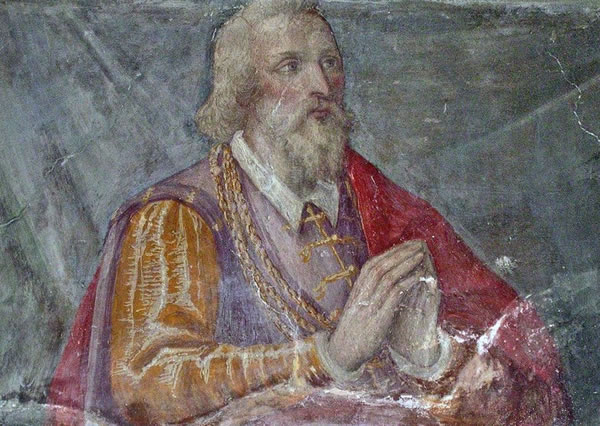
Painting of Aleramo by Guglielmo Caccia, known as "il Moncalvo," 17th century, preserved in the church of Grazzano Badoglio (Asti)
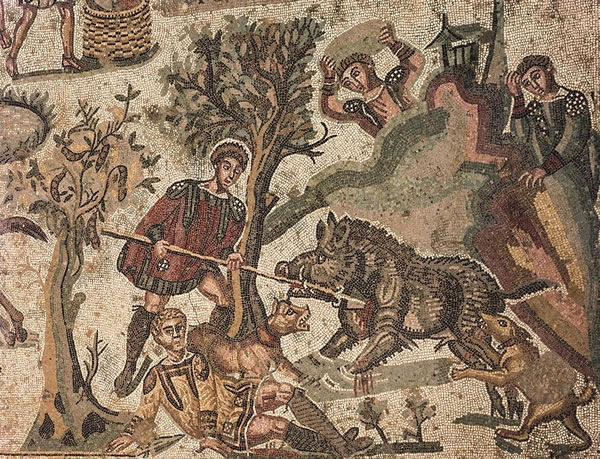
A 4th-century AD mosaic depicting a wild boar hunt adorning one of the rooms of the Roman villa of Casale di Piazza Armerina, Sicily, Italy
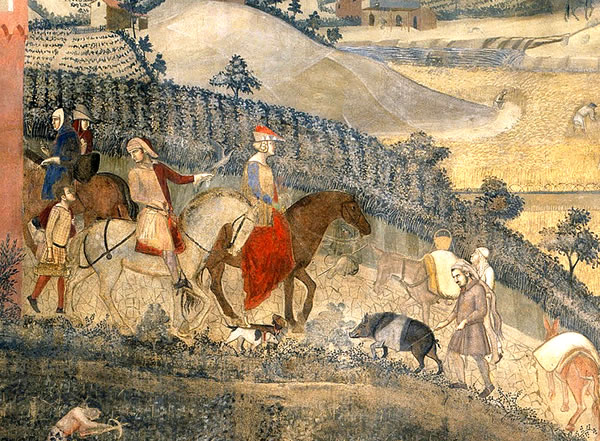
Detail with a wild boar from the fresco (1340) by Ambrogio Lorenzetti in the Palazzo Civico in Siena, Italy.
This page was last edited on 14 March 2026
© andmorestory.eu - All right reserved