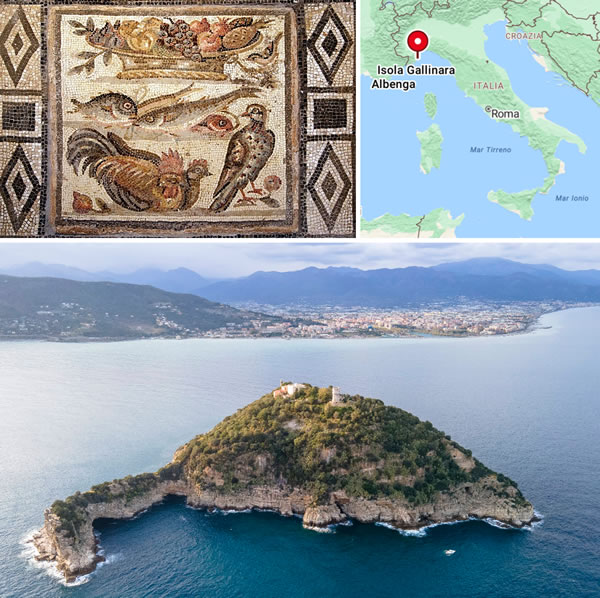
Floor mosaic depicting birds, fish and fruit basket. Opus vermiculatum, Roman artwork of the end of the 1st century BC/begin of the 1st century AD. - National Museum of Rome, Rome, Italy

Gallinara is a small island located 1.5 km from the Ligurian coast, almost opposite Albenga. It separated from Cape Santa Croce near Alassio due to a rise in sea level over 2.5 million years ago, and a channel (averaging 12 meters deep and 1.3 km wide) now separates it from the mainland. Legend has it that Gallinara was once so close to the shore that a man could comfortably throw a stone onto it from Vadino Beach. The island is mountainous and rugged, accessible only from the eastern side, where there is a small inlet called "Madonnetta." From here, a path begins, leading to the island's summit. The western side, by contrast, is entirely wild and rocky; in the Middle Ages, it hosted only a few wild rabbits. At the top, there is a small stretch of plain with a tower rebuilt in 1586 and the remains of ancient structures, including a cistern.
We do not know what the ancient Ingauni people called the island. However, through Cato, Varro, and Lucius Columella, we know the name the Romans gave it and which it still bears today: Insula Gallinaria or Gailiata, after the gallinae rusticae (wild hens) that once populated and proliferated there in great numbers. It is likely they escaped from the hold of some ship. Tradition holds that the monks living in Loano would come to gather their eggs in large quantities, and the town's coat of arms, which features an egg, is said to commemorate this.
In 357 AD, Bishop Martin of Tours, the future saint, fleeing Arian persecutions in Milan, found refuge in a cave on Gallinara—which still exists—for four years. It is unclear, but he may have first been in the company of Saint Gaudenzius and later joined by his teacher, Bishop Hilary of Poitiers. Hilary, having learned in Rome that Martin was on the island, decided to reach his disciple to embrace him again. Although he was advised against going there because it was an uninhabited, uncultivated island full only of venomous snakes, he refused to abandon his determination. Upon landing, he found himself fiercely battling these hungry serpents. But a sign of the cross from the Saint and an authoritative command from him caused the snakes to retreat to the remotest corner of the island. The Saint drove a stake into the ground at its entrance, as a boundary beyond which the snakes could no longer pass. The people of Albenga had a very small chapel built in honor of the Holy Bishops Martin and Hilary on the western part of the island.
Insula frugis ìnops, pascens radìcìhus herhae
An island barren of fruit, nourishing [him] with roots of herbs
Gallinara was described as an uninhabited island devoid of any sustenance, fertile only in brambles and wild herbs, whose roots Saint Martin ate. This was hellebore, a plant whose toxicity he was unaware of. Its roots had cardiotonic, narcotic, emetic, and edema-curing properties but were also a drastic purgative. One legend recounts that Martin, finding himself on the brink of death after eating this herb, prayed and was miraculously saved. He then left the island to return to Poitiers. The island contains the remains of a monastery founded in the 6th century and dedicated to Saint Martin. It also hosted Saint Hilary and Saint Benedict Ravelli. After Saracen destructions in the 9th and 10th centuries, the monastic building was rebuilt by the Benedictines. The southeastern slope of the island was the subject of an important archaeological campaign, specifically beneath the Cave of Saint Martin, where tradition generally holds the Saint's hermit refuge was located. The first excavation was conducted on a steep slope nearby; it uncovered a tomba alla cappuccina (a type of burial) placed on a steep incline near the cave. It lacked grave goods and datable materials and was considered a late antique burial of a monk. Inside the cave, a trapezoidal masonry casket tomb lined internally with cocciopesto (opus signinum)was found, dating between the 6th and 8th centuries, while the skeletons discovered inside were from the 14th century according to radiometric analysis. Remains of a glass suspension lamp, datable between the 4th and 7th centuries, were also found. These discoveries have suggested the interpretation of the tomb as a segnaculum—that is, a privileged burial site whose prestige was emphasized by the choice of the cave linked to Saint Martin.
Floor mosaic depicting birds, fish and fruit basket. Opus vermiculatum, Roman artwork of the end of the 1st century BC/begin of the 1st century AD. - National Museum of Rome, Rome, Italy
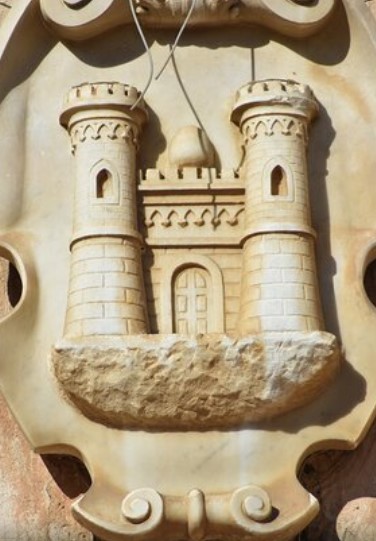
The coat of arms of Loano at the palace of Ligurian princes of Doria's Palace, Loano (Savona) Italy
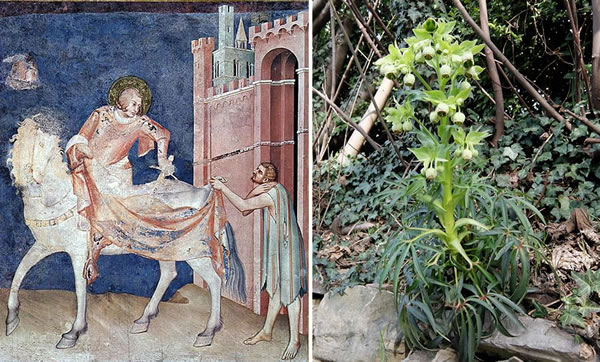
St. Martin sharing his cloak with the beggar, from the Life of St. Martin, 1326 - San Francesco, Lower Church, Assisi, Italy - Helleborus foetidus
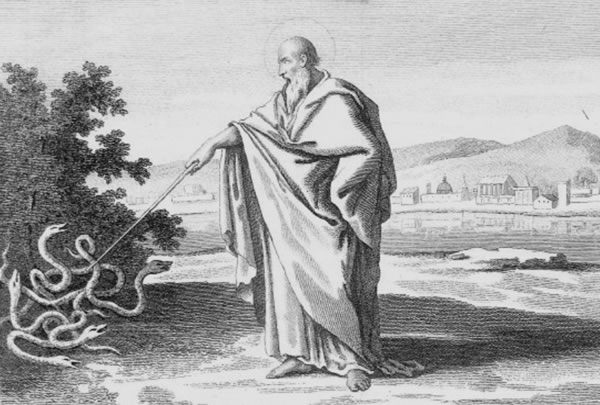
Sant'Ilario Vescovo di Poitiers, stampa del 1825
This page was last edited on 14 March 2026
© andmorestory.eu - All right reserved