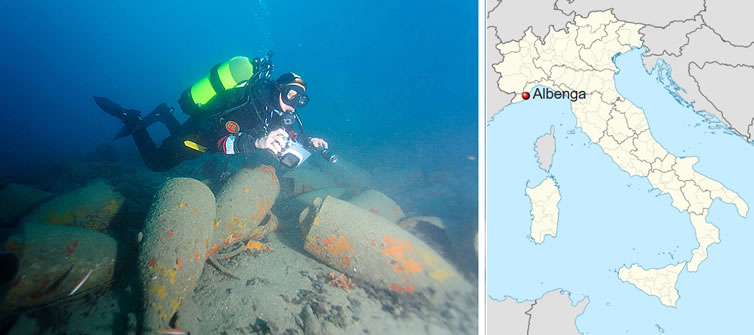
Amphorae of Roman merchant ship, Albenga (Savona, Italy)

In 1925, a fisherman trawling two miles off the coast of Albenga found three Roman amphorae entangled in his nets. It was clear that an ancient shipwreck lay hidden there, so he reported it to the authorities. For many years, no intervention was possible due to the estimated depth of about 42 meters, which severely limited operational capabilities with the technology available at the time. After the Second World War, archaeologist Nino Lamboglia (1912-1977) managed to raise funds for an unprecedented recovery operation. He enlisted the divers of the So.Ri.Ma company, already famous for major undertakings including the recovery of the cargo of coins and gold bullion from the English-flagged steamship "SS Egypt," which sank off the coast of Brest. Between February 8th and 20th, 1950, aboard the ship Artiglio II, over 700 amphorae from the main cargo of the Albenga wreck were recovered, along with stacks of black-glazed ceramic plates and cups, shipboard pottery, remains of bronze armor, and parts of the hull and ship's equipment.
Most of the amphorae were broken at the top, likely due to trawling nets but also the "octopus bucket" dredge lowered to the seabed. The news caused a great stir, both for the recovery and the damage to the artifacts. A few years later, thanks to new equipment, the Experimental Center for Underwater Archaeology was established. Starting in 1957, the site of the Roman merchant ship "Felix Pacata" was studied in several excavation campaigns. Many artifacts were recovered, then transported and housed in the Peloso Cepolla's Palace, a notable early 17th-century building in the heart of the city's ancient center, now the Roman Naval Museum of Albenga. About a hundred wine amphorae of the Dressel 1B type have been displayed and arranged just as they were originally on their ship, in a special wooden rack reproducing the ship's hold. Some amphorae still retain their original cork stopper in place, sometimes replaced by a pine cone, and in some cases, part of their contents of hazelnuts, which they transported alongside the main cargo of wine. Furthermore, other recovered archaeological finds can be admired: vases, and various objects for personal use by the crew and the armed guard on board—the latter necessary for defense against pirates who infested the Ligurian coast in particular. The absence of any mark or seal on the amphorae and the discovery of the remains of eight bronze helmets, which could indicate the presence of an armed guard on board to protect the ship from pirates, suggest it was a public or military transport.
Thanks to research conducted over the years, we now know that the ship was a cargo vessel of the corbita type, propelled solely by two sails; and that it dates from between 100 and 90 BC, a period coinciding with the granting of Latin rights to the Ligurian populations, the Romanization of the region, and the consequent development of cities. Indeed, the city of Albenga, already a pre-Roman center, became a municipium in the 1st century BC and a diocese in the 5th century AD. The ship probably sank due to a sudden storm. Sailors are well aware of the dangers of the Ligurian Sea, which even today claim victims among fishermen caught unawares in sudden storms driven by the cold Mistral winds. In fact, navigating the Mediterranean is not simple. Even though it seems like a closed basin, during seasonal changes there are rapid and unpredictable meteorological and marine variations without modern equipment. Therefore, ancient navigators could only rely on knowledge of seasonal winds and breezes which, together with currents, allowed them to use different routes depending on the time of year. The least favorable period for navigation was certainly winter (the period of "mare clausum"). The crew's great experience was necessary to sail in favorable wind conditions and without night cloud cover that prevented seeing the stars used for orientation at night. The wreck of the Roman Ship of Albenga is the most famous among all those discovered so far in the western Mediterranean. It is the largest type of Roman merchant ship, with a length of about 50 meters, a width of at least 10 meters, a mainmast with a diameter of 50 cm, and an estimated cargo capacity of between 11,000 and 13,000 amphorae. Consider that the amphorae weigh 21.5 kg empty, that their content was 26 liters, so each full amphora weighed approximately 45 kg – therefore the ship had a carrying capacity of 500/600 tons. The amphorae contained wine from Campania destined for the markets of southern France and Spain (Gallia Narbonensis).
Viticulture in Campania has ancient origins: indeed, even before the arrival of the Etruscans, there were populations devoted to vine cultivation. The Etruscans first, and then the Greeks, contributed to the development of production techniques. During the Roman Empire, Campanian wine-making flourished, and its wines were exported beyond the Italian peninsula. Many of the celebrated wines of the time, such as Caleno, Faustiniano, and particularly Falerno, were produced in Campania. Pompeii became the main wine-trading hub of Campania. From the ports of Pozzuoli and Sinuessa, tens of thousands of hectoliters set sail, reaching Mediterranean countries and Gaul. With the fall of the Roman Empire, Campanian viticulture began to decline, culminating in the Middle Ages, which marked one of the darkest periods for vines and wine in this region. Along with the wine, black-glazed pottery was exported—stacked in the empty spaces between the amphorae, probably packed with light materials (straw or other), surrounded by fragments of pumice stone—and other types of pottery. A very large ship for that era, then, one of the largest transports of its time discovered so far in the Mediterranean. The amphorae were stacked in 5 rows, and among them, a large quantity of pottery intended for trade was found. The Museum displays the remains of some hull elements, numerous materials recovered during the successive excavation campaigns on the wreck: game pieces; fragmentary helmets and remains of armor attributable to the ship's probable armed guard; black-glazed ceramics from Campania; jugs, olpai, and pans in common pottery; some objects belonging to the ship's equipment, including lead fistulae related to the bilge, a quartz crucible (suitable for melting lead to carry out urgent soldering and repairs), a circular lead instrument (perhaps a mechanism involving a lead wheel fixed, by means of a central square-section hole, onto a wooden structure that allowed its rotation; arranged crosswise relative to the hole, there were four others, inside which individual ropes passed that, thanks to the wheel's movement, twisted together to form sturdy lines), and a lead horn with apotropaic functions (either as a charm or part of an animal statue).
Amphorae of Roman merchant ship, Albenga (Savona, Italy)
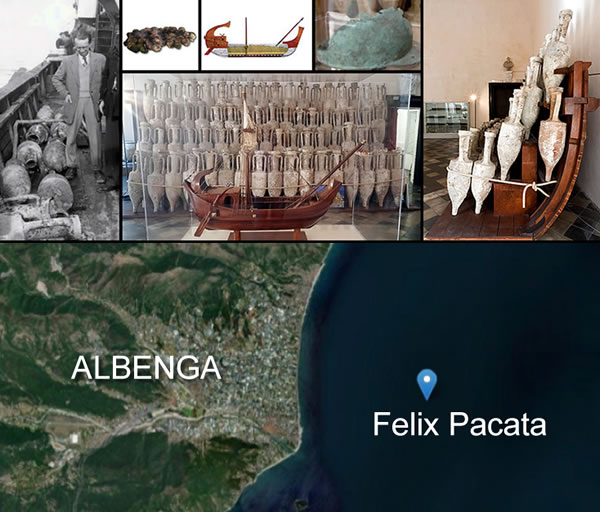
Roman Ship of Albenga (1st century BC): Professor Nino Lamboglia aboard the Artiglio in 1950 with some recovered amphorae - Hazelnuts found in the cargo - One of the bronze helmets - Reconstructed longitudinal section of the ship - View of the reconstructed midship section with Dressel 1B amphorae in stowage position and, in front, the ship model
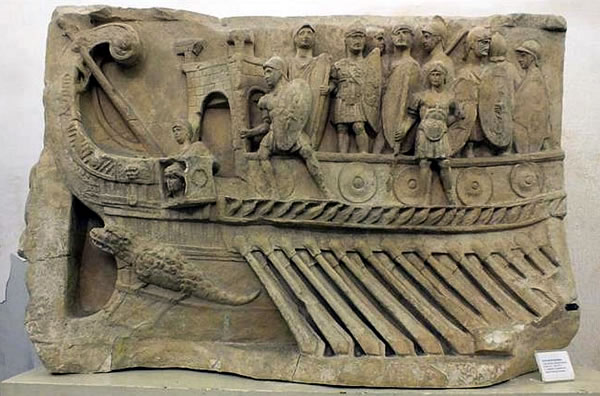
Praeneste relief. Roman galley, bas-relief of the Fortuna temple in Prague, 1st century BC (Vatican Museums)
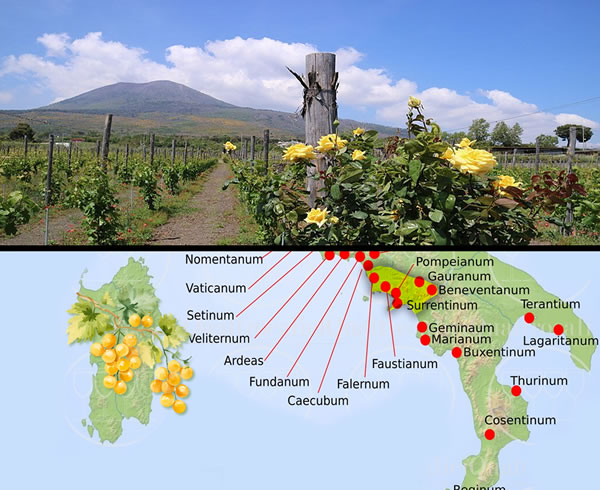
Ancient viticulture in Campania
This page was last edited on 14 March 2026
© andmorestory.eu - All right reserved