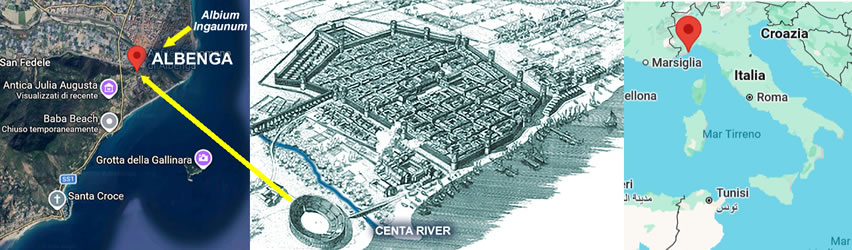
Albium Ingaunum, Albenga

Before the Roman conquest, Albenga was the seat of one of the most powerful Ligurian tribes, the Ingauni, from whom their principal city derived its name: Albium Ingaunum ('the fortress of the Ingauni,' Albenga). However, the origins of Albenga are linked to the Greek-Phoenician myth of the journey of Hercules-Melqart from Spain to Italy. Hercules, renowned for his prodigious strength and labors, was the Greek hero born to the mortal Alcmene and Zeus. The latter, true to his nature, seduced the woman by disguising himself as her husband Amphitryon, and from this union Hercules was born. The child was particularly hated by Hera, and it was precisely because of her jealousy that Hercules was forced to undertake the twelve terrible labors. Driven to madness by the goddess, he killed his wife and children, and to atone for these murders, he was compelled to overcome the difficult trials. According to other traditions, however, the labors were the only path to immortality, as the mighty hero was merely a demigod, born of a mortal and a deity. Melqart (in Phoenician mlqrt, from mlk-qrt "king of the city") was a Phoenician god, worshipped in the city of Tyre, whose cult later spread to Syria and the Phoenician colonies in the West, particularly Carthage. In the Greek and Roman world, the god Melqart was simply identified with Heracles or Hercules. This represents an overlapping of mythological figures or deities, and as Herodotus states in his writings, the cult of the "Lord of the city of Tyre" predates that of Heracles-Hercules; often myths and legends referring to the latter should more correctly be attributed to Melqart.
The tenth labor took Hercules far from Greece, to the limits of the known world. His task was to capture the cattle of Geryon, guarded by a herdsman on the island of Erytheia, beyond the strait that led from the Mediterranean to the mysterious Ocean. The hero landed in Libya, headed towards the Ocean, crossed the strait, and erected two pillars on each side, thereafter known as the Pillars of Hercules; he reached the island, killed the herdsman and his dog, and seized the cattle. On his return journey, he passed through wild lands: from the Pyrenees of Spain to southern France; from there into Liguria, where he had to resist the Ingauni, a barbarian people who wanted to rob him of his cattle. According to legend, he entered the land of the giant sons of Poseidon, Albion (or Alebion) and Bergion (or Bercino). The two brothers lived peacefully in Liguria when they found the immense herd before them. So, by common agreement, they decided to steal some animals from the hero, but Heracles, more skilled than they, first discovered them and then confronted them. Having exhausted all his arrows against them, he killed them with the help of Zeus, who overwhelmed them with a dense hail of stones. He proceeded into Etruria and stopped on the banks of the Albula, the ancient name of the Tiber, where, as a guest of the good King Evander, he killed the monstrous Cacus, also guilty of an attempted theft of part of the herd. On his long return, the hero then passed through Reggio Calabria and finally set sail for Greece, but as he landed on Hellenic soil, the cattle escaped all the way to Thrace. Having recovered most of the animals, Hercules crossed the Strait of Corinth, where he fought victoriously against the terrible giant Alcyoneus, and finally reached Mycenae. The cattle of Geryon was supposed to be the last labor, but because the second and fifth were not considered valid by Eurystheus, the hero had to undertake two further tasks.
According to legend, Albion founded Albenga and Ventimiglia. In reality, we know that around the 6th century BC, groups of Ingauni Ligurians colonized the plain formed by the Centa river to establish an agro-pastoral society. To control and protect the plain, they founded an oppidum, a fortified center known as Albium Ingaunum, "the fortress of the Ingauni." The oppidum is located a stone's throw from the sea, near a wide, sheltered inlet, a sort of natural harbor. Two centuries later, the Ingauni acquired considerable maritime knowledge and came to build a small but formidable fleet. Exploiting the potential offered by the bay, they practiced piracy with lucrative profits. Titus Livy recounts that the Ingauni were excellent sailors but also fierce pirates with sleek and fast ships, for whom privateering was the main activity. During the Second Punic War (218–201 BC), Albium Ingaunum allied with the Phoenicians of Carthage. Mago, brother of Hannibal and admiral of a powerful fleet, used the roadstead of Albium Ingaunum on more than one occasion for his military actions, and according to tradition, after an unfortunate mission, he died right in the waters of the Ingaunian port. After the defeat of the Carthaginians, the Ingauni allied with the Romans but continued their pirate raids. Rome, no longer willing to tolerate this, sent an expedition in 181 BC commanded by Proconsul Lucius Aemilius Paullus. After a fierce struggle, the proconsul heavily defeated the Ingauni, and Rome could finally subdue all their territory. Albium Ingaunum was destroyed to its foundations, so much so that no trace of the ancient Ligurian city has been found, and the phase of Romanization began: their ancient oppidum first became a military castrum and later transformed into a Roman town called Albingaunum.
Albium Ingaunum, Albenga
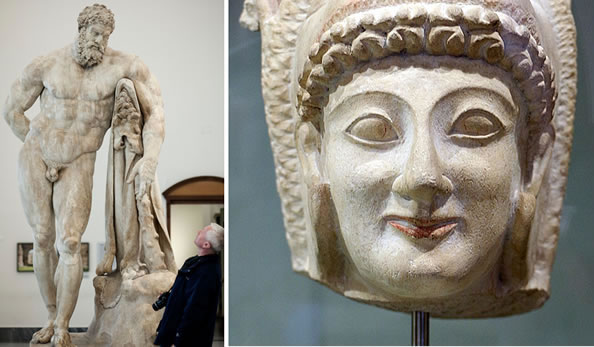
Statue of the Farnese Hercules (National Archaeological Museum, Naples, Italy) - Phoenician Melqart, 6th century BC (Barracco Museum of Antique Sculpture, Rome, Italy)
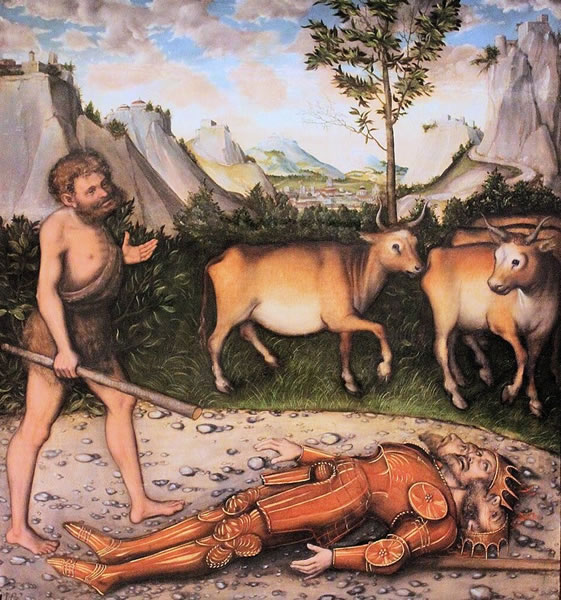
Hercules and the Cattle of Geryones by Lucas Cranach the Elder and workshop (1472–1553), Herzog Anton Ulrich-Museum, Lucas Cranach
This page was last edited on 14 March 2026
© andmorestory.eu - All right reserved