Lidless Pots
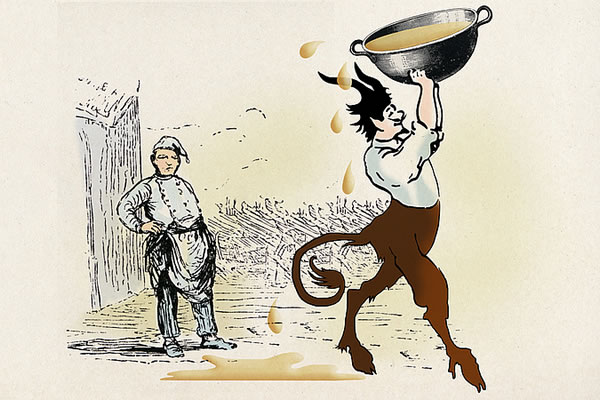
Proverbs are repositories of folk wisdom and common sense, tinged with moralism, and the devil often features in them as a bad or imperfect counselor. The very popular saying "The devil makes pots but not lids" means that it is easier to do evil than to avoid its negative repercussions. In other words, it is better not to plot wicked or dishonest actions because they can easily backfire. The saying originates from an ancient legend: after being expelled from Eden, Adam and Eve were content for a time to eat whatever they found; but then their tastes became more refined and they began to desire cooked food. God then told Satan to help them, and Satan sent his devils, who took Adam on their backs and carried him to a coastal area where there was clay extraordinarily suited for making vessels. There, they improvised a potter's wheel and a kiln, and before long, pots and pans of every size were ready. On the bottom was written 'Albisola': the place that saw the dawn of the terracotta art. Quite pleased, Adam returned on the backs of the devils to Eve with his pots, and immediately the couple began to boil meat over the fire. However, the wind rose and ash and dust fell into the broth: as usual, the devils had made the pots but not the lids. This inconvenience was remedied much later by the sons of Japheth (son of Noah). Knowing by reputation of the wonderful land of Albisola, they went there and, finding the potter's wheel and kiln intact, having survived the Flood, they devoted themselves to the potter's art. And thus the town arose.
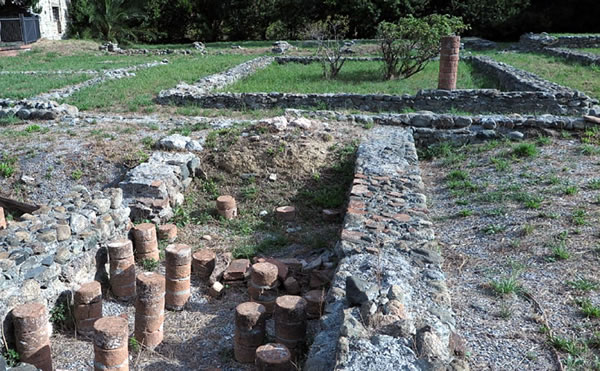
This area of Liguria, Albisole (comprising Albisola Superiore and Albissola Marina), is indeed famous for its manufactures and the prized creations of a very ancient tradition. An art that has remained largely unchanged over time. Even in Roman times, thanks to the clay basins inland and the red clay and white earth from the beach, there were kilns producing bricks and amphorae, used for transporting wine, oil, and grains produced locally. Like those of Publius Helvius Successus (126-193), nicknamed pertinax (persistent) by everyone for his determination in achieving his goals. He was a successful freedman: from profitable trade in timber and wool, to agricultural holdings, to kilns for producing the transport amphorae he needed for his commerce. He grew rich quickly, rose in the social hierarchy and in the esteem of his fellow citizens, enabling him to marry a wealthy matron, Lollia Acilia. They would have a son to whom the father gave the name Publius Helvius Pertinax (126-193), instead of Publius Elvius Successus, the future Roman emperor (who reigned for only 85 days).
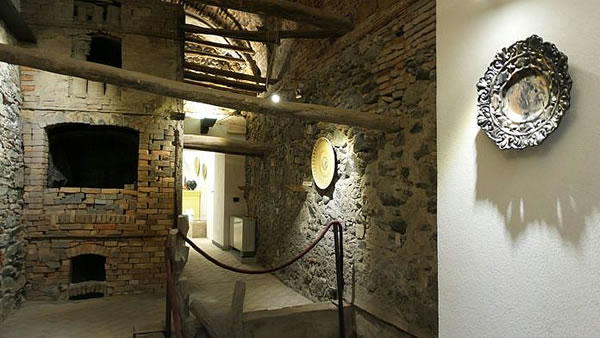
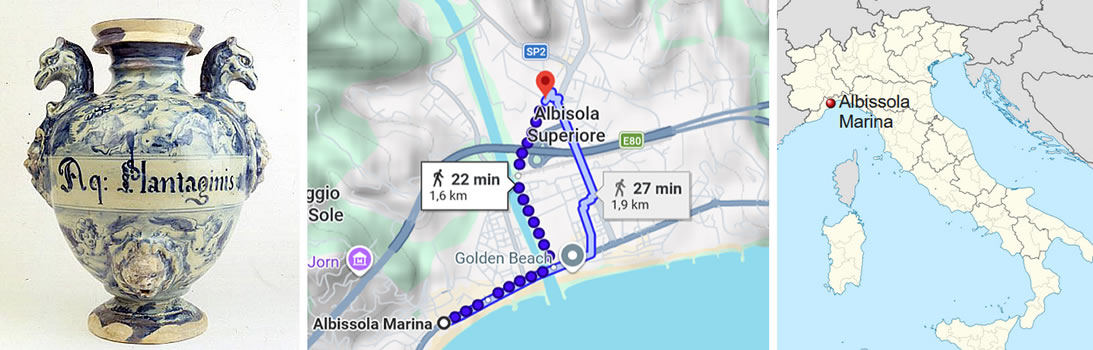
We know that in the 11th century, Benedictine monks from a convent located in Albissola Marina produced ceramic containers. The religious rule required prayer but also productive activities, and this gave impulse to the economic and civil growth of the territory. The monks are certainly credited with building dry-stone walls to form cultivable terraces on the steep inland terrain; and they were the first apothecaries, or rather speziali – who with ointments, salves, infusions, and plant extracts attempted to alleviate diseases and infirmities of all kinds. It seems the Benedictine monks are to be credited with the disappearance of Leprosy from these areas, imported by maritime trade with the East. And it was precisely the need for waterproof containers for medicines that fostered an increasingly rich and varied production of vases and containers. For centuries, production continued mostly for everyday objects, such as cooking pots, but also maiolica, i.e., ceramics decorated over glaze.
The quantitatively highest development occurred in the 16th and 17th centuries: if in 1569 there were thirteen kilns, by 1640 a good 23 kilns were active, led by families of ceramists distinguished by their typology of decoration and the emblem used: the Grosso family used the lantern of Genoa, the Corrado family the crown, religious orders requested ceramics marked with figures of saints or with coats of arms. Specimens from this era are preserved in the Diocesan Museum of Albenga. In 1508, the Della Rovere, a noble family from Savona, became lords of Urbino, consequently favoring the transfer of artists from Urbino to the Savona area, where they imported new and more refined styles. The 'raffaellesche' (Raphaelesque), a chromatically more vibrant decoration of Urbinate origin, and the 'calligrafo' (calligrapher), a complex pictorial decoration of Arabic origin, influenced the style of Albisola ceramics from then on.
The often solid and important relationships with French culture began as early as 1578, when Luigi Gonzaga called to Nevers, a town in Southern France, two brothers from Albisola, members of the Conrado family, one of the most important in the ceramic sector in terms of number and prestige. In France, they spread the style of Albisola ceramics, working in collaboration with artists from Faenza and France. Problems became more complicated at the end of the 18th century when the import of Chinese porcelain onto European markets significantly damaged the flourishing trade and forced ceramists to attempt imitations. In this sense, the Savonese artisans Boselli and Guidobono and the Albisola native Levantino worked hard, trying to discover the secret of porcelain paste and inventing new decorations: thus were born the airy and polychrome statuettes of the style aptly named "Levantino". With the French Revolution and the fall of the nobility, the flow of manufactured goods to France stopped and production had to shift towards more popular items. Alongside fine ceramics, terraglia emerged—a terracotta with a lead-based glaze, brown in color with black spots—which, with some modifications, is still present today in the industrial production of Albisola pots. But competition from English porcelain factories, tariffs on products imposed by France and Spain, the not-so-high cost of kaolins needed for the paste to withstand impermeable porcelain, and the increasing cost of fuel for kilns, led to a turning point. Throughout the 19th century, production was mainly of long-lasting crockery and cookware.