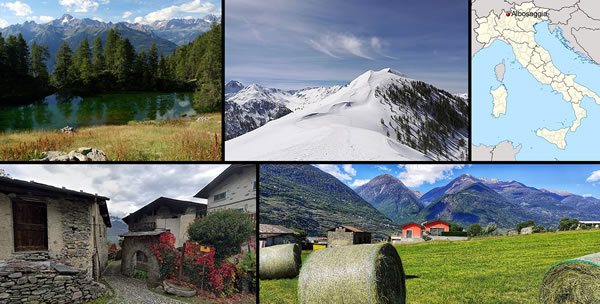
Albosaggia (Sondrio, Italy)

Albosaggia is a small village in Valtellina, a stone's throw from Sondrio, known for its panoramic trails through woods and alpine pastures where blueberries and kiwis are cultivated. Today, it is an ideal destination for those who love hiking, nature, and history. Its name derives from alpes agia and means "sacred alpine pasture." Its history has prehistoric roots. Located in the Livrio Valley in the central Orobie Alps, this area was, from the earliest times, one of the most frequented transit routes between Valtellina and the Bergamo region. This is evidenced by the discovery of a winged bronze axe, suggesting the existence of a prehistoric settlement in the area. During the Roman Imperial era, the territory was crossed by important connecting routes between Cisalpine Gaul and Raetia. Coins from the Imperial age confirm passage through the area but not the presence of settlements, as there was no establishment of military camps (castra) or new urban centers. The first documented trace of Albosaggia dates back to the 13th century, when the hamlet that formed the nucleus of the town, called "Paradiso," was mentioned in some deeds. In the Middle Ages, Albosaggia developed as a mountain community on the Orobic slope, connected to traffic and trade across the passes towards Bergamo. In the following centuries, the village experienced various dominations while always maintaining its strong identity tied to the mountains and the Catholic faith. Not far from Albosaggia, situated on a hill at 1,311 meters above sea level, lies the ancient Church of San Salvatore. Here, the deceased from the surrounding valleys were buried even before the inhabited village of Albosaggia existed. Tradition holds that the bodies of the first Christians from the Bergamo area were brought here to prevent their desecration by pagans. Until a few decades ago, the ossuary of this church contained visibly exceptional-sized skulls and bones, objects of great devotion. We know that San Salvatore is considered one of the oldest churches in Valtellina, a fact also indicated by its dedication not to a saint, but to Jesus Christ (a title given to early Christian churches). According to tradition, it dates back to the 6th century AD, as confirmed by a plaque found there datable to 537 AD. It is fairly certain, however, that it was one of the first outposts of the Christian faith in Valtellina, if not the very first, although nothing remains of the original building. The current structure dates from the Baroque period. It is no surprise, therefore, that various legends and traditions have flourished around it.
• A priest was killed at the church altar by a prominent figure from Bergamo because he had begun the religious service without waiting for his arrival. After this event, the parishioners, due to the desecration, decided to demolish the altar and rebuild it on the opposite side to the west, where it stands now.
• On the southern side of the church is an ossuary, and for centuries it was said to contain the bones of giants and magic skulls. At the end of the 19th century, the naturalist and mountaineer Bruno Galli Valerio, intrigued, went to analyze them and summarized the findings as follows:
The measurements of the bones have shown us that these were, in general, people of large stature (from 1.70m to 1.90m) and the large muscle impressions revealed a strong musculature.
Regarding the magic skulls, it was a deeply rooted belief that two skulls possessed supernatural powers, capable of influencing weather conditions. Galli Valerio also recounted an anecdote on this matter. He tells that the priest, after authorizing him to examine the skulls, gave him this recommendation:
For heaven's sake, do not mix up the two skulls that are on the altar. The peasants bring them from time to time near the stream, one to make it rain, the other to bring sun. A mix-up could have dire consequences.
For centuries, the skulls were used to perform propitiatory rites. In particular, during the most violent storms, the oldest woman in the village would take the skull associated with fair weather, carry it to the stream downhill, immerse it in the water, and implore an end to the precipitation. However, things did not always go as planned. There were at least a couple of "incidents" that seriously prompted a reconsideration of the wisdom of such rituals. The first happened after two months of severe drought, which had brought crops and farmers to their knees. The idea then came to use one of the prodigious skulls. It was taken to the stream and moistened with the trickle of water that remained. It seemed to work because within hours the sky darkened and it began to rain. But the rain grew increasingly violent, becoming torrential, and a very strong wind also rose, uprooting trees, tearing off roofs, and hailing abundantly. The people interpreted what happened as divine punishment for an act they considered sacrilegious. Another time, something similar happened, but with the second skull, the one for fair weather. It was raining "cats and dogs," as they say, and people began to fear for the stability of meadows and slopes. The skull was therefore taken for the usual ritual, but this time the weather, instead of improving, worsened, and the elements seemed to intensify their fury. In this case too, some interpreted the event as punishment for the sacrilegious rite, but there were also those who explained it by speaking of an intervention by the devil, who, as is known, was attributed the power to unleash storms and hurricanes. Finally, it seems that the ritual of washing the skulls had a broader meaning than a simple propitiatory rite. In fact, they were washed to appease the deceased and thus ensure their protection.
Albosaggia (Sondrio, Italy)
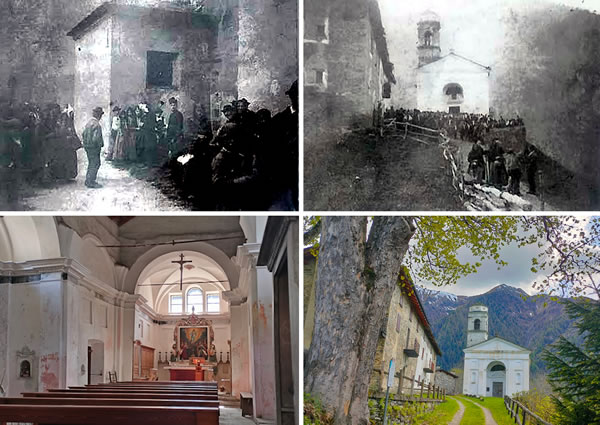
The Church of San Salvatore in 1896 and Today
This page was last edited on 14 March 2026
© andmorestory.eu - All right reserved