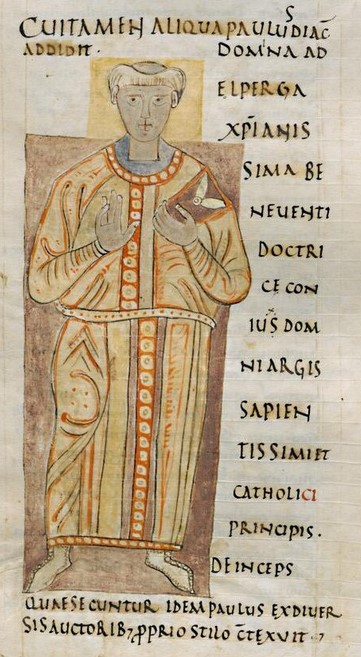
Illuminated depiction of Paul the Deacon at the beginning of the Historia Romana in the Codex Laurentianus, Plut. LXV 35 (11th–12th century))

Saint Baudolino (712–744) was a visionary hermit, born and raised in Villa del Foro (Forum Fulvii) on the banks of the Tanaro River, amid the dense woods that covered the hills and plains where the city of Alexandria would be founded about four centuries later, in 1168. The accounts we have of him are mostly popular legends and fragmentary stories recorded by monks, concerning his role in mediating the difficult relationship between local populations and nature—especially animals. The earliest and most important testimony comes from Paul the Deacon (Paul Warnefried), a Lombard Benedictine monk (c. 720–799) who was a contemporary not only of Baudolino but also of Charlemagne. In his Historia Langobardorum, Paul refers to him as “a man of wondrous holiness,” a hermit endowed with the gifts of miracles and prophecy. One witness to his supernatural gifts was Liutprand, King of the Lombards from 712 to 744, who was among the many who sought the saint for healing. Born in Villa del Foro, a Roman-era settlement near Alexandria on the right bank of the Tanaro, into a noble and wealthy family, Baudolino led a simple and austere life from his youth. After his parents died, he gave away all his possessions to the poor and went to live in a humble hut, alone and in meditation, near the river and the thick surrounding woods. Legend has it that geese, deer, and other animals gathered around him in his hermitage to listen to him, which is why he is sometimes depicted surrounded by these creatures. The people of Foro soon regarded him as a saint, due to certain healings believed to be miraculous, and his fame spread. One episode from his life remains in popular memory and is also recorded in a 16th-century text by the Dominican theologian Arcangelo Caraccia da Rivalta: the legend of the geese (or ducks). It is said that one day, Villa del Foro was invaded by thousands upon thousands of wild geese that emerged from the woods. Large and particularly aggressive, they devastated the local fields, devouring seeds, destroying crops, and refusing to leave. Nothing frightened them, and the peasants were powerless against them. Desperate over the destruction, they came to believe the geese were evil spirits sent from hell to torment the poor working folk, and that the man of God might drive these diabolical creatures away. So they decided to summon Baudolino. He came and commanded the birds to appear before him—which, to the townspeople’s astonishment, they did. The geese flocked around him, bowing in humility. He had them all locked up for the night, and the next day he set them free, ordering them to leave and stop causing harm. But the geese stayed and made a great racket. One goose, it turned out, had been stolen during the night. So Baudolino asked for another goose to be brought to him—one that, in the saint’s iconography, is always recognizable as the only white goose amid the gray ones. Standing amid the squawking flock, Saint Baudolino raised his pastoral staff and blessed the animals. The geese, thus blessed, took flight and vanished into the sky, never to return.
The holy hermit died in 744 near Forum Fulvii, where his hermitage stood, and was buried in Villa del Foro. When the city of Alexandria was founded in 1168, the inhabitants of Villa del Foro relocated there, bringing the saint’s relics with them. A few years later, in 1174, tradition holds that he appeared on the city’s ramparts to drive off the besieging Ghibelline forces. In 1189, a church was built in his honor, where his remains were placed, and it was entrusted to the Umiliati. The Umiliati, a movement that arose between 1170 and 1178 in Milan, were a religious society of wool workers devoted to evangelical poverty, labor, continence, penance, and preaching. After various developments and schisms, a part of the movement was approved as a religious order for both men and women; the male branch was suppressed in 1571, while the female branch lasted until the end of the 18th century. The Umiliati counted Baudolino among the saints of their order. Upon the suppression of the Umiliati, the church passed to the Dominicans in 1571. Hoping to enhance the already considerable popularity of Saint Baudolino, they expanded upon the sparse biographical information available, gradually shaping the legend of his life—mixing real or plausible facts with others that are decidedly fanciful and improbable. Moreover, it came to be said that the bishops of Tortona and Acqui, recognizing the great popularity of the holy hermit, regarded him as a bishop. Some even went so far as to call him Bishop of Alexandria—hence his occasional depiction in episcopal vestments.
In 1786, Saint Baudolino was proclaimed the principal patron of the city and diocese of Alexandria; his feast day is celebrated on November 10. In 1803, when the Dominican church was closed, the saint’s relics were first moved to the church of Santi Alessandro and Carlo, and later, in 1810, to a specially dedicated chapel in the newly built cathedral. On April 18, 1979, a new church dedicated to Saint Baudolino was consecrated in Alexandria, and part of the relics were transferred from the cathedral to a crypt built beneath the new church.
Illuminated depiction of Paul the Deacon at the beginning of the Historia Romana in the Codex Laurentianus, Plut. LXV 35 (11th–12th century))
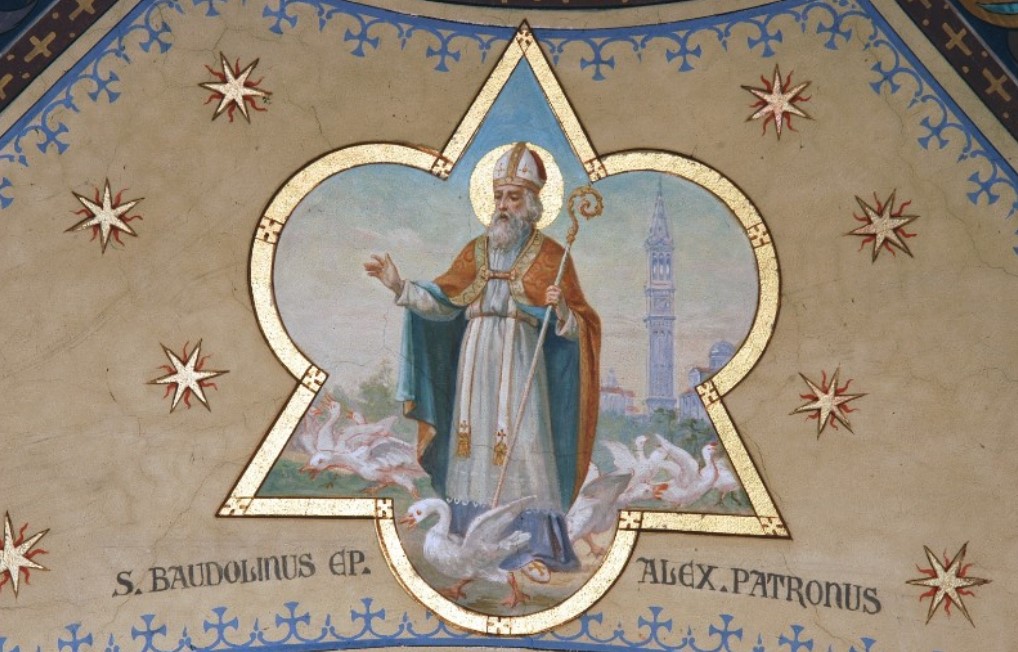
Luigi Morgari, Saint Baudolino in Episcopal Vestments, fresco, 1896–1897, Diocese of Piacenza-Bobbio
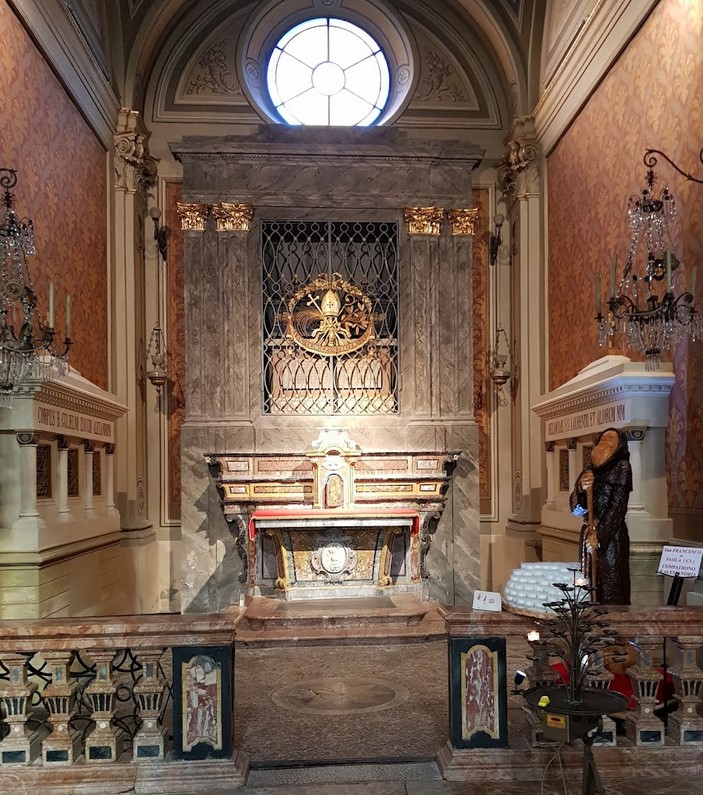
Aedicule with the saint’s sarcophagus placed above the altar in the Cathedral of Alexandria
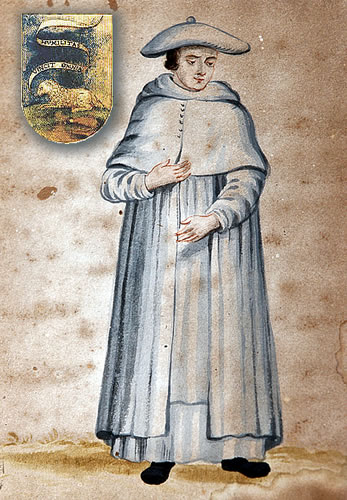
Coat of arms and monk of the Congregation of the Umiliati (drawing from before 1656) – Church of Santi Stefano e Cecilia al Ponte, Florence, Italy. This drawing is part of a series of graphic works depicting monks from various religious orders, as indicated by the inscription below the figure. The simple composition, lacking background, makes it difficult to date; some believe it may date to before 1656, as one of the depicted orders—the “Cruciferi d'Italia”—was suppressed that year. The artist, perhaps a monk himself, executed this and other illustrations of “ecclesiastical fashion” as a kind of visual guide for the monks of the Badia, so they could identify the many friars traveling through the city. For this reason, the drawings hold significant documentary value. These small watercolors were moved to Santo Stefano al Ponte following the death of the last pastor of the Badia Fiorentina, Monsignor Gino Bonanni, in 1994; as Don Pacciani noted, they had been hanging on the walls of the Minor Sacristy of the Badia.
This page was last edited on 14 March 2026
© andmorestory.eu - All right reserved