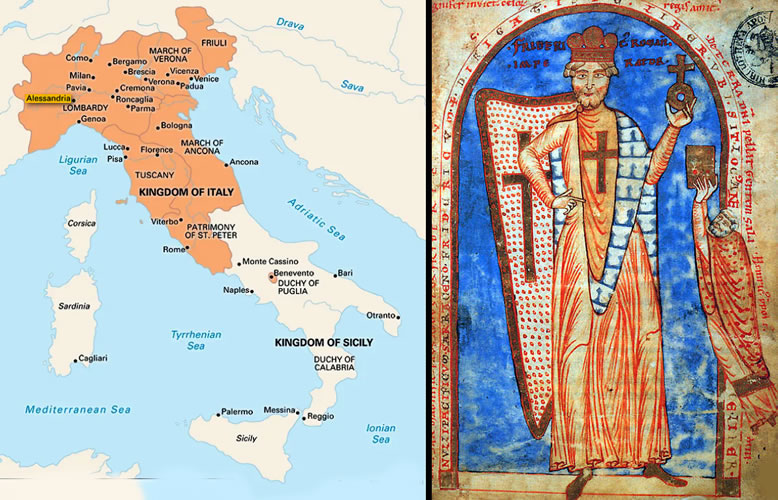
Italy in the late 12th century and Frederick I, Holy Roman Emperor as crusader. Dedicatory image from a manuscript of Robert the Monk's Historia Hierosolymitana (Vat. Lat. 2001, dated ca. 1188)

William V, known as "the Elder" (c. 1110–1191), was Marquis of Montferrat from 1137 until his death. He was brother-in-law to King Louis VI of France and uncle to Emperor Frederick I (Frederick Barbarossa, 1122–1190). By birth and marriage, he was thus closely related to the most powerful rulers of Western Europe. We know that he took part in the Second Crusade (1147) and was a fervent Ghibelline—therefore a supporter of the Holy Roman Emperor, in opposition to the Guelphs loyal to the papacy. In 962, King Otto I of Saxony conquered the Kingdom of Italy and established the Holy Roman Empire. The Italian cities, however, maintained a high degree of autonomy and were required to pay taxes to the emperor only when he traveled to Italy. In 1152, with Ghibelline support, Frederick Barbarossa was elected emperor. Like his predecessors, he sought to restore imperial unity, which had been weakened by the autonomy of the Italian communes and by the political—as well as religious—power of the pope. The autonomy of the maritime republics (Italian city-states that, thanks to powerful fleets, achieved political independence and economic prosperity through commercial dominance in the Mediterranean) ushered in the historical era of the communes, which chose an independent form of government.
Frederick Barbarossa decided that the situation had to change. He therefore convened the Diets of Roncaglia (1154 and 1158) and, in 1162, destroyed Milan, the most important commune of the time. The other communes then decided to unite to resist the emperor and preserve their autonomy, giving rise to the Lombard League. Frederick descended into Italy several times in an attempt to regain control of the country. William the Elder, his ally, took part in the struggles against the rebellious communes. At William's suggestion, Barbarossa burned Asti and Chieri (1155) and was aided by him—unsuccessfully—in the siege of Alessandria. Later, William switched sides, allying himself with Alessandria and forging ties with Manuel I Komnenos, the emperor's enemy.
William the Elder aimed to control communications between Piedmont, Liguria, and the Milanese area. To this end, he encouraged the union of the communes of Marengo, Gamondio, and Bergoglio around his castle at Rovereto. Meanwhile, the fortunes of his nephew Barbarossa were worsening. On May 3, 1168, in Lodi, the consuls of the newly formed urban center also added their signatures to the act of the Lombard League. The members of the League welcomed the adhesion of an additional city. The refugees from the smaller towns destroyed by Barbarossa, having gathered to found a new city, christened it Alessandria, in honor of the head of the Lombard League, the anti-German Pope Alexander III. Thus, it is not true that Alessandria was founded against Barbarossa; rather, it was founded by an uncle of Barbarossa. Nor is it true that it was called Alessandria della Paglia (Alessandria of Straw) because of the material used—in great haste—to cover the roofs. In the 12th century, indeed, thatched roofs were commonplace and abundant even in the best-equipped and walled cities. How could they have become a mockery for the inhabitants of a town born out of wartime necessity? Even Nizza Monferrato was called—and officially so, by the Nizzardi themselves—Nizza della Paglia (or more frequently, delle Paglie). Since Nizza was built a few decades after Alessandria, in opposition to it, by refugees from the Asti countryside harassed by the Alessandrians, it is clear that this appellation could not have been intended derogatorily, neither by the Alessandrians nor by the Astigiani. Della Paglia might simply be a corruption of de palea, meaning "of the marsh." Alessandria della Palude (Alessandria of the Marsh) was the phrase used, because the land around the castle of Rovereto—which formed its initial core—was marshy. This is corroborated by a truce document (1175) signed in Pavia after the famous retreat of the Imperial forces—led by Barbarossa—from beneath the walls of Alessandria. The document, signed by the representative of Alessandria, reads:
... of all the Alessandrini, that is, of that place they call Palea
The founding of Alessandria took place in a geographically strategic location, not only from a military standpoint but also, and above all, for its road connections. It thus filled the gap left by the absence of a major population center in that area. Within a few decades, the city experienced remarkable urban and commercial development, acquired its own contado, and fostered the birth of new settlements in its surrounding territory. A question puzzles historians: was the founding of Alessandria planned by the League and financially supported by the government of Genoa, or was it a process of spontaneous, gradual aggregation, without pre-established plans—at least initially—only later codified by the League, which adopted the initiative and welcomed it into its fold? A completely exhaustive answer seems impossible, given the contradictory nature of contemporary sources, both narrative and documentary. Certainly, Alessandria was not founded overnight, as legend would have it. It was instead a collective enterprise, slow and painstaking, the result of collaboration among diverse peoples. The events leading to the birth of Alessandria have a popular aspect: the inhabitants of the villages identified a marshy area—and thus unhealthy—on the border between various powers, almost a no-man's land, at a strategically important point due to the proximity of the two banks of the Tanaro River, and they began to build a settlement to escape the dominion of others—in short, to govern themselves: a typical aspiration of the age of the Communes. But the events also have a geopolitical aspect: the great powers of the time were also interested. There was Genoa, which would contribute two hundred gold coins, considering that the new city could become fundamental for its connections with Northern Europe. And there was the Pope, who saw it as at least a disruptive element in the schemes of his great enemy, Frederick Barbarossa.
I, Alexander III, in the fullness of my duties and aware of the importance of my Church, given the need to protect the territory chosen by the Lombard League to form the city of Civitas Nova between the Tanaro and the Bormida, and to populate and fortify the area, today receive the sum of five hundred gold coins from the Templar Master Bertrand de Blanchefort to contribute to the foundation, encouraging the union of the boroughs of Gamondium, Bergolium, Roboretum, and Marengo. Venice, October 1st, in the year of our Lord 1167.
This letter of credit from the era was discovered in the secret archives of the University Library in Paris in the 14th century by Jacopo Caetani degli Stefaneschi, who transcribed it in his Opus Metricum II. During that period, Alexander III was going through a difficult time: he had to flee from the antipopes supported by the emperor and spent a large part of his pontificate in exile. It is unlikely that he possessed substantial personal financial reserves in that situation; hence his recourse to the Templars, who, moreover, had commanderies in the Alessandria area, the main one at Bergolium. It is difficult to assess the value of five hundred gold coins; furthermore, the receipt merely acknowledges delivery: how many were then passed on, and to whom, is unknown. But the following year, three consuls of the Civitas Nova signed the adhesion to the Lombard League, and in 1170 the city was offered to Pope Alexander III, who accepted it as his fief. For political reasons, certainly, but perhaps also because of the money he had invested in it. In its first twenty years, the Civitas Nova is referred to in sources by four different names: Alessandria, Cesarea, Palea, and Rovereto.
• Alessandria was adopted—or accepted—by the founding inhabitants themselves in honor of Pope Alexander III, albeit without superior juridical sanction.
• Cesarea was imposed by the emperor in the Reconciliatio Norimbergae of 1183, but was soon obliterated by the local inhabitants themselves, being an element extraneous to their collective consciousness and identity.
• Rovereto recalls the original oak grove (roveri) on the site where a curtis regia stood. It was the only inhabited nucleus on the site, on this side of the Tanaro, that possessed a juridical qualification, that of a curtis. We know from a document dated November 20, 1179, recorded in the cartulary of the notary Arnaldo Cumano of Savona (edited by Laura Balletto), that the late Aleramici marquis of the Bosco branch, William Picalota, had granted as a fief to an eminent Genoese figure, Ido Piro, for one of his sons, everything he possessed «in the territory of Rovereto, where Alessandria is now said to be, in the place called Bormiola, near Sant'Andrea». The sons of the deceased marquis, on the date indicated above, confirmed the grant to Ido Piro.
• Palea (marsh) is meant, according to the most common current interpretation, to indicate the marshy place; in our specific case, the fluvial stony plain at the confluence of the Bormida and Tanaro rivers, or rather, the point of the modest rise in the ground that protected it from floods and swamping. The new agglomeration in Palea, although it called itself civitas or urbs, possessed no qualification whatsoever under international feudal law.
Expressions such as Alexandria civitas de Palea (Alessandria, city of Stone) or Alexandria Palearum urbs (city of Stones) occur, in contrast to Alessandria della Paglia (Alessandria of Straw), following the derogatory interpretation adopted by its Pavian enemies. This is, however, the most precise indication of the new city's location, which is therefore not exactly placed on the site of the current area of Santa Maria di Castello—that is, the ancient curtis of Rovereto—which was only later topographically incorporated into the urban center created by the decision of the League's consuls and the action of the immigrants who converged from Gamondio, Marengo, and other places. The deserted area of Palea, however, fell within the district jurisdiction of the curtis of Rovereto, and this explains the alternation of the locational toponyms Palea and Rovereto in contemporary sources or those immediately following the foundation, when they intend to indicate the exact location of the nova civitas. This was an occupation suggested by the favorable position of the site, not subject to flooding. The Genoese thus actively intervened in the birth of the new city not only with the funding of 1168 and 1169, but also with the prior and prescient territorial acquisition where the new inhabited nucleus would arise—that is, in the uncultivated space adjacent to the Rovereto curtis, towards the arm of the Bormida, in the place commonly called Palea.
The initial population of the city came from four groups of individuals, belonging to at least two socio-economic categories, with different juridical qualifications according to the parameters of the time. They were all men of the Marquis of Montferrat whom the rebellious movement—very likely stimulated by the League and Genoese intervention—drove, along with their families, to break away from centuries-old feudal and seigniorial structures, organizing themselves into a new communal formation, which by 1168 was already structured according to the consular system:
• homines agrarii (populares): country folk, farmers, peasants;
• milites (nobiles): the leaders of the immigration movement.
All this indeed gives the impression of a pluralistic immigration movement, developing in a short time. Therefore, it is not true, as is commonly said, that the League promoted the founding of the city; the opposite is true: it was those inhabitants who thought to find natural allies in the League and in Pope Alexander III—who became its patron. Alessandria appears in history on May 3, 1168, when it had already achieved a defined topographical, urban, and administrative configuration, demonstrating its structure of community governance according to the consular system of the collective, although we do not know the bureaucratic details. Certainly, pressure from the League influenced the shaping of the civic structure; but Genoese stimuli and experiences must not have been lacking, since Genoa showed interest in the establishment of the new city, first privately through the episode of Ido Piro, then publicly through funding. When it suddenly appears in history, Alessandria was already governed by a consular regime, although it is not known how many consuls there were at the time, because the three present at the League meeting in Lodi were not necessarily the entire body of regents of the new city—still under construction; indeed, it is highly probable that they were an embassy, their colleagues remaining engaged in civic government.
In 1169, Alessandria already had a Council of Credence (Consiglio di Credenza), composed of one hundred cives, while sometime later a General Council (Duecentootto) was established, composed half of families from the Commune and half of families from the People (Popolo): here the distinction between the nobiles (i.e., the milites) and the populares viri (i.e., the homines agrarii) is evident. All this concerned the internal organization of the new settlement, responded to the needs of the new coexistence among immigrants from different places, and even concerned relations with neighboring centers willing to maintain them—independently, for political reasons, of the abnormal juridical-territorial situation of the new city. Its internal juridical ordinances did not, however, remedy either the arbitrary occupation of others' territorial areas without authorization, nor the rupture of the juridical bonds that tied the immigrants in the new city to the seigniorial and feudal structures of their places of origin, including the very diocesan, pieval, and parochial structures with their obligations for sacred functions and payment of tithes, although in this sector the new cives brought with them their original rights and duties.
Some remains of the Palatium Vetus (1170) date back to the period of Alessandria's foundation, incorporated into the present-day building overlooking 'Piazza della Libertà'. In the 13th and 14th centuries, the palace functioned as the Broletto, thus the center of political, administrative, and judicial life of the medieval commune. After many vicissitudes, in 1856 the Municipality of Alessandria ceded it to the State, which installed the guardhouse of the Division Command. Until 1995, the building housed the Military Headquarters and District, and since 2012, it has been the seat of the Fondazione Cassa di Risparmio di Alessandria, which entirely financed its restoration.
Italy in the late 12th century and Frederick I, Holy Roman Emperor as crusader. Dedicatory image from a manuscript of Robert the Monk's Historia Hierosolymitana (Vat. Lat. 2001, dated ca. 1188)
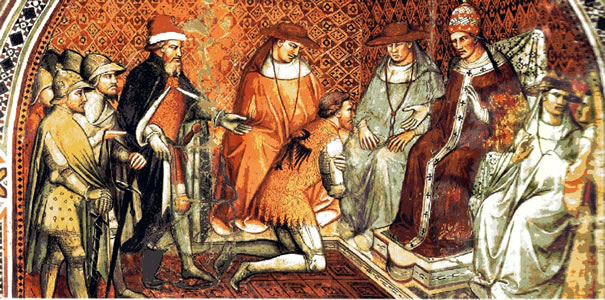
Fresco in Palazzo Pubblico, Siena depicting the submission of the emperor Frederick Barbarossa to the authority of Pope Alexander III
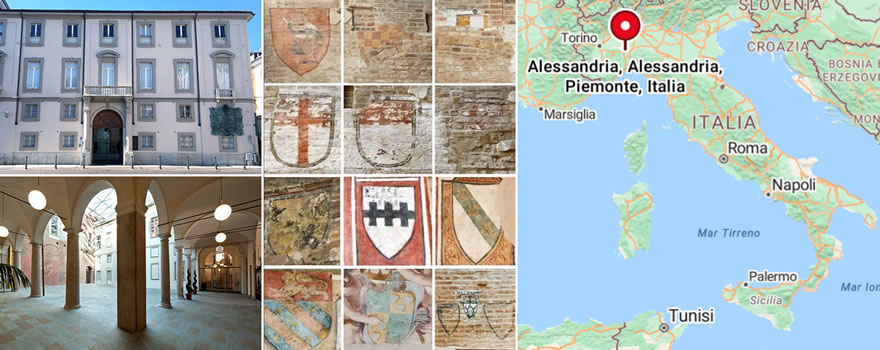
Palatium Vetus, Alessandria (Italy)
This page was last edited on 14 March 2026
© andmorestory.eu - All right reserved