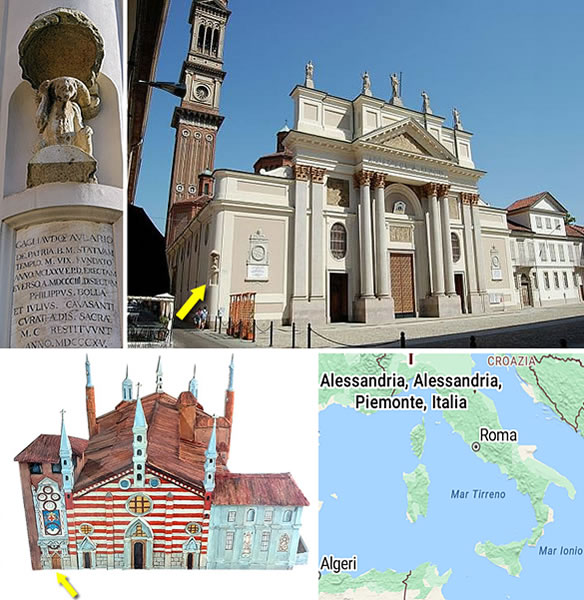
Sculpture of Gagliaudo with related inscription on the modern-day Alessandria Cathedral and on the old one.

Around the siege laid by Frederick I to Alessandria in the years 1174-1175, various popular traditions arose among the people, which eventually pieced together a story of the siege quite different from the true one. The historical facts refer to the fifth descent into Italy of Emperor Frederick I, who, after subduing Susa and Asti, encamped around Alessandria, confident of taking possession of it in a short time, since it had been founded only six years earlier. The city, born from the yearning for freedom of the Lombard League, had many enemies: Pavia feared its expansion, the Marquess of Monferrato wanted to regain possession of those territories, and the emperor was determined to destroy it to eliminate one of the symbols of the League's revolt against the empire. The decisive events took place during the Easter period: Barbarossa, fearing he would be trapped between the army of the besieged and the army of the League, which was arriving to aid the city, attempted to achieve success through treachery. He stipulated a truce with the Alessandrians valid for the three holy days of Easter, but used this time to have a tunnel dug that emerged inside the city. On the night of Good Friday, he attempted the sortie, but the sentries managed to alert the population in time: the treacherous attack was thwarted, and the Alessandrians, instead, threw open the city gates and attacked the enemy army, which scattered across the countryside, thus putting an end to the emperor's ambitions. This is the true story, which aligns with tradition up to the point where the city, suffering from a lack of provisions, was determined to seek salvation only through its own valor.
During the siege of 1174, which lasted a year, the people of Alessandria were at their limit. The city was at a crossroads: accept unfair terms to buy a shameful peace, or surrender to total ruin. While the Council of Elders was meeting at the Castle of Rovereto, a commoner came to their aid, devising a stratagem to save the city. This was the peasant Gagliaudo. A descendant of the noble but humble Aulari lineage, laden with years and wisdom, rich in cunning, he had spent his entire life grazing flocks and making cheeses. He devised a way to deceive the enemy and restore freedom to the city, without bloodshed. He owned a single heifer, a survivor of such scarcity. He began to feed it with the last grains of wheat salvaged from the city's granaries, both public and private. When the beast was plump and full of vigor, one evening he went out through the city walls, via the Genoa gate, to take the beast to graze. He led it right into the midst of Frederick Barbarossa's army. Greedy for plunder, the besiegers immediately lunged at it. Gagliaudo was imprisoned and the heifer was killed. Upon disemboweling the animal, the soldiers noticed that its entrails were full of grain and immediately informed the emperor, who promptly summoned the peasant for questioning. He confirmed to him that the city was well supplied with provisions and could hold out for many more months. Thus, Frederick Barbarossa realized he had made a grave error: he believed the people of Alessandria, after a year of siege, were reduced to starvation and on the verge of surrender, yet that heifer, fattened on grain, revealed that the city still had an abundance of food, and that conquering it would not be easy. The emperor decided to lift the siege and depart. As a sign of mockery, Barbarossa then called Alessandria the "City of Straw," not understanding that this very city, strong in the valor and ingenuity of its inhabitants, would soon inflict a stinging defeat upon him.
Today, during the Carnival period, Alessandria celebrates its folk hero, Gagliaudo: through the city streets, one can see a peasant pushing a cow with a prominent belly ahead of him. And in memory of its hero, on the left side of the facade (corner of Via Parma) of the present-day Alessandria Cathedral, there is a Romanesque sculpture depicting him carrying a small Lodi cheese on his shoulders. Previously, it was located on the small door of the old Cathedral's bell tower. When that was demolished in 1803, the bas-relief was initially placed in a warehouse and in 1815 was positioned on the corner of the square with the following inscription:
GAGLIAUDO AULARIO / DE PATRIA B. M. STATUAM / TEMPLO M. VIX FUNDATO / ANNO MCLXXV E.P.D. ERECTAM / EVERSO ANNO MDCCCIII DISIECTAM / PHILIPPUS BOLLA / ET JULIUS CAVASANTI / CURATORES AEDIS SACRAE / M.C. RESTITUERUNT / ANNO MDCCCXV
To Gagliaudo Aulario, who had the statue of the Blessed Virgin erected at his own expense in the newly founded temple in the year 1175. When it was destroyed in 1803, Filippo Bolla and Giulio Cavasanti, wardens of the sacred edifice, restored it here in the year 1815.
At the beginning of the twentieth century, a rumor spread, probably a well-crafted prank, that the sculpture had been seen moving and even shouting on nights with a full moon.
Sculpture of Gagliaudo with related inscription on the modern-day Alessandria Cathedral and on the old one.
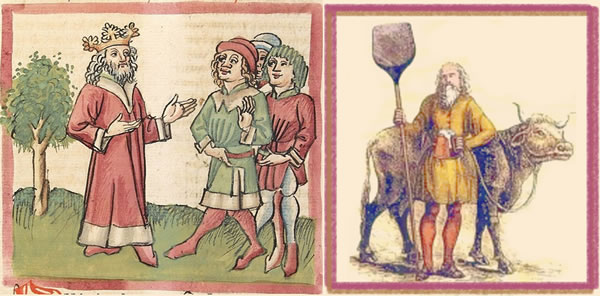
Frederick depicted with three subjects (circa 1460) and Gagliaudo Aulari with his famous cow
This page was last edited on 14 March 2026
© andmorestory.eu - All right reserved