Giuseppe Mayno

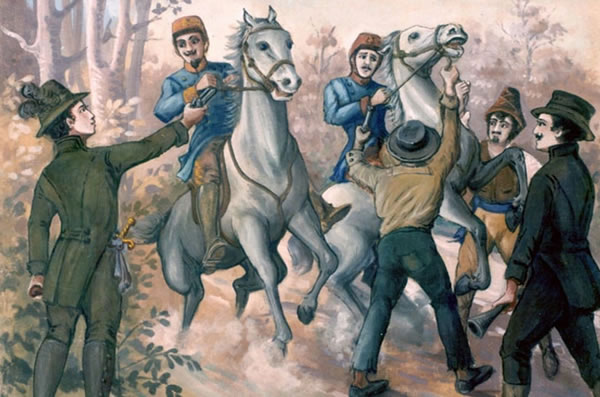
In the early nineteenth century, Napoleon's regime had consolidated its power almost everywhere, and pockets of resistance had grown fainter. Even Piedmont, after long struggles, seemed to have resigned itself to the situation. Despite this, there was one brigand who gave the French a run for their money. His fame spread from the Piedmontese Alps to the Ligurian Apennines. The people lauded him, considering him a gentleman bandit who fought against the invaders and protected the weak. The French did everything in their power to flush him out, even going so far as to clear-cut hectares of land where he and his band hid: an impenetrable thorny maze where everything would vanish, and which the French were afraid to enter. Many are the anecdotes: it is said that one day he attacked the papal procession heading to France, and did so again on its return, but this time to ask for forgiveness; on another occasion, he disguised himself as a gendarme and roamed around Alessandria, even hitching a ride on the carriage of the chief of police, engaging him in a discussion about the brigandage problem, undoubtedly displaying remarkable knowledge of the subject. Another time, thanks to his informants, he managed to ensnare none other than the Minister of Police, Antoine Christophe Saliceti, a man dear to Napoleon. He released him after robbing him, though he left him, at the minister's request, a precious ring, a memento from a Genoese lady. But Mayno also delighted in mocking Napoleon himself, proclaiming himself "King of Marengo" and "Emperor of the Alps." This was Giuseppe Mayno, the most famous bandit of Monferrato. He had formed a band of brigands destined to go down in history for their daring deeds, composed of a permanent core of over forty mounted men and more than two hundred on foot, all organized along military lines. In the ranks of Mayno's band, one could find not only drifters or adventurers but also wealthy cattle merchants, landowners, tenant farmers serving the high nobility, farm laborers, tailors, farriers, innkeepers, carters, and even a police commissioner, a lawyer, and a parish priest. The band could also count on the occasional participation of many others and on a dense network of contacts and protectors within the police and government bodies. According to popular tradition, he was forced to become a brigand due to a foolish love affair and soon became feared throughout the region. Later, surprised by a gendarme ambush while sleeping with his wife, he managed to escape, but wounded in the heel, he chose to kill himself rather than fall into the hands of the soldiers.
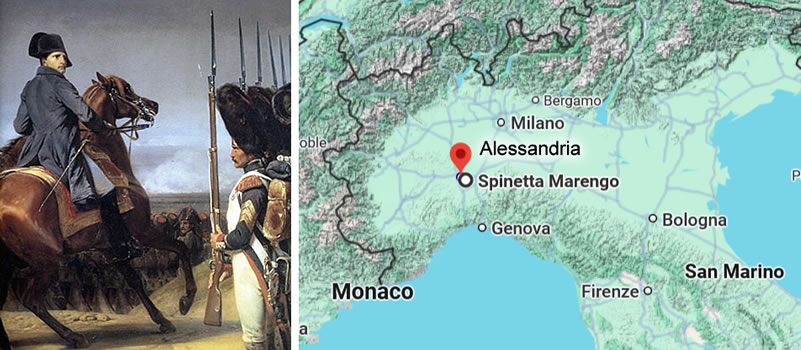
Giuseppe Mayno was born in Spinetta Marengo, around 1780, into a family of small-scale farmers. For a time, he had studied at the seminary, from which he left, intolerant of any discipline. When Republican France attacked Piedmont, Mayno enlisted as a soldier in the Tortona regiment. Forced to take to the maquis following an act of insubordination, he remained away from Spinetta for several years, during which he fought among the "Barbetti" under the command of Violino, a man famous for his ferocity against the invaders and his generosity towards the populations loyal to the House of Savoy. Mayno formed his own band in 1803, shortly after returning to Spinetta, and became a nightmare, primarily for the French and their collaborators. The theater of his deeds was a large area in the Alessandria region, between Alessandria, Novi Ligure, and Tortona, as well as some areas of Liguria. Mayno loved to mock the French, helped by the fact that he spoke their language very well.
To hunt him down, their top man in the fight against "bandits," a certain Galliot, who had already distinguished himself in France, was sent to Alessandria. He was the commander of the 56th Squadron of the Imperial Gendarmerie. After months of intense work, Galliot managed to track down the brigand and surrounded the house where he was hiding with many of his men. Mayno could not escape and was killed. His death was announced to the prefect of the Montenotte department:
Finally, the famous Majno ended his tragic scenes yesterday at five o'clock, having been killed at Spinetta... but he did not fail to put up a terrible defense, having killed a lieutenant of the Gendarmes, one gendarme, and mortally wounded three others.
The bandit's body, completely disfigured "by the heavy blows [...] of sabers, pistols, and rifles," was laid out in the courtyard of the Alessandria prefecture. Many came to pay their last respects. After his death, it took more than a year to completely break up his band. Some were killed; most were captured and sentenced to long prison terms or death.
Giuseppe Mayno
Napoleon
This page was last edited on 14 March 2026
© andmorestory.eu - All right reserved