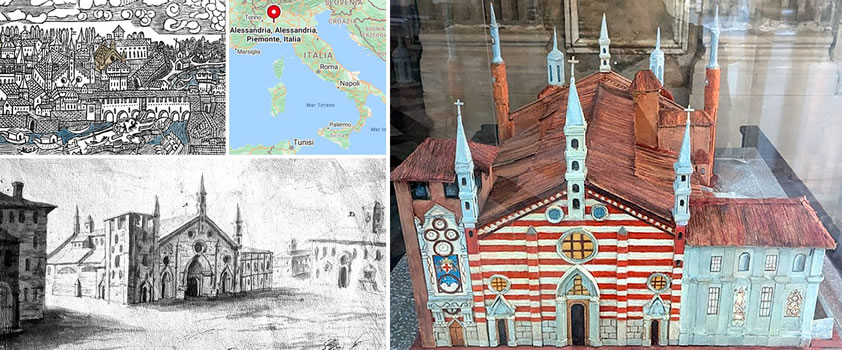
St. Peter’s Cathedral in Alessandria (Italy)

In 1802, Napoleon ordered the demolition of Alessandria’s old cathedral, St. Peter’s, built between 1170 and 1175, to make room for a large military parade ground. The building was deemed an obstacle in the city’s new urban layout. Thus, in the very first days of 1803, an appraiser was tasked with calculating the compensation owed to Alessandria, and two advisors were appointed to draw up an inventory of the furnishings and movable objects belonging to the cathedral, in order to prevent loss, concealment, theft, or vandalism. On January 7, the church was permanently closed to worshippers, and the church of St. Alexander was designated as a provisional cathedral, despite its small size and cramped quarters. However, since it still lay bare and desecrated—awaiting urgent cleaning and decoration before it could be returned to worship—the nearby convent church of the Santissima Annunziata was chosen to house the movable furnishings of St. Peter’s.
Almost in secret, at midnight, the miraculous statue of the Blessed Virgin of Salve was transferred there without ceremony or illumination. The following morning, at dawn, the same church received the Blessed Sacrament, carried in procession by the canons, accompanied by a large group of faithful and lighted torches. On February 17, the temporary cathedral was finally reopened, and a solemn procession—setting out from the church of the Annunziata—composed of priests and canons in choir robes, returned the Blessed Sacrament and the most venerated relics of the True Cross and the Holy Thorn to the newly renovated seat. On January 31, 1803, military engineers placed several explosive charges at strategic points in the masonry to bring about the collapse. Although some of the mines failed to detonate as intended, and although the sturdy medieval structures sometimes withstood the assaults, the sustained use of explosives, ropes, pickaxes, and iron bars led to a complete collapse after one month, leaving a shapeless heap of ruins. Subsequently, laborers sorted through the debris, separating salvageable materials from those irreparably damaged, recovering usable bricks from the remains of centuries-old mortar, and saving wooden beams and iron fittings. The rubble was carted away in hundreds of wagons, destined to be reused as fill for fortification embankments, as stone blocks for the bridge over the Bormida, and as limestone slabs for the floors of warehouses and military quarters.
The Napoleonic spoliations were a series of seizures of artworks or valuable objects, carried out by the French army or by French and Napoleonic officials in Italy, Spain, Portugal, the Netherlands, Belgium, and Central Europe during the Napoleonic era. Although they take their name from Napoleon Bonaparte, the order to initiate them came from the Directory, and their continuation was due to various officials of the Republic and the Empire. The spoliations were perpetrated continuously over a span of twenty years, until 1815. According to historian Paul Wescher, the Napoleonic spoliations represented “the greatest displacement of works of art in history,” which also caused considerable damage, as “it is difficult to determine exactly how many uniquely valuable works of art were destroyed or lost in those days.” In Italy, the Napoleonic spoliations degenerated into theft and speculation by officials of the new state. French officers melted down artworks to extract gold and silver; on several occasions they attempted to develop techniques to detach frescoes, causing significant structural damage both to the artworks and to the walls. Perhaps St. Peter’s Cathedral suffered a similar fate. The fact remains that it once housed a painting, by an unknown artist, depicting St. Peter appearing to Frederick Barbarossa—a work that disappeared after the demolition. The episode portrayed in the painting occurred during Barbarossa’s siege of the city. As the attackers were about to seize Alessandria through a secret passage, St. Peter appeared to them mounted on a white steed, holding the keys to Paradise in one hand and a threatening sword in the other. The Germans took fright, and the people of Alessandria were able to slaughter them and repel the attack. Clearly, this time the saint had failed to frighten off the French.
St. Peter’s Cathedral in Alessandria (Italy)
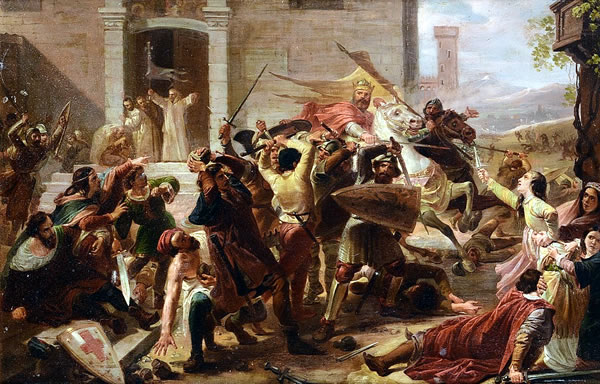
Painting from 1851 by Carlo Arienti, depicting an episode from 1175: the expulsion of Emperor Barbarossa from Alessandria.
This page was last edited on 14 March 2026
© andmorestory.eu - All right reserved