Three Saints, an Angel, and a Rooster
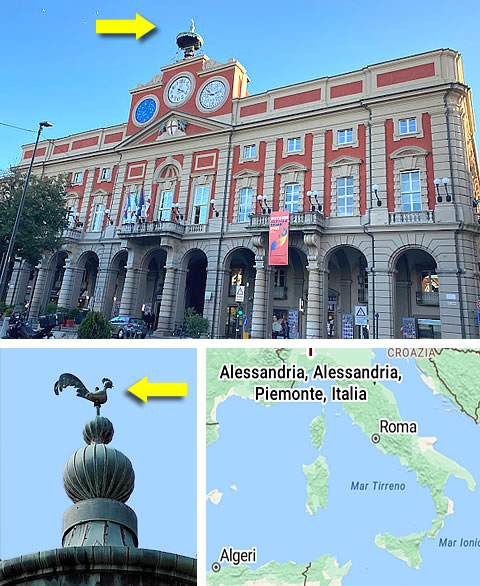
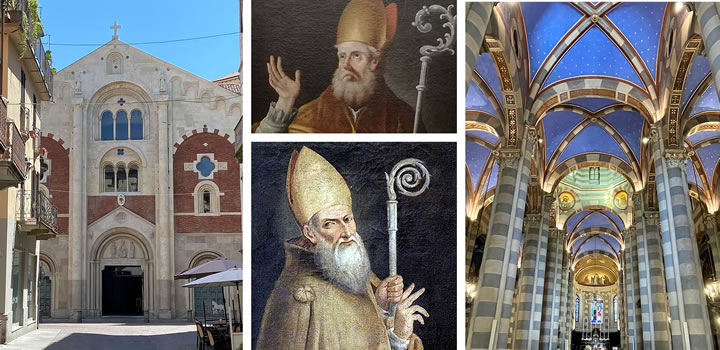
According to folk tradition, in 1215 the inhabitants of Alessandria, with the help of those from Vercelli and Milan, occupied Casale Monferrato and other lands in the Monferrato region. The looting and violence were boundless. Many inhabitants were slaughtered, their women raped. Having put everything to the torch, they carried off a rich bounty, including the bodies of Saints Proietto of Imola, Evasio, and Natale, an angel, and a rooster, which were placed in the old cathedral of San Pietro in Alessandria, where they remained until 1803, the year the cathedral was demolished by order of Napoleon. Subsequently, the bodies of the three saints were returned to Casale Monferrato. The little rooster was placed on the spire of the clock on the municipal palace, where it can still be seen today. The angel, however, was initially put in a storage room, then disappeared, no one knows how; it is thought to have been stolen on commission by some antique dealer.
Alessandrian historiography sought to justify the violent episode of 1215 by resorting to Old Testament biblical references: Casale Monferrato had been destroyed like the proud biblical cities of Amalek and Jericho, which were annihilated by the Hebrew people by divine order.
1215 - To avenge their own citizens killed by the Casalesi, emboldened by the memory of the damages suffered, [the Alessandrians] went powerfully with people given to them by the Milanese, Tortonesi, and Vercellesi, their confederates, under the command of Count Thomas of Savoy, elected by these Alessandrians as their own captain, to Casale; which, besieged, saw many bloody battles during the siege, always with the worst outcome for the Casalesi; whence Casale, greatly weakened by this, was attacked by a great multitude of Alessandrians, and with the defenders opposing their onslaught in vain, Casale fell on the second of August into the hands of the Alessandrians; who, as if with a command equal to that with which, according to what the sacred History of Kings narrates, God commanded Saul that, conspiring for the ruin of the proud city of Amalek, he should make a most cruel slaughter without any regard for age or sex, as if the god Mars had so ordered them; they put it to fire and blood with cruel slaughter of every age and sex, finally desolating it to its very foundations; which, ruined and destroyed, another Jericho demolished by divine command, and its rebuilding forbidden under grave penalty; they prohibited rebuilding it with a public edict, willing that it should remain desolate and uninhabited forever. The glorious bodies of Saints Evasio, Natale, and Proietto, with all the treasure of the church of Casale, they then carried to their city of Alessandria.
- G. Porta, L’alessandrina tetracty overo la quatternità d’Alessandria, Milan 1670
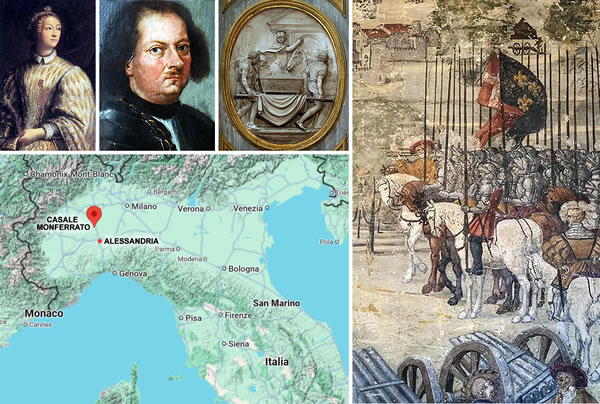
About two centuries passed when the opportunity for Casale Monferrato to take its revenge arrived. On September 6, 1403, Alessandria rebelled against the Visconti. In the following days, Caterina Visconti (1362-1404), Duchess of Milan, made the decision to suppress the revolt, relying on the arms of the Italian condottiero Bonifacio Cane (1360-1412), known as Facino (1360–1412), who began preparations for the military expedition. News of these preparations, immediately transmitted to Casale and skillfully managed there by the Cane clan, mobilized the local municipality not only to favor the enlistment of men for what was shaping up to be a military-predatory operation, but also to plan, within its framework, an action of great importance from a municipal and religious perspective: the recovery of the relics of the three saints long held by the Alessandrians. The military operation against Alessandria was led by Facino with speed and success: by the evening of September 21st, he already held the rebel city firmly in his grasp, except for Borgoglio. The news immediately bounced back to Milan; and the following day, Duchess Caterina transmitted it to the Lombard city authorities, inviting them to celebrate with illuminations and the ringing of bells. The relics were kept in the church of San Pietro and were objects of great veneration by the Alessandrians. The episode of the retrieval, or rather the belief in the retrieval, was set in motion. However, the episode of the finding of the relics of Saints Natale and Proietto in the Casale cathedral is well documented by the "Liber Capituli," ACCM, CSE, file 16-4:
M° CCCCXXVIIII, VII Indiction, day XIII October. For the purpose of wanting to rebuild a chapel called the Chapel of San Natale as the Chapel of Sant'Antonio, a lead box was found in which was written on a certain lead tablet: "These are the relics of Saint Natale." Likewise, on the second day, a certain box was found in which was written: "This is the body of the blessed martyr Proietto, disciple of the blessed Evasio." In honor of the blessed Anthony and the blessed Natale and Proietto, the consecration of the altar of that chapel took place from the feast day of San Gallo by Lord Brother Proculus, bishop of Conobiensse, suffragan of the reverend in Christ father and lord, Lord Ibleto di Fieschi, by the grace of God and the Apostolic See, bishop of Vercelli and count. During the time of Lord Iacopo de Bezinis, provost; Lord Imoneto de Grassis, vicar; and the canons of this church, Lord Benedetto de Sarazenis, Lord Ranieri de' Medici, Lord Agostino de Bezinio, Lord Garvagno de Bazanis, and Lord Antonio de Reniate; and during the time of Antonio Otarelli, prior of the said confraternity; and many others of whom no mention is made here, etc.
But history, at times, plays tricks that only centuries reveal. Only the relics of Sant'Evasio actually came from the Casale cathedral. The others, of unknown identity, did not correspond to the Casale relics of Saints Natale and Proietto. These, in truth, had never been removed from their original site but had remained buried, in 1215, under the rubble of the cathedral of San Pietro, which the attackers had severely damaged; and not having been found during its subsequent reconstruction work, it was believed that they had been stolen together with those of Evasio. The misunderstanding was only clarified in 1429, when two lead boxes containing sacred relics were fortuitously found during the renovation work of a chapel in the Casale cathedral; boxes marked respectively with the inscriptions: "These are the relics of Saint Natale" and "This is the body of the blessed martyr Proietto, disciple of the blessed Evasio." Naturally unaware of this misunderstanding, those in charge of the recovery thus removed from the Alessandrian church the relics of the three saints, all deemed equally authentic. The relics and sacred furnishings were then transferred and secured in Borgo San Martino, pending their solemn transfer to Casale. The devastating sack of houses and the coming and going of merchants who had poured into the city from the surrounding area to scoop up the spoils of the robberies. Bent and humiliated by harsh impositions, Alessandria would not be able, in the immediate future, to raise its head again. The victors, therefore, had the leisure to organize the celebrations for the solemn translation of the relics from Borgo to Casale. The date of the event was set for October 7th. There was an impressive mass religious manifestation, whose complex organization could not ignore a master plan: starting with the welcome in Borgo San Martino for the large crowd of participants gathered there from nearby localities and Casale; ending - after a processional route of over 8 kilometers, lasting 4/5 hours - with the solemn ceremonies of the reposition and veneration of the relics in the Casale cathedral. A well-orchestrated crescendo of self-celebratory scenographic moments, sanctioned by the sacredness of that exceptional religious rite. Today, in the Cathedral of Casale Monferrato, Saints Evasio (patron saint of the city), Natale, and Proietto are venerated, and no one wonders anymore whether the relics of the latter two are truly those of Evasio's disciples or of other unknown martyrs. What remains is the story of a clever ploy, a centuries-old misunderstanding, a lost angel, and a rooster that still marks time over Alessandria.