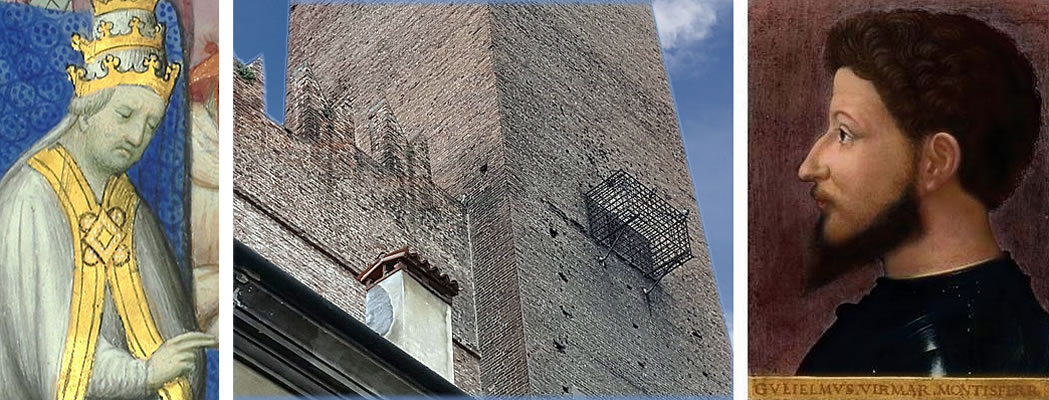
Portrait of Pope Nicholas IV and William VII, Marquis of Montferrat

The capture of William VII of Montferrat (1254-1292) by the citizens of Alessandria, incited by the Astigiani, in 1290, and his death in prison in 1292 are well-known events. William VII "Longsword," Marquis of Montferrat from 1253, was born in 1240 to Boniface and Margaret of Savoy. He extended his domains as far as the occupation of Milan, an expansion that brought him into conflict with the House of Savoy and Matteo Visconti. Having gone to Alessandria to enlist reinforcements, he fell into a trap: lured to Alessandria with a small escort, he was instead taken prisoner. Locked in a cell in the dungeons of the Palatium Vetus (then seat of the medieval commune), he was placed in an iron (or wooden) cage, suspended off the ground to be exposed to public ridicule. After almost two years, he died of starvation and hardship at the age of fifty-two. To leave no doubt about his actual death, his jailers dripped liquefied lard and lead into his mouth. It is also said that his body was displayed in the square on a bed, and that it remained there for an entire day so that everyone could see that he was truly dead. His body, never identified to this day, was returned to his subjects, who entombed it in the Cistercian Abbey of Santa Maria di Lucedio, where his father was already buried.
During the 13th century, Italy was torn apart by fierce internal struggles between the Guelphs and Ghibellines: the Guelphs supported the Papacy, while the Ghibellines backed the Holy Roman Emperor. The Marquis William VII of Montferrat was a bold and ambitious baron determined to rebuild the shattered greatness of his lineage, the Aleramici. Over time, he was feudatory, lord, and military captain of a great number of territories and cities: Pavia, Vercelli, Novara, Alessandria, Tortona, Alba, Genoa, Turin, Asti, Brescia, Milan, Cremona, and Lodi, to name a few. He pursued a shrewd and unscrupulous policy of alliances based on convenience: allied either with the Torriani, or the Visconti, or the Guelphs, or the Ghibellines, one day a friend of King Charles of Anjou, another day at war with him, all for the love of power. Between 1260 and 1290, he became one of the most powerful men on the scene in Northern Italy and beyond. Faced with the overwhelming power of the "Grand Marquis," however, the first rebellions had begun. In 1290, William VII was taken prisoner, but there are several versions of how it happened. The Alessandrian chroniclers recount that the marquis was captured in a clash that occurred between Castelletto and San Salvatore Monferrato: he had gone to Alessandria to enlist reinforcements, and on that very occasion, the Alessandrians, after convincing him to enter the city accompanied only by a modest escort, captured him by throwing a long gold chain, a symbol of the money that changed hands at that moment. Other sources, perhaps more reliable, maintain that the Astigiani paid the Alessandrians a full 85,000 gold florins to put an end to the Grand Marquis. So the Alessandrians lured him into the city on a pretext and imprisoned him. He never left the prison alive, despite appeals from across Europe. Montferrat found itself abandoned and defenseless. Only Nicholas IV (1227-1292), the first pope belonging to the Franciscan Order, showed concern for William's fate. He urged that the marquis be freed and entrusted to the Bishop of Orvieto, whom he charged with escorting him back to his lands; he recommended that the Genoese support his pleas with the Alessandrians; and he ordered the Bishop of Orvieto to go there in person, to do everything possible, eventually even using ecclesiastical censures, to settle the matter, and, if successful, to have the marquis offer suitable guarantees to the Alessandrians to protect them from the vengeance of the freed man. Alessandria was deaf even to papal invocations; certainly, behind Alessandria, Asti, the Visconti, and the Count of Savoy were pressing in the opposite direction, determined not to release the marquis until all the political advantages offered by the occasion were secured, and William was reduced to a state where he could no longer cause harm.
His son John I decided to avenge him by attacking Alessandria, which, thanks to the help of Matteo Visconti, managed first to resist and subsequently to launch a harsh counter-offensive that brought devastation and looting to the lands of Montferrat and Canavese.
Portrait of Pope Nicholas IV and William VII, Marquis of Montferrat
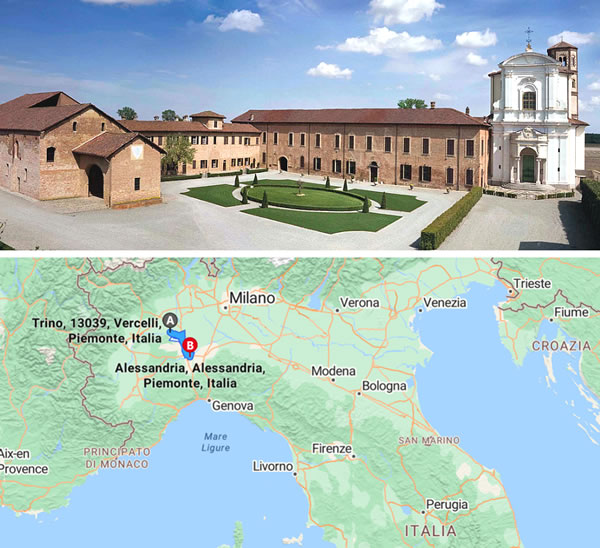
Cistercian Abbey of Santa Maria di Lucedio, Trino (Vercelli, Italy)
This page was last edited on 14 March 2026
© andmorestory.eu - All right reserved