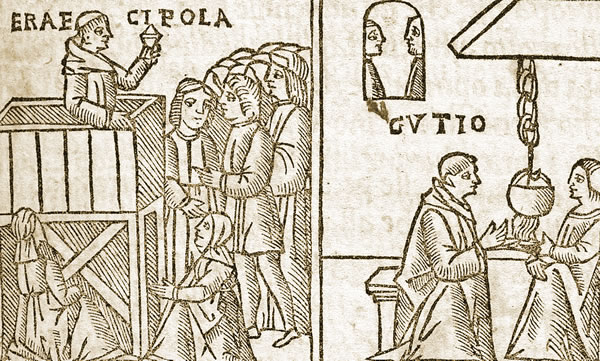
Novella of the Decameron by Giovanni Boccaccio (VI, 10)

Since the 11th century, the famous Hospice (hospital) of Altopascio for pilgrims was located along the Via Francigena on the stretch known as the Via Francesca Romea, between Lucca and the Arno crossing point. This was one of the most important medieval pilgrimage routes, leading from Rome to France and then continuing on to England.
In 1239, the Domus Hospitalis Sancti Iacobi de Altopassu became the centre of the Hospitaller order, which oversaw road maintenance and assisted pilgrims and wayfarers. It was the first medieval institution of its kind, serving as a model for others that later sprang up in various parts of Europe; it had a branch in Lucca, one in Pescia, and another in Paris, for pilgrims coming and going from Santiago de Compostela.
Adjacent to Piazza Ospitalieri is the church of Santo Jacopo Maggiore and its bell tower. This is a beautiful crenellated tower, with four orders of mullioned windows featuring marble colonnettes topped with capitals, adorned with various carved corbels in the shape of animals and human figures; at the four corners, supported by protruding corbels, one can see the symbols of the Evangelists. This highly important monument bears the date 1280. Preserved in the tower is the ancient bell known as "la Smarrita" (the Lost Bell), which bears a now-illegible inscription with the date 1327. For centuries, the bell served to summon pilgrims and wayfarers who had lost their way in the thick fogs of the area, amidst the dangerous forests of the Cerbaie or the Bientina marsh that once surrounded the hospice, areas once teeming with wild beasts and criminals. Indeed, ringing at dusk continuously for an hour, together with a great lighted torch on the loggia, it showed the way to anyone who was lost. The Smarrita is currently rung once a year, during the festivities for the patron saint, St. James the Greater.
Altopascio takes its name from a nearby stream now called Tassinaia and once known as Teupascio, which marked the border between the domains of Florence and those of Lucca. The place is famous in Tuscan history for the battle fought there in September 1325, between Castruccio, Lord of Lucca, and the Florentines, who were completely defeated. But its true and lasting glory is the famous Hospice. It was built before the 11th century (first mentioned in 1084), in those then-wild and perilous places, for the convenience of pilgrims and wayfarers. Its purpose was to provide assistance to pilgrims and to maintain the road itself.
Around the Hospice, which soon became extremely wealthy, the town grew up which, despite that continuous and open example of charity and peace, waged and sustained, like all the castles and towns of that time, long and fierce wars with the neighbouring communities, especially with Buggiano.
When the Hospice became important, in order to fulfill the functions for which it was established, the religious and chivalric order of the Knights of the Tau was founded, perhaps the oldest in Europe.
According to tradition, it was created by twelve knights, citizens of Lucca or prominent men (probably "the choir of twelve" mentioned in the vernacular rule). While many scholars maintain that the legendary Grand Duchess Matilda of Tuscany (Matilda of Canossa) (1046-1115) was the founder, there is no certainty beyond popular tradition. Certainly, she owned a splendid property near Altopascio, the Vivinaia, in the vicinity of Montecarlo di Lucca. She was a cousin of Godfrey of Bouillon, the founder of the Knights of the Holy Sepulchre, and was very active in providing assistance to pilgrims and the needy, founding numerous hospitals in the territories under her control.
The Order of the Knights of the Tau also engaged in belligerent activities, but to a lesser extent compared to other chivalric orders. Primarily, the friars of Altopascio, or of the Tau, initially followed the Rule of Saint Augustine. They were responsible for assisting pilgrims, maintaining roads and navigable waterways; furthermore, they also oversaw the construction and maintenance of bridges, which attests to the high technical and organizational level they achieved. Their skill is documented by the construction of bridges for crossing various rivers along the Via Francigena, such as the Arno, the Elsa, the Usciana, the Taro, and the Arda.
In 1239, they were assimilated into the Rule of Saint John of Jerusalem by a bull of Pope Gregory IX, who named them an "order under the equestrian rule" of the Hospitallers of Jerusalem. The pope became the depositary of the benefice, meaning the institution's assets, and the right to invest the grand master; the friars retained the patronage right, i.e., the right to present the commendatory abbot or patron. In 1459, Pius II (1405-1464) dissolved the Order of the Knights of the Tau and ordered the confiscation of its assets, to merge them with those of the Congregation of Bethlehem, which he had established. However, thanks to the resistance of the Grand Master Giovanni Capponi, who refused to obey, it survived until February 20, 1587, the date of the suppression of the Magistracy of Altopascio and the perpetual dissolution of the entire Order, which was merged into the Order of the Knights of St. Stephen by Cosimo I de' Medici (1519-1574), who held its assets in commendam.
However, no further mention of the friars is found after 1456, and with the death of Giovanni Capponi, a new and thorny situation arose in the Grand Magistracy of Altopascio: Cosimo I made it known to the Capponi family, and obtained their agreement, that he wished to present a person of his liking for the top responsibility of that ancient institution. Ugolino Grifoni (1504-1576), already Secretary to the Grand Duke and the Lady Mother, proved to be the key man, destined to cover the political, military, and even more significant economic and landholding interests linked to the Hospice of the Knights of the Tau. Ugolino Grifoni's appointment to the title was sanctioned by Papal Bull in 1540.
An indirect testimony to the generosity of the friars can be found in the tenth novella of the sixth day of the Decameron, where Boccaccio, using a certainly proverbial expression, mentions the 'calderone dell'Altopascio' (the Altopascio cauldron). In this novella, Boccaccio, exalting the cunning and inventiveness of Friar Cipolla, develops one of the great themes of the Decameron, namely that of human intelligence, which knows how to resolve the intricate situations that Fortune presents to us. This is especially evident in Friar Cipolla's famous speech. In the tale, told by Dioneo, Friar Cipolla goes to Certaldo, a town near Florence where he goes once a year to collect offerings from the devout, swindling them thanks to his very fluent speech. In introducing him, Boccaccio already emphasizes this characteristic by resorting to exaggeration, stating that anyone who didn't know the friar, hearing him speak, might mistake him for Cicero or Quintilian, great masters of ancient rhetoric. On this occasion, Friar Cipolla even declares to the naive faithful that this time he will show them a very important relic: a feather from the wings of the Archangel Gabriel, which fell at the moment of the Annunciation to the Virgin Mary. However, upon hearing this solemn declaration, two friends of the friar from Certaldo, Biagio Pizzini and Giovanni del Bragoniera, decide to play a salacious trick on Cipolla and head towards his lodging. Guccio Imbratta, Friar Cipolla's servant who was supposed to guard the fake relic, had wandered off; he had gone to the kitchen to try to seduce a cook named Nuta.
Guccio Imbratta, who was more eager to be in the kitchen than a nightingale upon the green branches, especially if he caught sight of any wench there—having spotted one in the innkeeper's kitchen, fat and dumpy and ill-made, with a pair of breasts like two dung-baskets and a face like one of the Baronci, all sweaty, greasy, and smoke-begrimed—no differently than a vulture throws itself upon carrion, he left Friar Cipolla's room open and all his things unattended, and descended upon her. And although it was August, he sat himself down by the fire and began to chat with this woman, whose name was Nuta, telling her that he was a gentleman by procuration and that he had more than a thousand-nine hundred florins, besides those he had to give to others (which were rather more than less), and that he knew how to do and say so many things that the Lord only knew what. And without regard for his hood, upon which there was so much grease that it would have seasoned the cauldron of Altopascio, and for his doublet, torn and patched and enameled with dirt around the collar and under the armpits, with more spots and more colors than any Tartar or Indian cloth ever had, and for his shoes all broken and his stockings all torn, he told her, as if he had been the Lord of Castiglione, that he wanted to reclothe her and refit her and rescue her from that wretchedness of serving others, and without possessing great wealth, lead her to hope for a better fortune, and many other things, which, although he said them most affectionately, all turned to wind, as did most of his undertakings, and came to nothing.
Biagio and Giovanni thus took advantage of the friar's room that Guccio was not watching, stole the feather, which to their un-naive eyes was clearly revealed to be "a feather from the tail of a parrot," and replaced it with coals. At the moment of the sermon among the faithful, including the two pranksters, Friar Cipolla, unaware of the trick played behind his back, announces to the believers that he is about to show them the Archangel's feather. When, upon opening the box, the friar finds the coals inside, he, endowed with a marked oratorical and storytelling ability, manages to justify the incident, turning it to his advantage through an improvised but highly effective sermon. Friar Cipolla first recounts a mythical journey of his to the East, all the way to the Holy Land, where he claims to have seen with his own eyes thousands of incredible relics, which he lists to astound his naive listeners. Thus, the coals can be passed off as those from the martyrdom of St. Lawrence, and the fact that Cipolla has them with him instead of Gabriel's feather is obviously explained as the result of divine will (given that the feast of St. Lawrence, August 10th, is approaching). After Friar Cipolla's rhetorical "spectacle" concludes and the faithful disperse, Biagio Pizzini and Giovanni del Bragoniera approach the friar to compliment him and return the feather to him.
Novella of the Decameron by Giovanni Boccaccio (VI, 10)
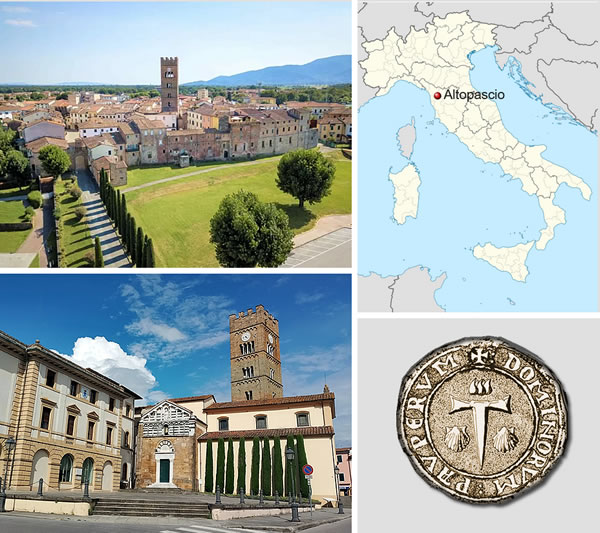
The Church of Santi Jacopo Maggiore and the coat of arms of the Knights of the Tau - Altopascio (Lucca, Italy)
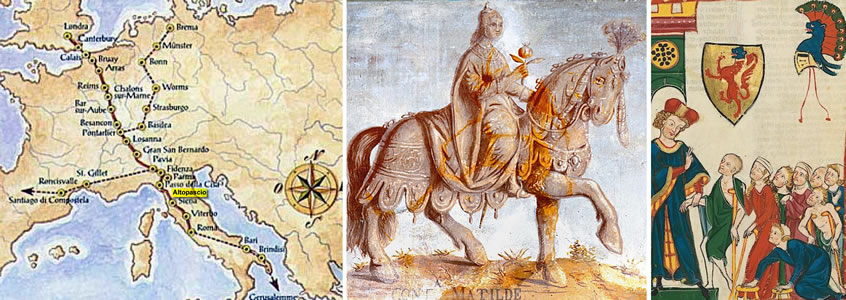
Map of the Via Francigena - Unpublished portrait of Matilda of Tuscany (Matilda of Canossa) - Codex Manesse, Hesso von Reinach (c. 1300)
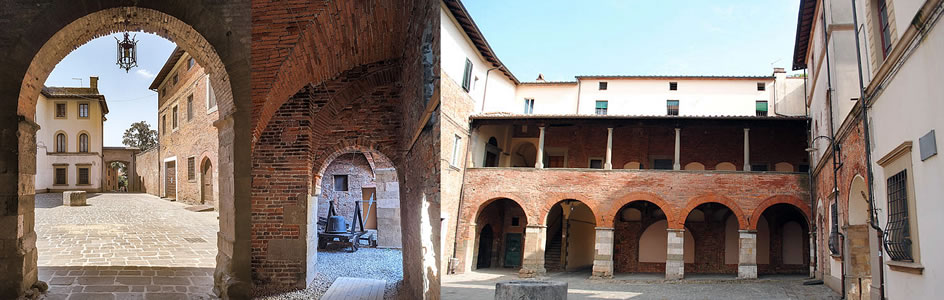
Piazza Ospitalieri - Altopascio (Lucca, Italy)
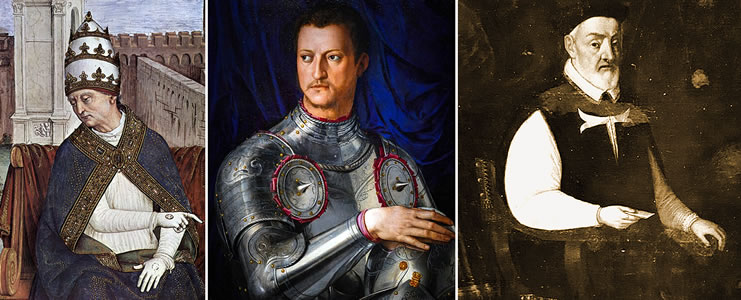
Pope Pius II (1405-1464) - Cosimo I de' Medici (1519-1574) - Ugolino Grifoni (1504-1576)Pope Pius II (1405-1464) - Cosimo I de' Medici (1519-1574) - Ugolino Grifoni (1504-1576)
This page was last edited on 14 March 2026
© andmorestory.eu - All right reserved