Lair of the Serpent, Punta Bianca, Ameglia (La Spezia, Italy)

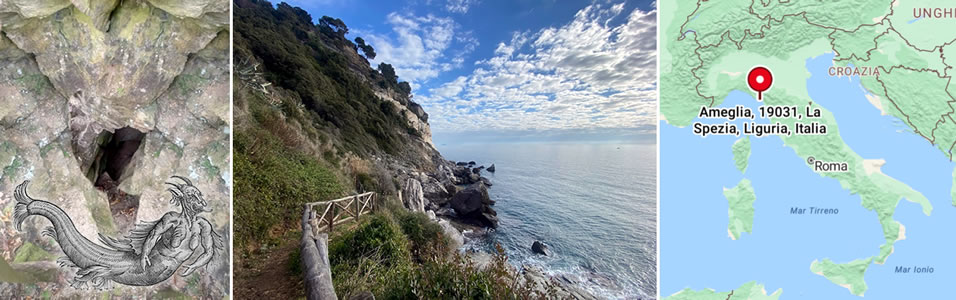
Punta Bianca (White Tip) is a magnificent limestone cliff in the Ameglia area, in the province of La Spezia, located below the village of Montemarcello. It contains about thirty natural cavities, with a total length of just over a kilometer, situated from sea level up to 358 meters in altitude. Its relatively difficult access, either by sea or along a often rugged path, has preserved its wild appearance and made it a destination for trekking enthusiasts and lovers of unspoiled nature. From Montemarcello, a dirt road leads to Punta Bianca which, as it descends, becomes a proper trail and reaches the beach of smooth, flat white rocks—hence the name—that attracts many tourists.
Near Punta Bianca, in a seaside cave still called the "Lair of the Serpent" (Tana del Serpente), lived the most frightening dragon the world had ever seen. Every day it would descend towards nearby Luni, devouring anyone it met, or slip into the sea and capsize ships. All attempts to get rid of it had failed; the inhabitants of the Luni countryside then asked for help from Saint Venerius, who dwelt on the island of Tino. At the Saint's injunctions, the monster emerged from its lair and, letting out piercing hisses, sank forever beneath the waves.
The legend of the Serpent of Punta Bianca dates back to the end of the 6th century. The terrible creature, a symbol of evil and paganism, poisoned the entire promontory with its mephitic breath and prevented boats from rounding the headland of Punta Bianca. Until one day, a young local man had his betrothed kidnapped by the terrible monster itself. Not knowing who to turn to, he found help from the hermit of Tino, namely Saint Venerius (circa 560-630), who promised to assist him.
The Saint, full of zeal, gathered in prayer right on the cliff of Punta Bianca. So great was this man's faith and so powerful the ardor of his prayer to God, that his body was enveloped in flames, a symbol of the Holy Spirit and a symbol of the new faith that, with his miracle, would blaze in the hearts of the poor inhabitants of the promontory. Thus, as he stood in prayer with his arms raised to heaven, the monster, suffering terribly and writhing in pain, descended back into hell, disappearing into the abyss.
Obviously, the girl was saved, and the young couple was able to marry. On the site of the miracle, the footprints of Saint Venerius remained imprinted, as did the cave inhabited by the monster, still known today as the "Lair of the Serpent," which can still be visited.
Saint Venerius was a hermit who lived between the 6th and 7th centuries. He was born around 560 to illustrious parents on the island of Palmaria (Gulf of La Spezia). Applying himself to his studies, he succeeded marvelously; but his greatest progress was in virtue, whereby, disgusted with his brethren and thirsting for solitude, he withdrew to the monastic observances that flourished on the island of Palmaria.
His exceptional qualities, and even more so the great miracles he performed, attracted people from the nearby mainland; and he, who feared nothing so much as the fame of his own name, hid himself in a secret place in Corsica, until for some unknown reason he decided to return. He then settled on the island of Tino.
On the island, Saint Venerius dedicated himself to prayer, nourishing himself only on what it had to offer (wild herbs and fruits). After years in solitude, a man nicknamed Agrestius arrived following a divine vision in which he was ordered to go to the island, seek out the servant of God, and do everything he asked. Having found him, Saint Venerius taught him and asked him to follow the paths of Charity and Virtue, but the man admitted he was unable to do what was asked, so he asked him to send him a rake and a barley plant. Having received what he requested, he proceeded to sow the barley. Although the harvest time had already passed, shortly afterwards he obtained a bountiful crop. With this miraculous event, many faithful began to go to the island of Tino to meet and listen to Saint Venerius.
After he miraculously saved a drowning child, his fame spread and even reached Rome. Thus, sick and demonically possessed faithful began to arrive at the island hoping to be saved.
Here, worn out by austerities and years, he ceased to live around 630. In his memory, a small sanctuary was first built on his tomb in the 7th century by Bishop Lucius of Luni, and later in the 11th century, a church and a monastery were erected near the saint's tomb, where a colony of Benedictine monks relocated. The site came to enjoy widespread fame and receive frequent donations from the nobles of the surrounding lands. The Benedictine monks were succeeded by the Olivetans in the year 1435, during the pontificate of Eugene IV, who remained there until 1446. The ruins of the monastery are still visible on the northern coast of the island.
Saint Venerius became the patron saint of Luni, but the city in the period following the year 1000 was sacked repeatedly by the Vikings and, above all, by the Saracens. As a consequence, the city fell into a very dark period during which the seat of the Bishopric was transferred to Sarzana. The saint's relics were instead transferred to Reggio Emilia, where the saint was joined with Saint Prospero and Saints Cosmas and Damian in the role of patron of the city. In more recent times, his relics have been transferred back to the island of Tino, to the Bishop's Palace in La Spezia, with a solemn ceremony.
He is remembered for his custom of lighting fires on the summit of the island of Tino to provide sailors with a reference point on moonless nights. Today, Saint Venerius is the patron saint of the Gulf of La Spezia and of the lighthouse keepers of Italy.
Lair of the Serpent, Punta Bianca, Ameglia (La Spezia, Italy)
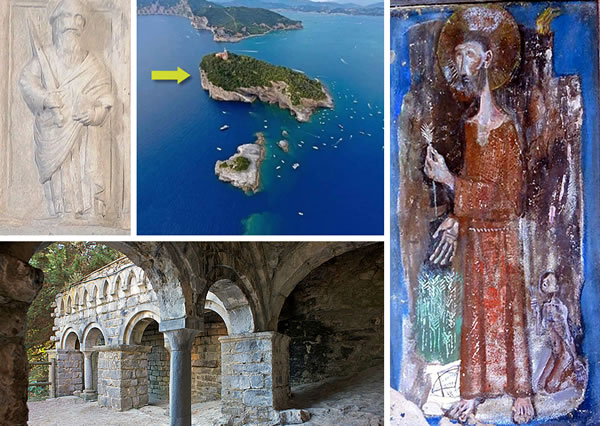
Saint Venerius depicted on the pulpit with Saints Peter, Paul, and Pachomius (Church of San Lorenzo, Porto Venere, Italy) and in a fresco (Diocese of La Spezia-Sarzana-Brugnato, Italy) - Island of Tino and remains of the monastery (La Spezia, Italy)
The island, together with Palmaria and Tinetto, closes the Gulf of La Spezia to the west. It is the second largest island after Palmaria, but unlike the latter, it is not open to visitors during the year, as it is property of the Italian State Maritime Property, except for September 13th and the following Sunday during the festivities in honor of Saint Venerius, Patron Saint of the Gulf of La Spezia and of Italy's lighthouse keepers. The island is today a UNESCO World Heritage Site and still preserves the remains of an 11th-century cenobitic complex, undoubtedly one of the most renowned and powerful abbeys in Liguria, built upon a pre-existing 7th-century chapel erected, according to legend, on the spot where the body of the hermit monk Venerius was found. The abbey was later abandoned during the 15th century by the Olivetan monks, who moved to the present-day area of Le Grazie.
This page was last edited on 14 March 2026
© andmorestory.eu - All right reserved