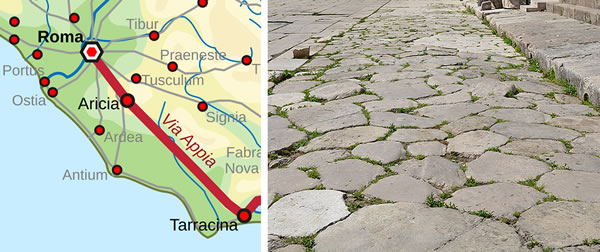
Route of the ancient Via Appia from Rome to Terracina and a photo of a section of it at Terracina.

Perhaps the first roads date back to the 2nd millennium B.C. and were built by the Assyrians and Babylonians, using compacted earth and only paved with bricks and bitumen for short stretches. In the Minoan-Mycenaean world, a road construction technique developed, involving the preparation of a foundation and a surface covering of cobblestones or flagstones (Knossos, Troy, Pylos). In the Persian Empire, Darius I (522-486 B.C.) connected the satrapies with a system of postal roads, which constituted a powerful tool for state unity. The Greeks of the Classical era, on the other hand, do not seem to have dedicated much effort to building roads suitable for vehicular traffic: only in a few cases did they pave or cut such routes; more often, to overcome slopes, common in the region, they limited themselves to carving steps into the rock, adapting it for pedestrian traffic. The Carthaginians are said to have been the first to introduce gutters at the sides of roads to collect rainwater, and were perhaps the first to build winding roads on mountainsides. The Etruscans and Carthaginians were masters to the Romans in road construction techniques. The Romans, however, did not conform to the lay of the land, as the Etruscans did, nor did they concern themselves with easing steep ascents with switchbacks, as the Carthaginians did: they preferred to follow, as much as possible, a straight line, or in any case the shortest route connecting different locations. Precisely for this reason, Roman roads often had steep gradients (up to 20 percent), and deviated from the straight line only when encountering marshy terrain, while in mountainous regions, or over rivers and streams, the road maintained its direction thanks to the insertion of bridges and other artificial supports (achieved through earthmoving).
While the Greeks thought they had achieved their highest aim with the founding of cities, because they had concerned themselves with their beauty, security, harbors, and the country's natural resources, the Romans thought above all about what the others had neglected: to pave roads, to channel water, to build sewers ... They also paved the roads that pass throughout the territory, taking care to cut through hills and fill depressions, so that wagons could carry the loads from ships; the sewers, covered with vaults made of uniform blocks, sometimes allow the passage of roads passable by hay wagons.
Strabo (Geography, V,7.8)
The Romans' objective was to design an alignment as direct as possible to connect more quickly to an ultimate destination, taking advantage of the terrain traversed without fighting it, even if this required undertaking major engineering works. Therefore, they were not concerned with connecting more important centers along a route, but with aiming as quickly as possible at the final goal, seen as the ultimate terminus over a great distance. A typical example is the Via Appia, with its perfectly straight stretch of about 90 km connecting Rome to Terracina, conducted in this rigorous manner in overcoming all the Alban Hills and especially the Pontine Marshes, which it crossed diagonally to be faster: the road could much more easily, but with a longer route, have been conducted at the foot of the mountains. In that manner it would have also directly connected the notable cities located along that route, whereas in this way, so as not to be diverted by them, it connected to them only via linking branches.
The same occurred with the Via Aurelia, which, for example, did not go directly to Cerveteri, Civitavecchia, Tarquinia, Vulci, Cosa, Rosellae, etc., all of which were connected via branches, but in superb straight stretches it traversed impervious terrain and marshes (like that from beyond Civitavecchia to Montalto, nearly 30 km in length), to reach the north, to the borders of Italy, as quickly as possible.
The Via Flaminia also offers examples of magnificent straight stretches through the irregular hills between Otricoli and Foligno or through the marshes of the Marroggia and Clitunno rivers, between Spoleto and Trevi. But these are just examples of principles in route planning, which are commonly recognized on all the routes of the great arteries and not only on them. Through the mountains, more than elsewhere, the effort made by the ancients to overcome so many adversities is evident, and everything is studied so that along such routes humans, animals, or carts had easy and safe passage: cut cliffs, tunnels, viaducts, terraces often possessed support for the road towards the valley or its defense towards the mountain, bridges which, because they are often still in use today, arouse our greatest admiration.
The assertion, therefore, of a rational design even at the cost of extreme difficulties is another typical concept of Roman engineering, as it pertains precisely to the criteria of road construction. If the ultimate authority for road construction belonged to the Senate, their construction was entrusted to censors, consuls, also praetors, and emperors assumed the task as they combined such offices, particularly that of the censor. The physical construction of the road was entrusted to legionary labor; the praefecti fabrum, i.e., the engineers, had all the technical responsibility for the project, assisted by quaestors for financial matters. Once built, the road passed to civil administration, with its management assumed by the aediles, to whom the cura viarum(care of the roads) was entrusted.
Every important road had its curator(supervisor), or the same curator could have more than one, and to him was entrusted the entire commitment of its maintenance. This naturally was not limited to mere upkeep, but also included the restoration of the stability of the works, particularly the paving or sidewalks, signage, milestones (paracarri) and drainage channels for water on both sides, defensive and consolidation works for the entire horizontal and vertical alignment, vegetative or arboreal defenses, and service conduits running alongside the road itself, such as hydraulic ones. He also presided over the implementation of legal norms concerning the patrimonial protection of the road itself and police regulations regarding traffic. Roman roads were commonly paved along their entire length with polygonal stones, among which the basalt ones of central Italy are famous for their hardness and black sheen, but they were naturally also made of limestone, granite, and other compact stones depending on the regions traversed, where such material was easier to obtain.
The roads were generally wide, in the paved carriageway, 4.1 m (14 Roman feet): a canonical measurement for major communication routes, often maintained even by roads of lesser importance, which allowed sufficient space for wagons to pass each other. The road, however, with beaten-earth sidewalks on the sides for pedestrian traffic, generally added 3 meters on each side, thus assuming an overall width of 10.2 meters.
Roads were distinguished into:
• Public roads (viae publicae), built by the state, which was responsible for maintenance (initially through the magistracy of the aediles, then with officials called curatores viarum). They took their name from the magistrates who, having the right of eminent domain, had them built: these could be censors, consuls, or praetors, replaced, after the end of the Republic, by the emperor.
• Local roads (viae vicinales), which connected public roads and minor settlements, whose maintenance fell to the various administrative districts.
• Common roads (viae communes), opened subordinately by various communities.
• Private roads (viae privatae), opened by individual landowners.
Essentially, the main roads were built and maintained at state expense, while those connecting towns, branching off from the main roads, were entrusted to the care of local landowners.
At the end of the Empire, Roman roads were abandoned and largely fell into ruin from the elements or were overgrown by vegetation.
Route of the ancient Via Appia from Rome to Terracina and a photo of a section of it at Terracina.
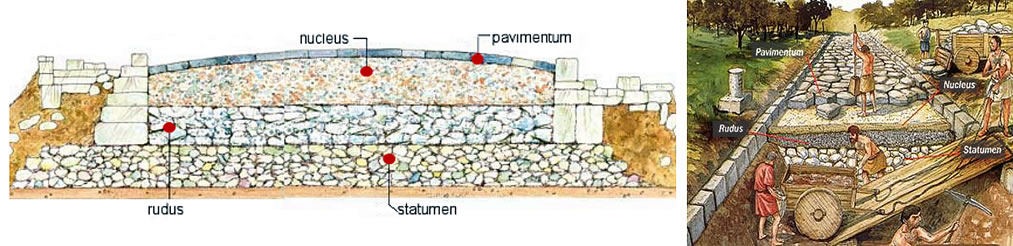
Roman Road Construction Techniques
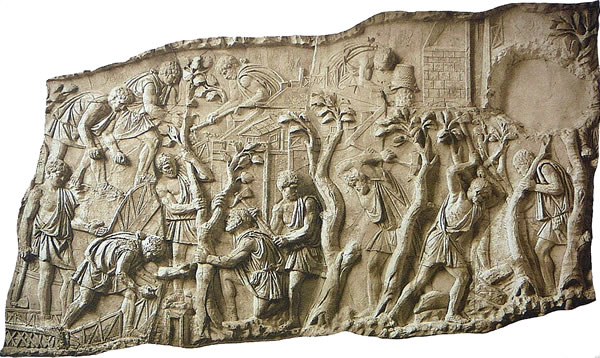
Road-building in the mountains (113 CE, scene XCII of column in Trajan's Forum, Rome)
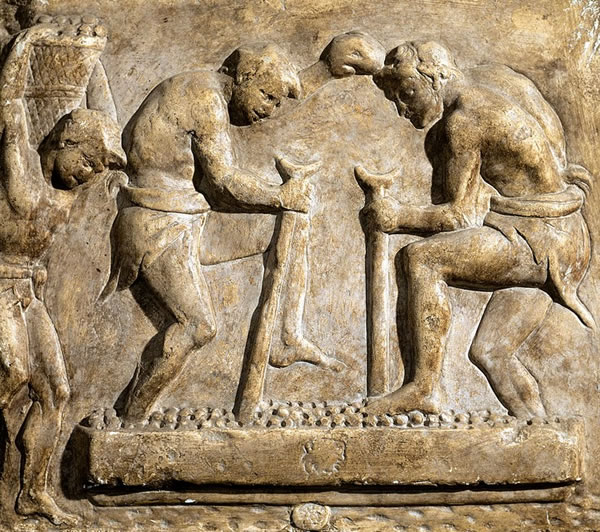
Paving a roadway, relief, first century A.D. Museum of Roman Civilization, Rome
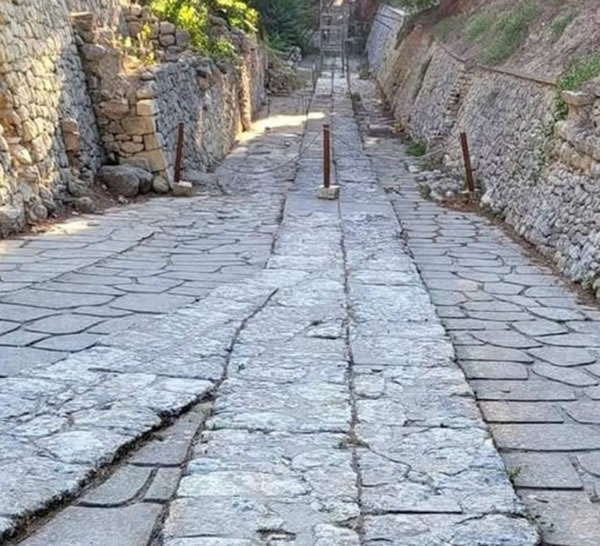
A 3,500-year-old Minoan road stretching 50 km (31 miles) from Knossos, Crete, Greece. It featured lateral drainage systems, a roadway made of 200 mm (8 inch) thick sandstone blocks bonded with a mortar of clay and gypsum. The surface was covered with basalt slabs, with separate curbs to delineate the edges of the roadway.
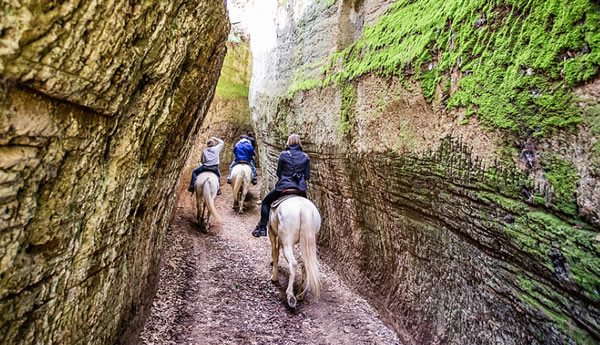
A section of the Vie Cave in Sorano and Sovana. These are great roads dug into the tuff hills by the Etruscans, with walls sometimes over 20 meters high. Today they are used to reach Etruscan necropolises, but we do not know if they were originally just communication routes, or channels for collecting rainwater, or roads used in religious ceremonies. - Sorano (Grosseto, Italy)
This page was last edited on 14 March 2026
© andmorestory.eu - All right reserved