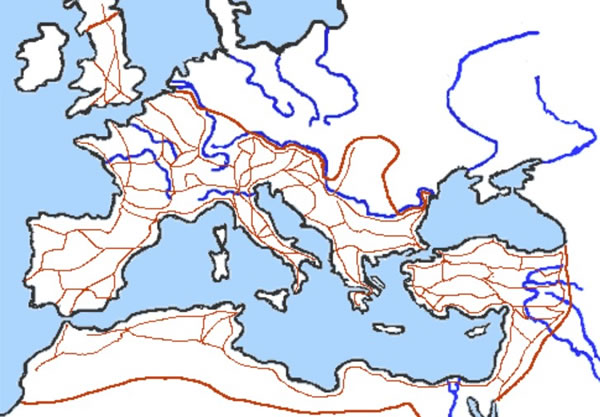
200,000 miles of Roman roads provided the framework for empire

Roman civilization lasted nearly eight centuries, and throughout its evolution, it stood at the heart of the entire ancient world's history: from the shores of the Mediterranean to the inland regions of the continents of Europe, Asia, and Africa. For hundreds of years, Rome was the political epicenter of a unique culture, shaped by the continuous infusion of knowledge from people belonging to vastly different civilizations. These contributions were assimilated, absorbing the best they had to offer. In this way, all regions of the empire became protagonists in a single, shared history. Tertullian, a Christian writer of the 2nd century AD, wrote (De anima, 30):
The world is more fully known every day, better cultivated, and more civilized than before. Roads have been traced everywhere; every region is known to us, every country is open to trade. Delightful farmlands have encroached upon the forests; herds have driven away the wild beasts; crops are sown in sandy soil; rocks are shattered. Marshes are disappearing. Now there are as many cities as there once were huts. No longer do we fear islands and cliffs. Everywhere there are houses; everywhere human habitations; everywhere well-ordered governments; everywhere signs of life...
This continuous exchange of knowledge was possible only thanks to an extensive communication system that shortened distances and reduced travel times, connecting distant lands. It consisted of the road network and the navigation system, both riverine and maritime. These were all effectively organized and developed. Regarding the latter two, they used postal boats (naves tabellariae) and public service vessels (naves publicae). River service, on both major rivers and streams, was organized with towpaths, quays, canals, piers, equipped harbors, ferries, dredgers, divers, and locks to enhance draft on minor waterways or during low water periods. Maritime service, meanwhile, relied on ports, and a city could have several. For example, Imperial Rome was equipped with the old river port of Ostia, the great double-basin port of Claudius and Trajan (near modern-day Fiumicino), and, as metropolitan harbors, the port of Civitavecchia (for communications with Gaul and Spain) and the port of Pozzuoli (for communications with Africa and the East).
The Roman road system was unique in the world: it was a monumental work extending across three continents, from Scotland to Mesopotamia, from the Atlantic coasts to those of the Red Sea, crossing mountain ranges and reaching into the heart of the Sahara Desert. Under Augustus, during Rome's greatest splendor, it is said that the extent of paved roads in the Roman Empire reached 100,000 km, with unpaved roads spanning 150,000 km, while the empire's population was estimated at 60 million and that of the known world at about 180 million. By the end of the empire, Roman roads were abandoned and largely ruined by the elements or overgrown by vegetation.
Pliny the Elder maintained that Rome's success in dominating territories, cultures, and countries was due to its understanding of the importance of water, sewers, and roads. Certainly, roads enabled the governance and control of the empire. Initially, they served only the strategic purpose of facilitating the rapid movement of armies and direct connection with military colonies; later, they also became important for trade and, more generally, for unifying Rome's dominions.
Roads are not a Roman invention, but they were exceptional builders of them. Perhaps the first roads date back to the 2nd millennium BCE and were built by the Assyrians and Babylonians, using packed earth and only short stretches paved with bricks and bitumen. In the Minoan-Mycenaean world, a road construction technique developed involving foundation preparation and surfacing with cobblestones or paving slabs. In the Persian Empire, Darius I (522-486 BCE) connected the satrapies with a system of postal roads, which became a powerful means of state unity. The Greeks of the classical age, however, do not seem to have dedicated much effort to building roads suitable for vehicular traffic: only in a few cases did they pave or cut such routes; more often, to overcome the frequent slopes in the region, they merely carved steps into the rock, adapting it to pedestrian traffic. The Carthaginians are said to have been the first to introduce gutters along the sides of roads to collect rainwater, and perhaps they were the first to build switchback roads on mountain slopes. Etruscans and Carthaginians were masters to the Romans in road construction techniques. The Romans, however, did not conform to the terrain's contour, as the Etruscans did, nor did they concern themselves with easing steep climbs with switchbacks, as the Carthaginians did: they preferred to follow, as much as possible, a straight line, or in any case the shortest connection between different locations. Precisely for this reason, Roman roads often had steep gradients and deviated from a straight line only when encountering marshy ground; while in mountainous regions, or over rivers and streams, the road maintained its direction thanks to the insertion of bridges and other artificial supports, achieved through earthworks.
For the Romans, roads were necessary works (moles necessariae) for the civil integration of the entire world. They were their distinctive feature, contrasted with the otiosa et stulta ostentatio pyramidum (Pliny, N.H. 30.75) and the inertia sed fama celebrata opera Graecorum (Frontinus, De aq. 16). The Romans paid particular attention to road paving, to make them usable at all times, even in rain, which turned unpaved roads muddy and impassable not only for carts, chariots, and stagecoaches, but also for the centuries of soldiers who always moved on foot.
When building, the Romans did so with the intention that their structures would last a long time (as per the Lex Iulia municipalis), would not require expensive maintenance, and would have a fine appearance. Vitruvius recommended three fundamental requirements:
• Solidity (firmitas): depth of foundations and choice of material.
• Utility (utilitas): arrangement of the most convenient and appropriate places, without impediments to use and properly directed.
• Beauty (venustas): adding to practical needs aesthetic value, a graceful and elegant appearance, and the coordination of parts according to balanced calculations of symmetry.
The terms commonly used in Latin to refer to the work of building a road were viam instituere, munire, struere, sternere, —that is, to establish a route, found, layer, consolidate and defend, make a surface level, and pave.
The high quality of construction of this Roman road system has left it largely unchanged for millennia, so that we still use it today. Many sections of these roads have been preserved as tourist sites, while others have been destroyed or covered by modern roads or buildings.
If communications were extremely slow back then, relying on the walking capacity of individuals or animal transport, the journey was nevertheless facilitated in every way by the efficiency of the route and by a widespread network of rest stops and refreshment places, such as the posting stations (mansiones) arranged along the roads at certain distances, with all sorts of provisions, where public couriers could change horses and rest.
200,000 miles of Roman roads provided the framework for empire
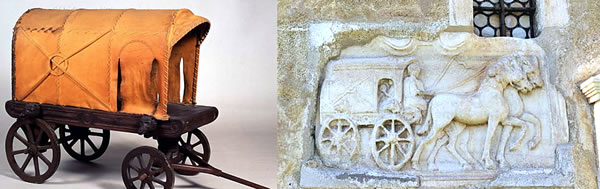
Carriage for the kingdom to come (CSIR II/4, 399), which brings a soul to the other world. Roman stone relief (2nd century AD) depicting a Gallic-origin four-wheeled vehicle used for long journeys (carruca dormitoria), covered with leather and also equipped with a side window, suitable for long trips in any season and weather conditions - Virunum II cemetery in Zollfeld near Maria Saal, exposed on the southern outer wall of Maria Saal Cathedral, Maria Saal market town, Klagenfurt Land district, Carinthia, Austria, EU; and a wooden model of a carruca dormitoria, Rome, Museum of Roman Civilization.
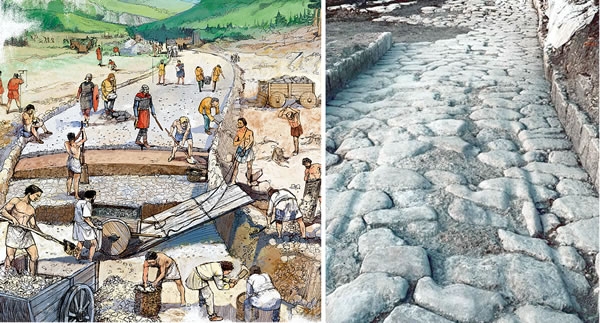
Paving of an ancient Roman road from the 1st century BCE discovered in the area of the ancient Attidium municipality, with traces of cart passage - Attiggio, Fabriano (Ancona, Italy)
This page was last edited on 14 March 2026
© andmorestory.eu - All right reserved