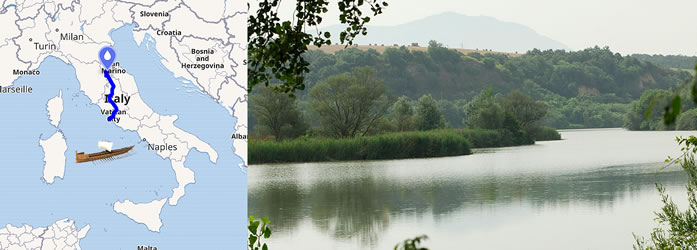
The Tiber river and the map of its course with a reproduction of a penteconter (or penteconter).

The Tiber, the principal river of central and peninsular Italy, second in terms of basin area and the third longest and highest in water volume among Italian rivers, has always been the soul of the city of Rome, as the plaque placed at its source on the slopes of Monte Fumaiolo (Emilia Romagna) states: Here is born the river sacred to the destinies of Rome.
The Tiber is indeed at the center of numerous myths, stories, and legends, starting from the very foundation of the city of Rome. But over time, it has also been the focal point of works of art, consular roads, routes, and saints, including Saint Benedict and Saint Francis, as well as feats of engineering.
In antiquity, it was called Albula for its clear waters, later taking the name of the Latin king Tiberinus, who committed suicide by drowning himself in its waters.
According to Roman mythology, every river, forest, and natural environment was associated with a deity. The Tiber possessed a true deity, called Pater Tiberinus. The god was the son of Janus and lived among the river's currents. He was a deity even capable of reversing the water's flow and for this reason was not only loved but also feared, as evidenced by the Tiber's disastrous floods, which once inundated vast areas. He was celebrated every year on December 8th during the festivals called Tiberinalia, to commemorate the anniversary of the founding of the temple dedicated to the god himself, located on Tiber Island.
The Louvre Museum in Paris houses a statue from the Hadrianic era depicting the god Tiber, flanked by the she-wolf nursing the twins, with the attributes of an oar and a cornucopia. In its numerous other depictions, including on many coins, the god is often represented associated with scenes recalling the origin of Rome, with nautical attributes. Therefore, the Tiber has always been a navigable river. Its tributaries were also largely navigable, unlike today, and together they constituted a natural superhighway. It bears no comparison to the great European rivers, beside which Italian ones seem like streams; however, their flow was abundant throughout the year, except in summer, and allowed navigation even with heavy ships, provided they were equipped with oars, as they were unable to sail upstream using only sails.
A famous passage from Herodotus (I, 163) indirectly explains how an archaic merchant ship could sail up a river against the current, specifically speaking of the Phocaeans. He recounts how they were the first Greeks to undertake long voyages—they discovered the Adriatic, Tyrrhenia, Iberia, and the region of Tartessos—and they did not sail with large cargo ships but with penteconters. They were accustomed to sailing up the courses of great rivers, especially the Guadalquivir—in their commercial navigation directed primarily towards the distant West.
Penteconters were fifty-oared ships, the first vessels suited for long voyages, previously used as warships, which, with the introduction of two banks of oars, had been relegated to troop transport. Herodotus does not clarify the reasons for this practice, but according to modern authors, their choice was linked to their ability to plough through waters quickly and to escape pirates. Indeed, they were capable of allowing agile maneuvers on the tortuous and treacherous routes of inshore navigation and in the delicate ramming maneuvers.
In a long, winding course of about 400 km, the Tiber connected the sea with the Apennine hinterland of the peninsula, skirting the ancient routes of transhumance and salt transport, fostering relations between different peoples.
The Via Salaria (or Salt Road) started from the salt pans at the mouth of the Tiber (campus salinarum) and reached as far as the mountainous Sabine interior (Pliny, Natural History, 31.89). These ancient routes were marked at the main junction points (characterized by the convergence of transverse roads, often at fords) by sanctuaries with evident emporic connotations. The primitive ford of the Tiber was the place for salt supply for transhumant shepherds of the Bronze and Iron Ages, coming from the interior of the peninsula and particularly from Sabina. This is confirmed by the discovery in the sacred area of Sant'Omobono of the oldest fragments of Apennine pottery (14th-13th century BC).
Archaeological finds show how, between the end of the Neolithic and the beginning of the Bronze Age (around 3500-2200 BC), the river was traveled by the people of the Rinaldone culture, which flourished around Lake Bolsena and spread as far as the Arno; during the Bronze Age by the Apennine culture, which traded with the Mycenaeans who sailed up the Tiber from the sea (Lake Piediluco); between the end of the 9th century BC and the beginning of the 8th century BC, by the Tomb Culture, which arrived in Lazio from pre-Hellenic Campania and pushed as far as Umbria.
The Tiber knew how to divide populations, marking their borders (Etruria, Umbria, Sabina, and ancient Latium), but also to unite them culturally, as for example at Lucus Feroniae. Here, on the right bank of the Tiber, in the archaic and early Republican age, a religious center and trading place was established near the spring and in the shade of the sacred grove (lucus), under the protection of the goddess Feronia. Here, Faliscans, Latins, Umbrians, Sabines, and Etruscans met in peace during the periodic festival, engaging in mutual cultural, economic, and legal activity. Over time, they managed to transform the place of fair and market into a center of collective life. The sanctuary that stood here symbolizes the extraordinary communion brought by the river among the peoples of central Italy. The functioning of this activity is clearly evident from the account of an episode that the annalistic tradition attributed to the reign of Tullus Hostilius, handed down by Livy (I.30.5-10.) and, in a much more extensive and interesting version, by Dionysius of Halicarnassus (3.32):
After this war, there was another against the Romans by the Sabines, the beginning and occasion of which were these: there is a sanctuary honored in common by the Sabines and the Latins, among the most sacred of those dedicated to the goddess Feronia, whom some translate into Greek as "bearer of flowers," others as "lover of crowns," others still as Persephone. To it, many would come from the surrounding cities on feast days to offer vows and sacrifices to the goddess, many to trade during the festival: merchants, artisans, and farmers. For here were held fairs more famous than in any other place in Italy. Some notable Romans, having gone to this festival, were kidnapped by some Sabines, who imprisoned them and robbed them of their riches. Despite the embassy sent for this purpose, they refused to do justice, but retained both the persons and the goods of the captives, and in turn accused the Romans of having welcomed Sabine fugitives, having built a sacred asylum...
Pliny the Elder alludes to the method used to increase the river's capacity and enhance navigation, by holding back the water with locks along the course, which were then opened to exploit the flood wave (N.H., III, 5.53). This occurred every nine days, coinciding with the nundinae, the days when boats brought agricultural products to the market. Traces of these locks are still visible today upstream of Sansepolcro, on the upper course of the Arno, and in a tributary stream upstream of Rome, on the Fosso di Vallelunga. Pliny the Younger describes this historic natural link between the Urbs and the hinterland thus:
Medios ille (Tiberis) agros secat, navium patens, omnisque fruges devehit in Urbem
It cuts through the midst of the fields, open to ships, and carries every crop to Rome.
- Pliny, Ep., V.6
The waterway was indeed especially useful for commerce, allowing easy transport of products from places of production to markets, and among these, especially agricultural products. Therefore, lands along the banks and the farms that managed them were of great value, so much so that Cato the Elder expressly recommended choosing a place to build a villa near a major watercourse which, the more capacious and rich in traffic it was, also offered an organized lighterage service. For these reasons, Cicero owned a villa in the Ocriculum area (Pro Milone, 24-64) which could be supplied via the Tiber, and 13 agricultural estates (Pro Roscio Amerino, VII,2) of great value precisely because they were contiguous to the river. Near Ponte Vittorio Emanuele in Rome, a bronze tablet that must have been affixed to a boat from the Trajanic era was recovered from the Tiber. Inscribed on it were the names of the great imperial estates (Praetoria) for which it provided service—the first at Saxa Rubra near the villa of Livia (ad Gallinas Albas) and the second at Fidenae—and the names of the two procurators who succeeded each other in their governance. The boats were also called caudicariae ships (naves caudicariae), i.e., fluvio-maritime vessels intended for transport along the Tiber. Their serial construction system was such that a central body of greater or lesser size was assembled at the bow and stern, depending on necessity. For example, the three caudicariae at the Museum of Ships in Fiumicino could transport approximately 70, 50, and 30 tons respectively.
Along the river, there was also heavy traffic in construction materials (timber, bricks, pozzolana, lime, limestone, sand, stone, squared stone blocks, tuff, travertine, precious marbles from all over the Mediterranean), because goods were very heavy and bulky, making land transport more difficult. Even in the Middle Ages, the river was used to transport marbles, such as those for the construction of Orvieto Cathedral.
Along the course of the river and its tributaries were quarries and brick factories attached to clay pits. Strabo narrates the use of the river as a flotation route for timber coming from the upper Tiber valley. Furthermore, the wooded regions of the peninsula's hinterland supplied timber for the construction of ships for the Roman fleet during the First and Second Punic Wars.
The Tiber brought to Rome not only goods but also armed forces: both Roman forces to push inland and northward, and enemy forces such as the Sabines of Titus Tatius from Cures, the Etruscans of Porsenna—the great king of Clusium—, and the Gauls of Brennus. Often naval battles also occurred on the river, as in the time of Tarquinius Priscus, near the confluence with the Aniene, between Romans, Sabines, and Etruscans (Dionysius of Halicarnassus, III, 55.3-4).
The Tiber was also used as a fast alternative to reach Rome. Via the Nera River, one could embark at Narni to reach the Urbs, avoiding the Via Flaminia (Tacitus, Annals, III, 9), which in the first century AD was very congested with traffic (Hist. 2,9 and 64). Perhaps the embarkation point was near the Pons Minucius, one of the most important bridges of the consular road that crossed the Tiber near Gallese, a few kilometers before reaching the ancient city of Ocriculum, in present-day Umbria. The bridge collapsed in the 15th century, and until the 19th century, the remains of the bridge piers were still visible in the riverbed, hence nicknamed the "Piles of Augustus."
Remains of a notable port facility at Taizzano, on the left bank immediately beyond the gorge of Narni, are located inside a long canal parallel to the Nera River. These consist of two front walls with a series of recesses. Such evidence has led to the hypothesis of an ancient assembly of small-sized boats (lembis non magnis) on site, according to the Greek geographer Strabo (Geographia V, 2, 10), who lived between 64 BC and 20 AD.
The remains were still visible in the 16th century until they were submerged by river floods. Given the difficulty that sailing through such a pass must have presented, perhaps there was a calmer transport service for passengers with embarkation from the landing further downstream, therefore 3 miles farther than the other. The river then easily led to the Tiber below Orte, where the important port facilities of Piscinale were located, to the right of the mouth.
In 1468, Frederick III, Emperor and King of Germany, and his entourage (500 knights and wagons carrying ladies, pages, beasts, servants, provisions), coming to Rome along the Via Flaminia, were forced to abandon it at the height of Otricoli to embark and follow the river to the outlet of the ancient Cremera, then resume the ancient consular road as far as Ponte Miglio, where the Roman nobility awaited them.
The Tiber was also used as a route for aid. In this regard, it is remembered when Valesius, a wealthy Sabine farmer from Eretum, used it to transport his sick children to the Urbs (Valerius Maximus, II, 4.5); or in cases of famine, as when the people of Crustumerium, descending the river with boats to deliver supplies to Rome, were intercepted and plundered by the people of Fidenae (Dionysius of Halicarnassus, II, 53.2); or when river convoys transported massive grain supplies to Rome in the 5th century (Livy II and IV passim; Dionysius of Halicarnassus XII, 1.9).) Since time immemorial, the Tiber has thus been the object of engineering works (embankments, dams, bridges). Along the well-maintained and equipped riverbanks, a chain of landing places persisted for millennia until the first centuries of the modern age. Given the regular and extremely intense traffic, Rome was equipped with multiple river ports within the city and its suburbs, such as the Republican military port of Rome upstream of the city (navalia, 4th century BC). Frequent and regular were the works of quaying and river regularization along its entire course up to the source. Suetonius and the Pseudo-Isidorian Historia particularly recall Augustus's interest in works to deepen and widen the riverbed, the restoration and strengthening of the then-built embankments, with a true intervention of regulatory building and planning of the lateral plains (Suetonius, Augustus, 28 and 30; Historia, 5). It was regularized and enhanced for tens of kilometers from Crustumium, north of Rome, to its mouth.
It was unfortunately the modern age that denied life to the great waterway. Indeed, the lack of maintenance of equipment and facilities led to the decline of the system from as early as the 16th century. Subsequent destructive floods, the great silting following the inundations, definitively buried the remains of the ancient landing places and riverbank facilities, with the moorings and haulage paths.Since time immemorial, the Tiber has thus been the object of engineering works (embankments, dams, bridges). Along the well-maintained and equipped riverbanks, a chain of landing places persisted for millennia until the first centuries of the modern age. Given the regular and extremely intense traffic, Rome was equipped with multiple river ports within the city and its suburbs, such as the Republican military port of Rome upstream of the city (navalia, 4th century BC). Frequent and regular were the works of quaying and river regularization along its entire course up to the source. Suetonius and the Pseudo-Isidorian Historia particularly recall Augustus's interest in works to deepen and widen the riverbed, the restoration and strengthening of the then-built embankments, with a true intervention of regulatory building and planning of the lateral plains (Suetonius, Augustus, 28 and 30; Historia, 5). It was regularized and enhanced for tens of kilometers from Crustumium, north of Rome, to its mouth.
It was unfortunately the modern age that denied life to the great waterway. Indeed, the lack of maintenance of equipment and facilities led to the decline of the system from as early as the 16th century. Subsequent destructive floods, the great silting following the inundations, definitively buried the remains of the ancient landing places and riverbank facilities, with the moorings and haulage paths.
The Tiber river and the map of its course with a reproduction of a penteconter (or penteconter).
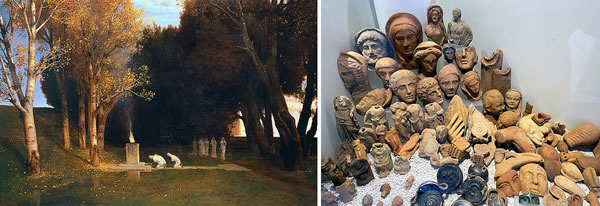
The Sacred Grove (Arnold Böcklin) and ex-votos to the Goddess Feronia.
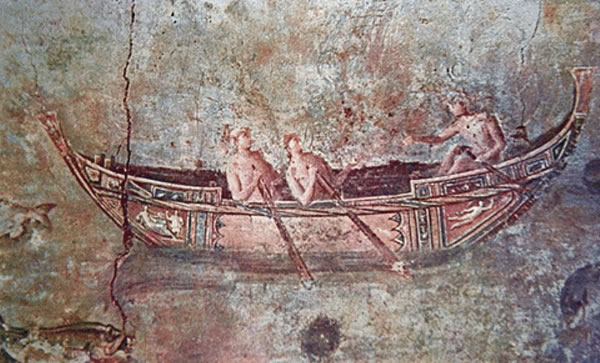
Painting of a small pleasure craft, found among the port facilities of Pietra di Papa, on the Tiber near Rome. On the boat are two figures each handling a pair of oars, and one at the stern, the helmsman, who steers the boat with a long oar. Of notable effect is the reflection of the boat on the water, revealing great refinement by the author.
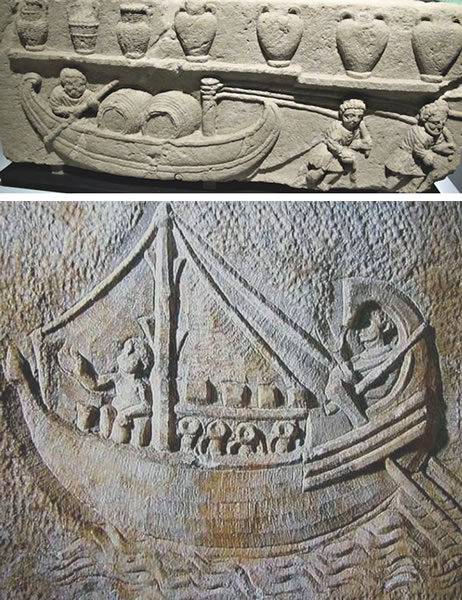
(Top) Bas-relief of upstream haulage, Museum of Arles. (Bottom) Boundary stone found in Trastevere, Rome, depicting a cargo ship from the 3rd-4th century AD used for transporting wine amphorae. It is a typical haulage riverboat, lacking oars and sail, equipped only with rudders and a robust forward hawser post, from which it was tied and towed from the shore with a rope. - National Roman Museum, Rome.
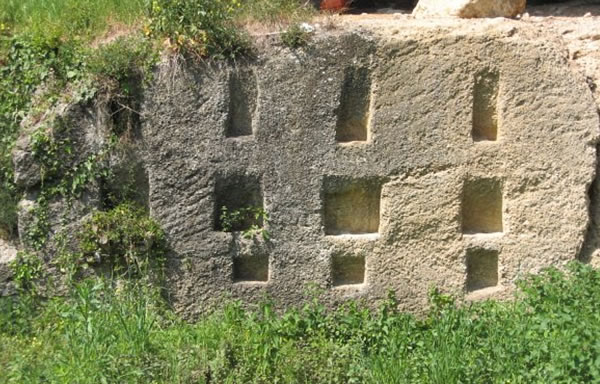
Remains of a port facility at Taizzano.
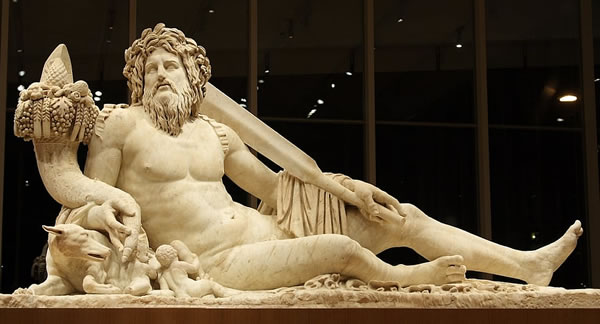
Large sculpture of Tiber river in the Louvre Museum (Paris, France).
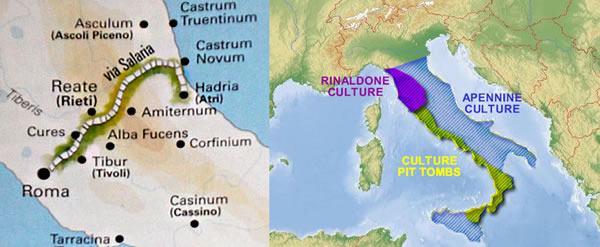
Map of the Via Salaria route and map of the Rinaldone, Apennine, and Tomb Cultures.
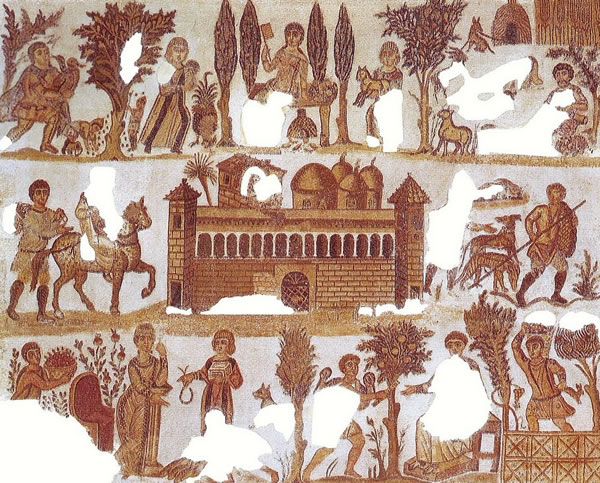
The property of Lord Julius from Carthage preserved at the Bard of Tunis - Bardo National Museum, Tunis
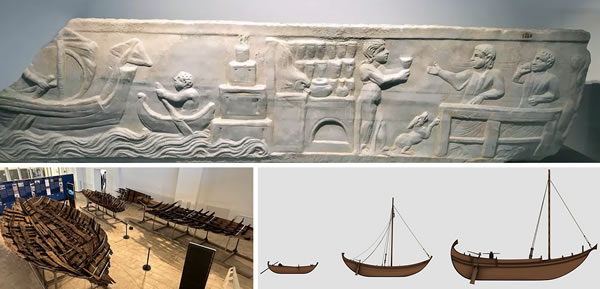
(Top) Funerary relief with a navigation and tavern scene from tomb 90 at Ostia Antica. Two customers, a woman and a man, are seated at a table. One is drinking from a cup, a barmaid brings a cup to the other. To the left of the barmaid is the bar counter, with a small water basin with a curved surface, precisely what can be seen in several bars at Ostia. Above the counter are shelves with long rows of ships. The bar must be located in the port. A simple port scene is depicted to the left of the bar. A cargo ship and a rowboat are approaching the Claudian lighthouse. (Bottom) Wrecks of three caudicariae ships at the Museum of Ships in Fiumicino (Rome).
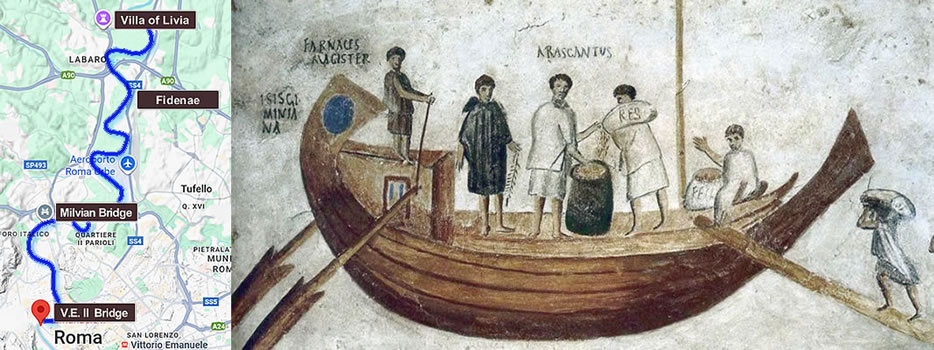
Course of the Tiber from Ponte Vittorio Emanuele II to the Villa of Livia; and a fresco from Santa Severa (Rome) depicting the loading operation of a caudicaria ship, Vatican Museums.
This page was last edited on 14 March 2026
© andmorestory.eu - All right reserved