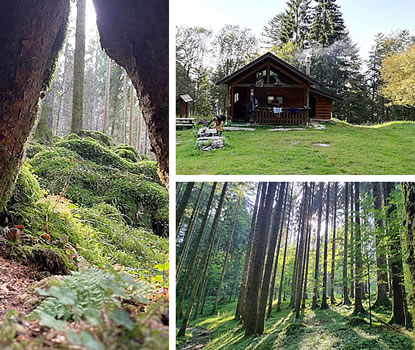
Cansiglio Ciada Delamis

A legend tells that in a castle near Andraz, a Count from the Puster Valley had imprisoned his beautiful wife, of whom he was extremely jealous, entrusting her to an old and wicked nurse who tormented her in every way. One day, during the Count's absence—he had left to seek the Arch of Égues, the finest weapon in the world—the Countess was at the window when a merchant passed by and offered her fabrics and jewels. The lady asked him if, instead, he might have the Arch of Égues. "I do not have it, but I can procure it for you," said the merchant. The wicked nurse had heard the lady speaking from the window with a man; when the Count returned, she told him about it. The jealous man, beside himself, dragged his wife to a ravine and hurled her into it. But on his way back, he met the merchant with the very arch he had so desired and sought in vain. Learning from him how things had truly transpired, he was filled with remorse and returned to the ravine to search for the body of his poor Countess. He did not find it. He made inquiries and learned that two men, who looked like sorcerers, had passed through various places carrying a woman with them. From their description of her, he understood she must be his wife. He followed their tracks but lost them on the Venetian plain. He continued searching, sold his jewels and his golden cloak, and even resorted to begging. Finally, discouraged, he began his journey home. Along the road, he came upon a forest called Cansiglio Ciada Delamis, where he was told sorcerers lived. Could his wife be inside there? He ventured in and found an isolated house whose master lived in the company of a deaf-mute carpenter, a horse, and a bear. He managed to get himself hired as a servant. He soon realized he was in an enchanted house. During one of the master's absences, he searched the entire place and found, in a secret room, a sack of walnuts, a small black mirror, and a large green mirror. Then, one evening, he burned all the wood shavings that flew from under the carpenter's axe during the day and which at night turned into mice. The carpenter, thus freed from the spell, immediately began to speak and explained to his liberator that his wife's soul was imprisoned inside the horse's head; that the master of the house was one of the two sorcerers who had abducted her; and that the bear was the other sorcerer, enchanted by the first because he had wanted the Countess entirely for himself and had tried to persuade her to flee with him. The Count then took the sack of walnuts and the two mirrors, leaped onto the horse's back, and fled—just in time, as the master was about to return. After an hour of riding, he noticed he was being pursued by the sorcerer riding the bear. "Throw a walnut behind you," said the horse. The Count obeyed, and at the spot where the walnut fell, a pit opened up, delaying the pursuit. This maneuver was repeated until the sack was empty; then it was the black mirror's turn, and where it fell, a lake with blackish waters formed. Lastly, the green mirror was thrown, transforming into a large lake with clear waters. The pursuers crossed that one too, and at the Pian del Lus, the horse and the Count found them very close. Then the Count confronted them: with a large stone, he crushed the sorcerer's head, and with a sword stroke, he killed the bear. When he turned around, in place of the horse stood his wife. They returned to the castle near Andraz, where they lived happily after driving away the old nurse, who went to live on the rocky peak above the Falzarego Pass, still called Sass de Stria today. It is the highest castle in Italy, at a height above 1700 metersAs for the lakes formed by the two mirrors, they are believed to be Lago Morto and Lake Santa Croce.
Cansiglio Ciada Delamis
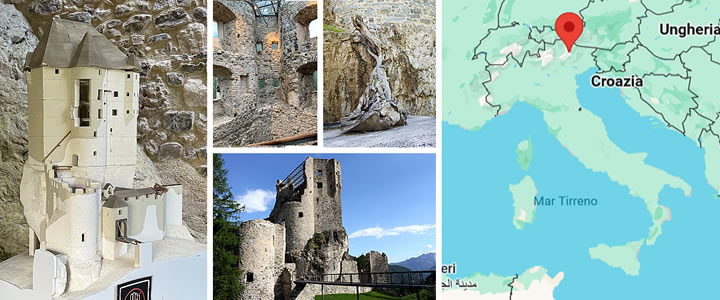
Castle of Andraz (Belluno, Italy)
This page was last edited on 14 March 2026
© andmorestory.eu - All right reserved