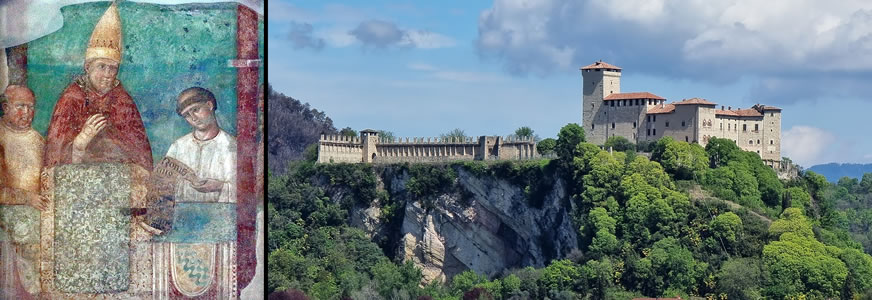
Boniface VIII declaring the Jubilee Year of 1300. A fresco by Giotto (1266–1337), San Giovanni in Laterano (Rome) - Interior - The fortress of Angera (Varese, Italy)

The Rocca di Angera is a place of timeless charm, rising between the Lombard shore of Lake Maggiore and the sky. Its walls are distinguished by Ghibelline swallow-tailed merlons, making it recognizable from afar as one ascends towards the rocky spur on which it stands in a panoramic position. The earliest records of the fortress's existence date back to 1066, when it was owned by the Archbishops of Milan. A turning point came in 1277 with the Battle of Desio and the assertion of the Visconti family over the Della Torre, an event celebrated in the remarkable frescoes of the Hall of Justice within the castle. The Visconti carried out significant expansion and decorative works. It was Vitaliano I Borromeo who purchased the property in 1449 for the sum of 12,800 imperial lire, making it his residence. The fortress became a cornerstone of the Lombard defensive system against incursions by the Swiss and Imperial troops. After a lengthy legal dispute with the Sforza family, around the year 1500, the Borromeo family became its permanent owners, a status they retain to this day. Within the fortress, Tebaldo Visconti (1230-1276), an Italian nobleman and military leader, nephew of Ottone and enemy of the Torriani, was imprisoned and tortured. His uncle was the first Lord of Milan from the Visconti house, appointed Archbishop of Milan in 1262 but never able to take possession of the see due to the opposition of the Della Torre, becoming a focal point for Milan's noble families. Napoleone della Torre or Torriani (?-1278), nicknamed Napo, was an Italian condottiero, Lord of Milan from 1265 to 1277, and the most powerful exponent of the Guelph Della Torre family. Napo's Torriani troops inflicted a heavy defeat on Ottone Visconti's forces at the Battle of Guazzera near Ranco, close to Lake Maggiore, in 1276. Tebaldo Visconti was captured in the battle and, along with twenty-two other prisoners, was beheaded on Napo's orders at Gallarate in 1276. Subsequently, Ottone counterattacked and moved against Napo and his family: Francesco della Torre, Napo's brother, was killed, while Napo himself and his nephew Guido, Francesco's son, were captured and later taken to imprisonment at Castel Baradello in Como. Ottone made a triumphal entry into Milan, establishing Visconti dominion over the city. Napo, confined in an iron cage hung from the outer walls of Castel Baradello, atop a hill overlooking Como, endured eighteen months of suffering before dying of hardship on August 16, 1278. Francesco I da Parma or Francesco Fontana (? – 1308) was an Italian Catholic archbishop. On August 23, 1296, he was appointed Archbishop of Milan by Pope Boniface VIII (1230-1303), famous for proclaiming the first Holy Year (Jubilee) in history in 1300. On November 11th of that year, Fontana made his solemn entry into the archdiocese, accompanied by the papal legates who had escorted him ever since the pope himself had appointed him to this diocese, against the wishes of the chapter of the Milanese metropolitan church. In 1303, the archbishop, disagreeing with the Della Torre government, left the city of Milan for the Rocca di Angera and then Cassano, returning to Angera in 1304 where he remained until his death, administering the diocese from a distance. He passed away on February 6, 1308, possibly poisoned by his brother or his nephew.
Boniface VIII declaring the Jubilee Year of 1300. A fresco by Giotto (1266–1337), San Giovanni in Laterano (Rome) - Interior - The fortress of Angera (Varese, Italy)
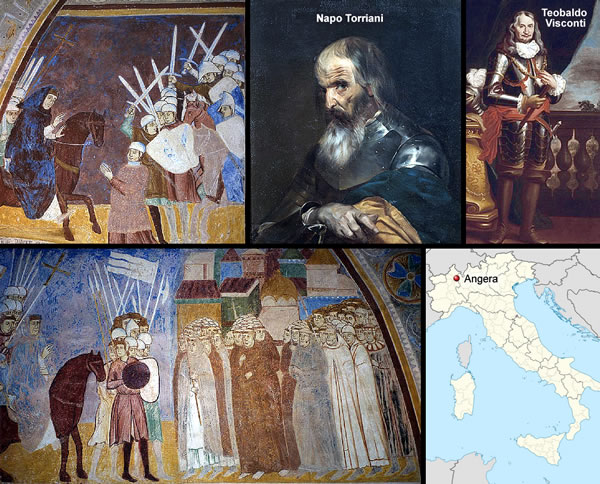
Master of Angera, Surrender of Napo Torriani to Ottone Visconti, fresco in the Hall of Justice; and Portrait of Napo Torriani, by an unknown artist of the early 19th century - Portrait of Tebaldo Visconti, by Adler, Salomon (1630-1709) - Master of Angera, detail with The Entry of Ottone Visconti into Milan, fresco, Hall of Justice.
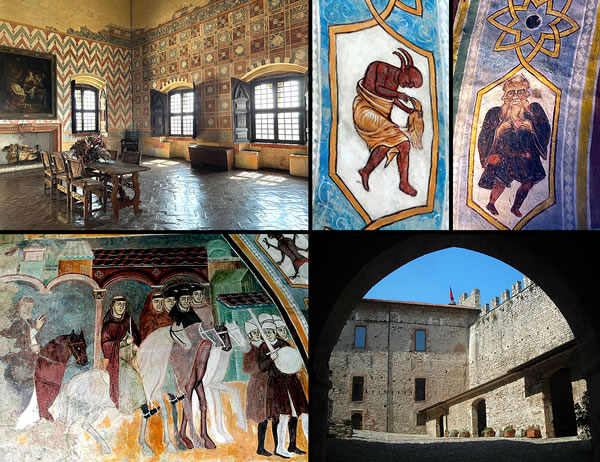
Frescoes inside the Borromean Fortress
This page was last edited on 14 March 2026
© andmorestory.eu - All right reserved