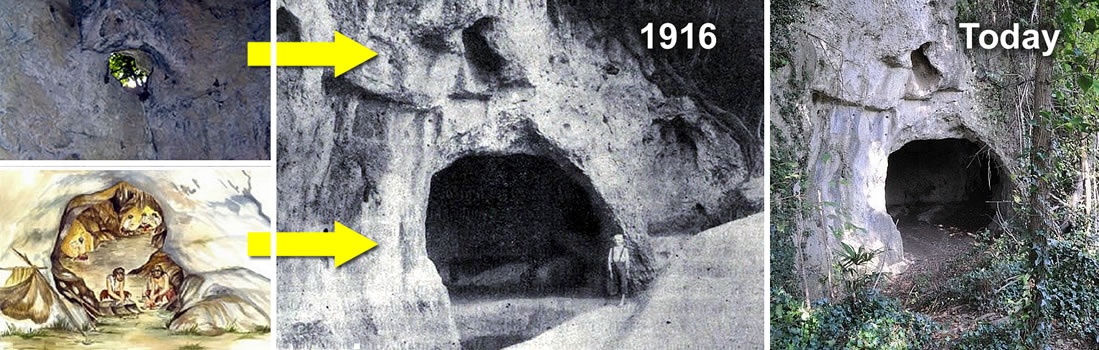
The appearance of the entrance and partly also of the interior after the 1916 excavation and today.

Halfway along the road leading to the fortress di Angera, a path on the left leads to a natural cave in the limestone rock, which also receives light from a high crevice. It is called by the local inhabitants the "tana del louff" (wolf's den) and is situated halfway up the mountain. A flourishing vicus once stood there, its name preserved on a base with figurative reliefs (scenes of the Gigantomachy) and a dedicatory inscription to Jupiter Optimus Maximus by one M. Calvius Satullio, vican(us) Sebuini (C.I.L. V, 5471). Among the antiquities of the vicus Sebuinus, those relating to the local cult of Mithras undoubtedly stand out. It was imported from Persia by the Roman legions and enjoyed great popularity under Trajan and Hadrian. In Roman times, in the wolf's den, the local inhabitants celebrated the dark mysteries of Mithras and Isis, accompanied by bacchanals and orgies. Ovid advised mothers not to lead their daughters to pagan shrines lest they be scandalized: the most nauseating vices were placed upon the altars, and at their feet, infamous rites and abominable sacrifices were performed. Here are the deities identified in the inscriptions and Roman monuments discovered in Angera: Hercules, the god of navigation; Vulcan, the god of fire and metallurgical industries; Silvanus, the god of the countryside; Isis, the symbol of the forces of nature; Mithras, the god of the sun; Cybele, the goddess of the fertility of the earth; the Matronae, the goddesses protecting the regions; incestuous Jupiter, the father of gods and men; Venus, the immodest goddess of carnal beauty and dishonesty; Apollo, the god of music, terrible in his vengeances; Mercury, the god of commerce and thieves, who commended themselves to him so that their swindles might succeed safely and with impunity; Panteo, a simulacrum representing the synthesis of all the gods. The cave at Angera is the only shrine of Mithras within a natural cave known in Italy. It is not open to visitors, but the finds are kept at the Angera Civic Archaeological Museum. Archaeological excavations carried out in 1916 in the cave brought to light structural remains and finds from multiple eras, including traces of Roman-era frequentation of a cultic nature, which numismatic data suggest began in the second half of the 3rd century and the beginning of the 4th century AD. The deity venerated here is Mithras, as attested by two epigraphs, unfortunately found in reused conditions: one dedicated to Mithras himself and the other to Cautopates, one of the two torch-bearers associated with the god. The 1916 excavations involved the removal of 70 cm of deposit across the entire surface of the cave, until a beaten earth floor and a hearth, located under the niche present in the back wall, were brought to light. Investigation of the underlying levels was carried out by cutting a trench transversely from the entrance to the back wall. This revealed a succession of deposits and structural elements, with the presence of a second beaten earth floor level, covered by a thick layer of earth containing Roman pottery, glass fragments and crystalline quartz, animal bones, and numerous valves of Unio vulgaris. Based on the scant information in the excavation publication, it seems that the greatest concentration of coins was in the deposits beneath this second beaten floor, near the cave entrance, and over a relatively large area, on either side of a small wall built in a later period with remains of already-ruined Roman structures, aiming to convert the cave into a stable or storage area. Perhaps the coins were part of a hoard, concealed after the cessation of the cave's use as a Mithraeum and disturbed during the construction of the aforementioned wall. The coins have disappeared without a trace, but we still have a precise description of them at the time of discovery: the oldest ones (three asses of Valentinian III, one of Faustina I and one of Antoninus Pius for Marcus Aurelius Caesar, and a sestertius issued in the name of Otacilia) were found outside, near the cave entrance; while the group of 261 coins found inside shows a particular concentration of materials from the post-Constantinian age up to the 80s of the 4th century AD. Only one coin appears from the emissions of the late 4th and early 5th centuries AD, and a single coin is attributable to those of Valentinian III between 425 and 455. The presence of a fairly high number of coins inside the cave does not seem to justify the interpretation of a concealed hoard. If it were a single small treasure hoard from the 5th century, we should not find antoniniani, except for certain types not present here, such as those for Divo Claudio, and probably in the form of imitations. Furthermore, theoretically, and subject to verification of the currency circulation in the area, we should observe that coins of more recent issue, i.e., from the first half of the 5th century, maintain higher percentages. Instead, it is precisely the most recent specimens that are present in low percentages. A final consideration casts doubt on the interpretation as a hoard: in the hypothesis, yet to be verified, that the second identified floor level represents that of the Mithraeum and that the wall was built after its use ended, if the coins were part of a hoard found during the excavation of the wall's foundation trench, their dispersion would have occurred over a surface later than that used for the place of worship, not beneath it. In the current state of knowledge, it appears more probable that the coins constitute gifts presented to Mithras. As for many other aspects of Mithraic ritual, no literary source offers information on monetary offerings. Only archaeological evidence leads us to recognize their existence and hypothesize that they were made according to methods and purposes analogous to those, much better known, relating to other types of cults. Proof that initiates also consecrated sums of money to their god is offered by their discovery in other Mithraea. In conclusion, it seems plausible to recognize in the Tana del Louf at Angera the seat of a cult dedicated to Mithras, based on the choice of a cave and some analogies with other Mithraea. The coins found here could attest to its final phase of use and the adoption, also here, of this type of offering.
The appearance of the entrance and partly also of the interior after the 1916 excavation and today.
This page was last edited on 14 March 2026
© andmorestory.eu - All right reserved