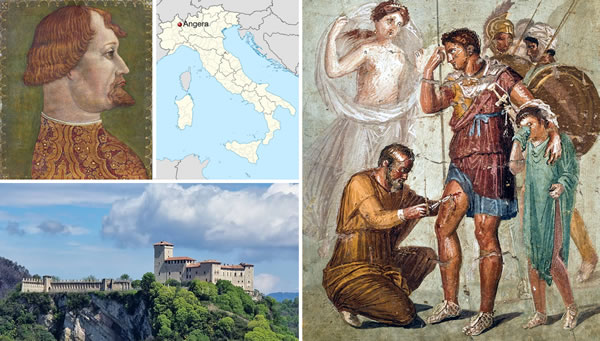
The City Founded by the Grandson of Aeneas
Angera is a town of just over five thousand inhabitants located on the Lombard shore of Lake Maggiore. Its ancient name, Angleria, may derive from the Latin 'in glarea' ("on the gravel"), indicating its proximity to the lakeshore; or from 'Angularia', from 'angulus', in the broader sense of "a corner of land eroded by river currents."
Thanks to its fortunate sunny exposure, the town enjoys a particularly mild climate, and it is not surprising that the area has been inhabited since the late Paleolithic period, as evidenced by artifacts found in a natural cave on the hill of the fortress (fortress).
However, it was during the Roman Empire that Angera experienced its first significant developments, testified by finds related to the veneration of the god Mithras, dating back to the 2nd century BC. Numerous further inscriptions and gravestones tell of the importance of this settlement, known at that time as Vicus Sebuinus. Indeed, between the 1st century BC and the 1st century AD, present-day Angera was an important market center for timber and the prized "pietra d'Angera" (Angera stone), a building material still used today. Following its commercial fortunes, the town became the main center of the province and took the name, still during the Roman imperial period, of Stazzona, from statio, meaning a station where troops and naval fleets were housed.
Ancient Angera was destroyed by Ataulf in the 5th century. It was later rebuilt by the Lombards, of whom we have knowledge thanks to numerous place names and some local documents. Subsequently, the territory of Stazzona became a County (Contado) and was included in the Duchy of Milan under the authority of Charlemagne. Sources from the 10th century attest to the town's oldest name, 'Statio', which seems to indicate the role of port and trading station that Angera played in ancient times.
The name changed in the early Middle Ages to 'Angleria', of uncertain etymology, but most likely derived from the contraction of 'Ad Glaream', meaning "near the gravel," which was abundant in the alluvial soil where the main nucleus stood. At least since the 11th century, a fortified structure stood on the site of the current fortress di Angera, which later became the property of the Archbishops of Milan.
In the 13th century, the structure passed into the possession of the Visconti family, who transformed it into a powerful fortress dominating the entire town and the lake. A late legend, the work of flattering genealogists, attributes the founding of Angera to Anglo, grandson of Aeneas, from whom a line of rulers supposedly descended, all the way to the Visconti, who indeed numbered among their titles those of Angli and Counts of Angera. In reality, it was they, the lords of Milan, who promoted this mythical genealogy to strengthen the prestige of their house. Their desire was to trace their origins and nobility back to the mythical age of ancient Rome through the creation of panegyrics. These were prose works with celebratory aims, mostly skillful forgeries designed to bring luster to minor lineages that lacked a proven family origin.
The ambition of Gian Galeazzo Visconti (1351-1402) knew no bounds. He had the genealogy of his house imagined, and it was compiled in the most grossly sumptuous manner possible. Thus the chronicle of the Counts of Angera was created. They resorted to Aeneas of Troy, whose grandson Anglo was made the founder of Angleria, the Latin name of a fortress in the Lake Maggiore district called Angera.
In the 14th century, although part of the assets of the Archiepiscopal Table (Mensa arcivescovile), the fortress di Angera was effectively used by the Visconti: in the document of excommunication of Archbishop Cassone della Torre against Matteo Visconti in 1314, among the charges was that of having illegally occupied it.
The Archbishop of Milan was invested by the Holy See with the southern part of the county, which was the most substantial nucleus of the ancient domain of the Milanese Church, until the county itself was granted by Pope Clement VI in 1350 to Caterina, daughter of Bernabò Visconti.
The fortress was then acquired in 1384 by the Visconti family together with the archiepiscopal assets of Angera.
From Anglo they traced the descent of many kings and many heroes. Leaning on this genealogy, Gian Galeazzo's successors later aspired to add the title of Duke of Milan to that of Count of Angera. Titles were invented or bought: on May 11, 1395, Emperor Wenceslaus granted the imperial ducal title to Gian Galeazzo Visconti for the price of 100,000 florins; on September 5 of the same year, during a grand ceremony in Sant'Ambrogio, Galeazzo was crowned Duke of Milan.
In 1397, Wenceslaus, King of the Romans, elevated Angera to a county (contado), with jurisdiction over Lake Maggiore, in favor of Gian Galeazzo Visconti, Duke of Milan. A new imperial diploma led to the constitution of the County of Angera (January 25).
It is not at all surprising that, having risen in the social hierarchy, the Angera family subsequently appropriated both the myth of origin constructed for the Visconti and the comital title, which appears as early as the first half of the fifteenth century and persists sporadically in various notarial documents of the first half of the sixteenth century, all the more so after the recognition of the title of Count Palatine granted in 1523 by Charles V to his distant cousin Pietro Martire Angera.
But from the definitive Visconti possession in 1397, the history of Angera was particularly troubled. Emperor Wenceslaus invested Gian Galeazzo as Count of Angleria, and under his rule there were a few years of peace until his death in 1402, the year in which two disastrous situations occurred: the civil war between Guelphs and Ghibellines and the raids of the lake pirates, the Mazzarditi. It is presumed that in the fifteenth century the economic status of Angera was not particularly rosy, given the consequent tax exemptions granted by the Visconti in 1412. The inhabitants were exempted from paying taxes to help them overcome that lean period, which was the opposite of the prosperity enjoyed by the inhabitants of the opposite shore of the lake in Arona. In 1439, this fief was worth three times the price paid for Angera by Vitaliano Borromeo, banker and treasurer to Francesco Sforza, when he obtained the fief from the Ambrosian Republic.
Once the Visconti lordship ended in 1449, the Community of the Ambrosian Republic decided to sell it to the ducal treasurer Vitaliano Borromeo. In 1449, the land and fortress of Angera were given to the Borromeo family, who held it with the title of marquis, until the abolition of feudal bonds.
The assignment of the fief to the Borromeo family was, however, contested by the heirs of Francesco Sforza, particularly by Ludovico il Moro. In 1497, he took the possession from Gilberto Borromeo and conferred upon Angera the title of city (città) and granted it the right to hold two annual fairs and a weekly market. Throughout the fifteenth century, Angera enjoyed Sforza privileges and exemptions, but the end of the happy days was approaching: Charles V descended into Italy at the head of the French regiments, and the Duchy of Milan, like the rest of Italy, became a battlefield between the French and the Spanish. The latter emerged victorious, and in 1535, with the death of Francesco II Sforza, the Duchy of Milan came under their dominion. In the immediate post-war period, the Borromeo family, who had been allied with the French, had difficulty dealing with the Spanish, but they reached an agreement in 1623, the year in which they obtained the conferment of the fief of Angera.