The Flammable Marshes
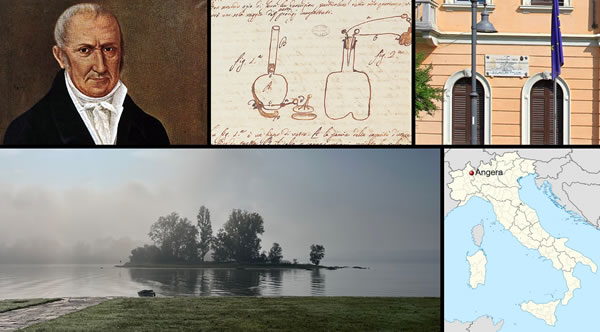
Towards the end of 1770, the people of Angera had noticed something strange: bubbles rising from the marsh that could be ignited with a flame. This "burning air" was a source of both wonder and apprehension. It was a local legend, a strange and mysterious phenomenon of nature. This attracted the attention of the physicist Alessandro Volta (1745-1827).
The study of gases was fashionable at that time, and he was no absolute novice. At 13, he began his humanities studies in rhetoric and philosophy at the Jesuit school in Como. At 16, he entered the Royal Benzi Seminary in Como, where he completed his studies and struck up a friendship with Canon Giulio Cesare Gattoni, who encouraged the young man's scientific vocation by making his natural science laboratory available to him. Thus, his parents' plans to steer him towards the priesthood or legal studies were definitively abandoned. In 1769, Volta published his first scientific paper, and seven years later, he was appointed permanent professor of experimental physics at the schools of Como.
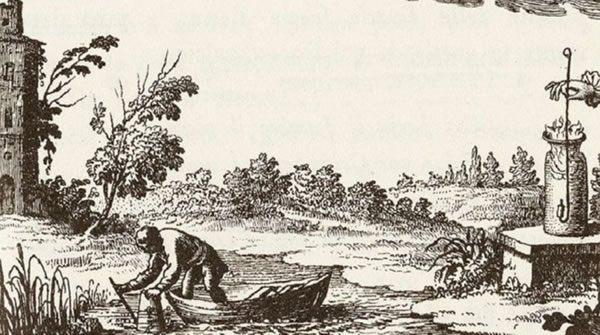
In 1776, Alessandro Volta was invited to Angera by Carlo Ludovico Giorgio Castiglioni, the land registry chancellor of the time. Castiglioni's sister, Teresa, had married Cesare Ciceri, a nobleman from Como, and this most likely explains the friendship with Volta and the invitation to spend a few days in the area. The visit to Lake Maggiore was brief but fruitful. It is said that during an outing by boat, he reached a marshy area in front of the Angera reed beds and around the shores of Isolino Partegora. There, he stirred the bottom with the help of a stick and saw air bubbles rising to the surface. Curious, he trapped the gas inside glass vials and began to study its properties. He conducted a series of tests to determine its composition. He meticulously documented his findings, applying the scientific method to unravel the secrets of this unusual phenomenon. It was not mere observation; it was scientific research. He wrote in his diaries:
This air burns quite slowly with a beautiful bluish flame […] indeed, it crackles with the greatest din and noise when mixed with a volume of common air double its own; that, on the other hand, ignites and explodes to maximum effect if eight parts of common air are added to one measure of it.
I took it into my head to test whether, by means of electric fire alone, the flammable air could be made to ignite. […]
As for the air obtained from metals by dissolving them in an acidic liquor, the goal is achieved much more easily than one would believe.
I merely present the mouth of a flask full of this air to the Shield of my electrophorus.
The spark […] sets that air on fire, […] just as would have happened if I had intermittently brought the flame of a candle near it.
He would observe the same phenomenon later in Pietramala (today a hamlet of Firenzuola) in 1780, and near the ruins of ancient Velleia, on the hills of Piacenza, in 1781.
Thanks to his meticulous experimentation, Volta identified the key ingredient in the "flammable air": methane, a natural gas produced by the decomposition of organic matter. It was a new gas, different from the already known metallic flammable air (hydrogen). He recognized it as a distinct gas, different from other components of air. It was a very important discovery that added a new piece to the mosaic of atmospheric chemistry.
A plaque on the façade of the Town Hall of Angera commemorates that Alessandro Volta, on November 3, 1776, discovered the phenomenon of flammable air in the nearby marshes. The Italian physicist succeeded in isolating the gas, which he called "flammable air of the marshes," what we today call methane.