The freedom enjoyed by Etruscan women at Banditaccia (Caere)
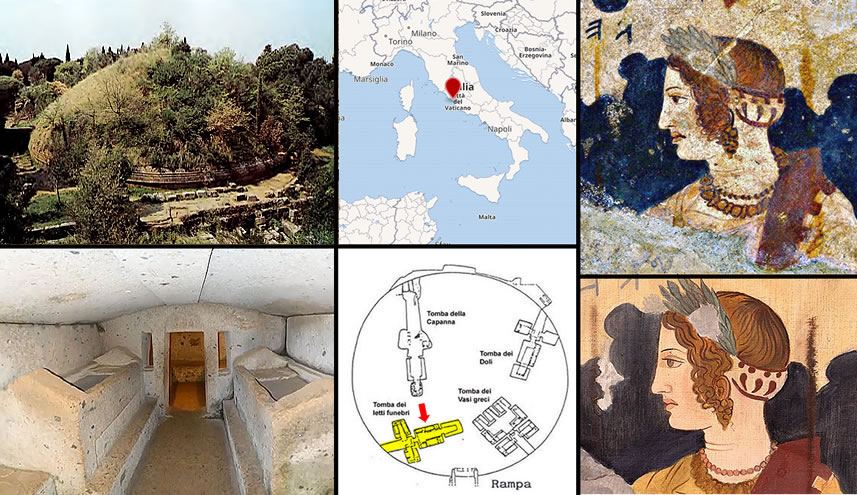
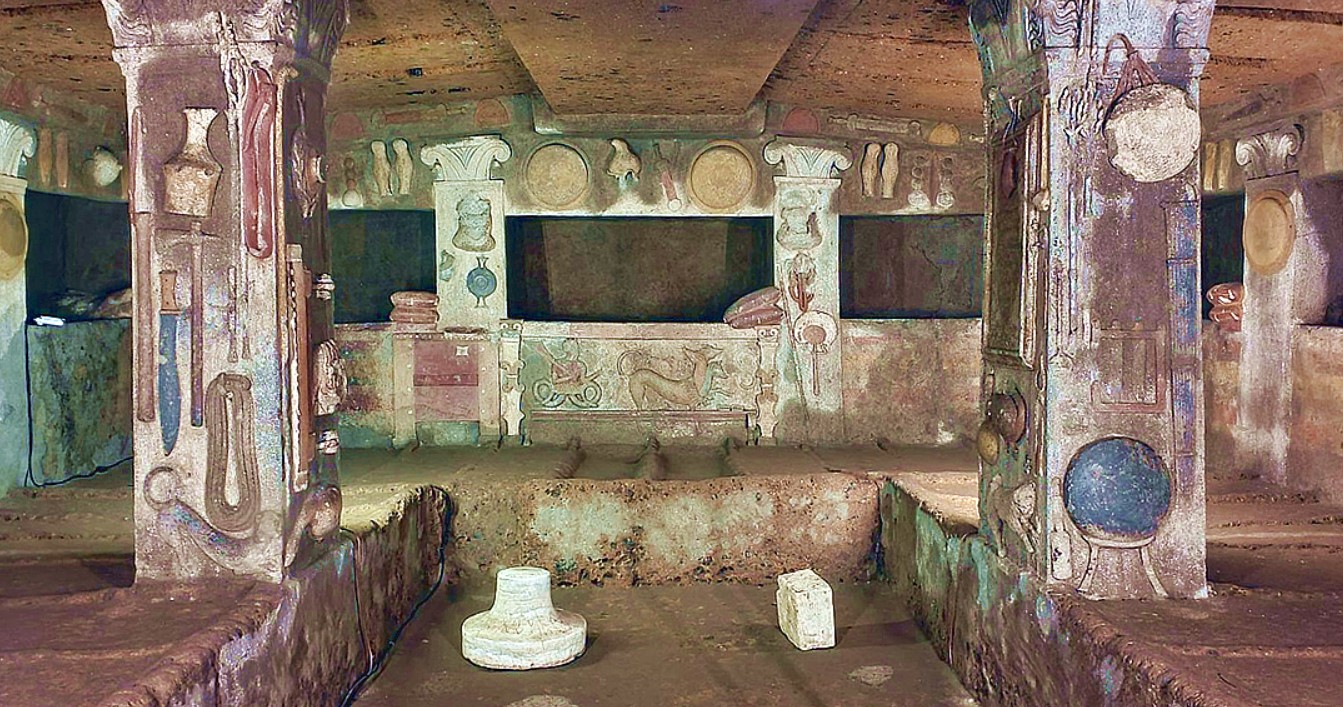
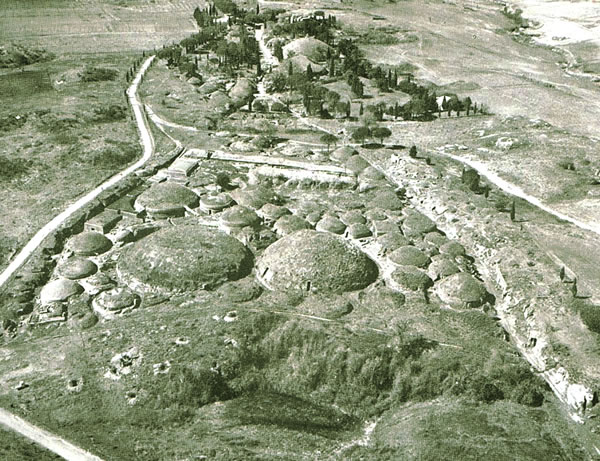
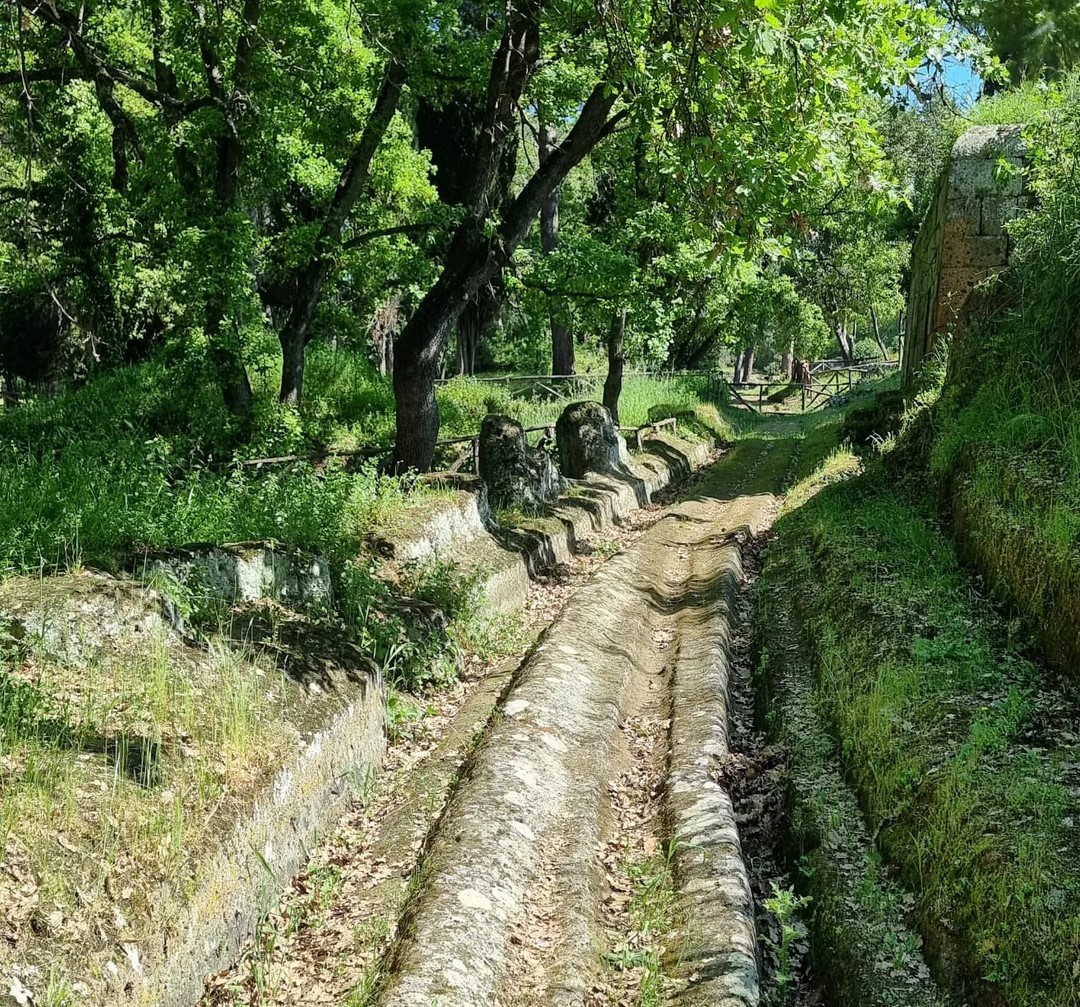
In the Etruscan Necropolis of Banditaccia, you can visit several tumulus tombs dating back to the 7th and 6th centuries BC. These were carved into banks of tufa and feature a circular ground plan that encloses multiple tombs within. Each tomb represents the dwelling of the deceased, complete with a corridor (dromos) providing access to the various rooms. For example, Tumulus II houses four tombs, including the one known as the Tomb of the Funeral Beds. It takes its name from two monumental, sarcophagus-like funeral beds for women, located in the main chamber. Beyond this, along the same axis, lies another chamber containing simple benches or niches for burials. The large chamber is preceded by two smaller side rooms, which hold two more funeral beds—one male and one female.
Etruscan funeral beds can be distinguished by their shape: those belonging to women have a triangular headboard at both ends of the roof-like structure, while those of men are shaped like klinai (banqueting couches). In tombs with double burials, when looking at the beds from the entrance, the husband generally lies on the left and the wife on the right.
The Tomb of the Funeral Beds is significant because it demonstrates the high status of Etruscan women in society at the time, showing they could even hold a position superior to men. Numerous details inside confirm this: it is a tomb initially created for at least one woman, and the main chamber contains two female beds that are larger than the male ones, a sign of their social prestige. It dates back to the end of the 6th century BC, corresponding to the reign of Tarquinius Priscus, a period when the Romans conducted a lengthy military campaign against Caere (modern Cerveteri). This era corresponds to a peak in the economic prosperity of Etruscan society, which enabled women to begin participating more actively in public life. At that time, no other women in the ancient world enjoyed such a high degree of emancipation, freedom, and autonomy as the Etruscan women of Caere. This remained true at least until the 4th century BC, as later the influence of the Greeks and Romans led to a regression in their social standing.
The Etruscans were an ancient Mediterranean civilization that flourished from the 9th to the 1st century BCE. To the Greek poet Homer (8th century BCE), they were monstrously fierce pirates who jealously guarded access to the sea that still bears their name. During the 6th to 5th centuries BCE, the word "Tyrrhenian" referred specifically to the Etruscans, for whom the Tyrrhenian Sea is named, according to the Greek geographer, philosopher, and historian Strabo (c. 64 BCE - 24 CE).
The Greek historian and geographer Herodotus (484-425 BCE) provided an account of Etruscan origins that was almost universally accepted in antiquity, except by Dionysius of Halicarnassus (c. 60-7 BCE): according to Herodotus, they were inhabitants of Lydia in Asia Minor who decided to emigrate, following one of their king's sons to the land of the Ombrikoi. By Ombrikoi, he meant—like all Greek writers—the Umbrians, who according to tradition once occupied a much larger portion of Italy than the modern province bearing that name. The Lydians settled among them and called themselves Tyrsenoi, after the prince who led them.
But archaeological evidence has confirmed that the Etruscans were a native population of the Italian peninsula from the earliest times, dating back to the Late Bronze Age and Early Iron Age. The full manifestation of the Villanovan civilization occurred around the 10th century BCE, meaning their history spans a thousand years. The Etruscan civilization left its mark across many areas of our peninsula, from north to south, from Bologna (Felsina) to Salerno.
The Roman historian Livy (59 BCE - 17 CE) noted: "The renown of their name filled the whole length of Italy from the Alps to the Sicilian strait."
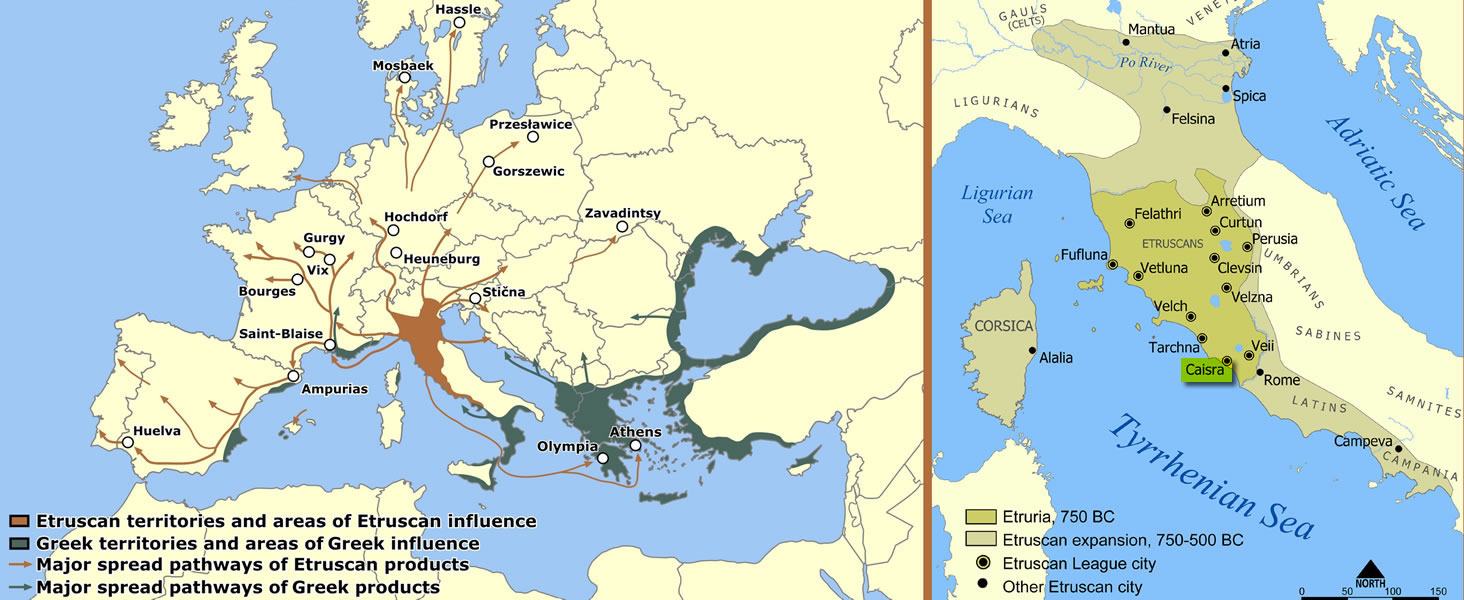
What we know with certainty is that their cities appear to have developed from the preceding Terramare culture, and they initially inhabited ancient central Italy (Tuscany, western Umbria, and northern Lazio). After conquering adjacent lands, their territory (Etruria) covered parts of both the northern and southern Italian peninsula.
They shared a common language and culture, forming an early federation of 12 city-states (Dodecapolis, Greek for "twelve cities"), from whom the Romans derived considerable cultural influence. The growth of their city-states was linked to the acquisition of wealth through trade.
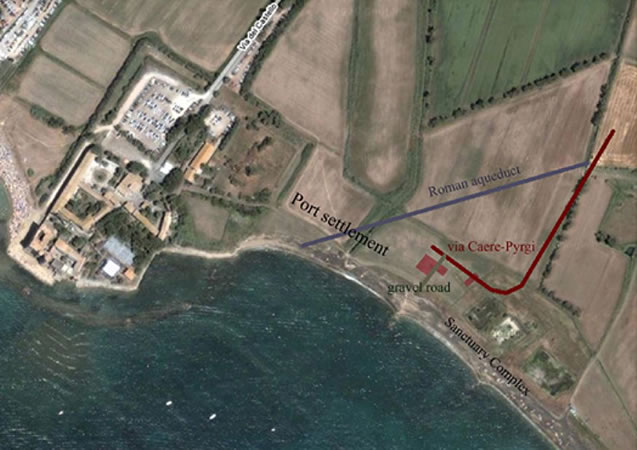
The wealthier cities were typically situated at a safe distance—about 5 km—from the sea coast. One such example was Caisra or Cisra (Caere or Agylla to the Romans), modern-day Cerveteri (approximately 50–60 kilometers north-northwest of Rome). It was one of the most important and populous cities of the Etruscan League, and one of the larger settlements in southern Etruria, occupying an area 15 times larger than present-day Cerveteri. Caisra had three seaports, which were vital for overseas trade. Pyrgi was the natural harbor and hosted sanctuaries for foreign worship.
Today, the area of Cerveteri and Banditaccia is best known for its Etruscan necropolis (cemetery) and archaeological treasures.
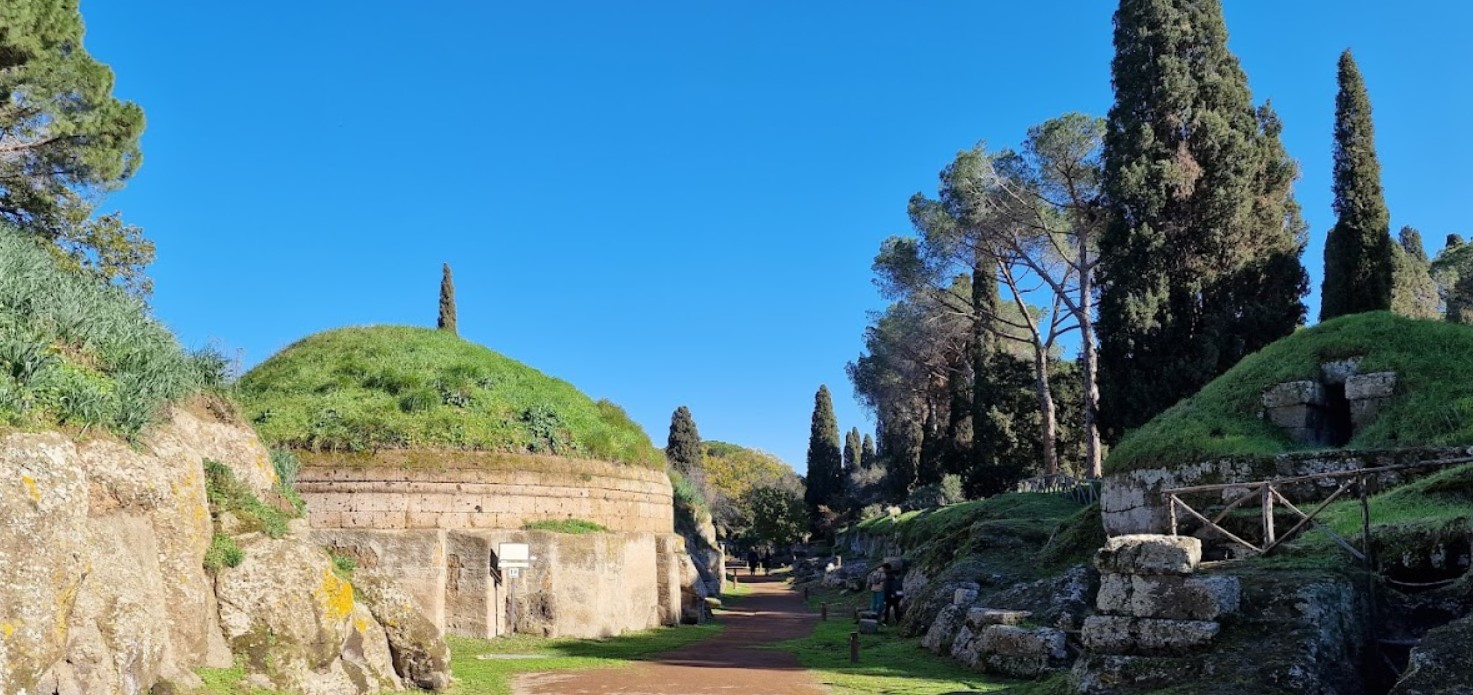
Banditaccia is the site of the largest necropolis of Caisra and one of the largest in the ancient Mediterranean world. It encompasses thousands of graves arranged like a city with neighborhoods and streets. The site extends over approximately 400 hectares, though the fenced and visitable portion represents only 10 hectares and contains about 400 burial mounds. It developed from the 9th century BCE (the Villanovan period) until the 3rd century BCE (the Hellenistic-Roman period) and is traversed by a burial road more than 2 kilometers long.
The hundreds of circular mounds belonged to high-ranking families and have yielded rich grave goods, including objects imported from the Near East and Greece. Observing these tombs, it becomes clear how central the family (lautn) was to Etruscan society, with the married couple (tusurthir) at the family's core. The Etruscans were a monogamous society that emphasized pairing:
• The lids of numerous sarcophagi were decorated with images of smiling couples in the prime of life, often reclining beside one another or in an embrace.
• Many tombs included funerary inscriptions naming the parents of the deceased—the father's name often written in Latin, and the mother's in Etruscan—demonstrating that maternal lineage was important in Etruscan society. Examining the archaeological findings reveals that Etruscan women enjoyed greater freedom than other women of their time:
• Spindle whorls and spring scales indicate they practiced manual work such as spinning and weaving, while loom weights show they produced their luxurious robes—the great and small luxuries for which Etruria was renowned throughout the Mediterranean.
• Inscriptions on some of their mirrors, used to explain the scenes depicted, demonstrate they could write and read.
• Funerary objects like exquisite Corinthian vases or glass vessels show they used scented oils.
• Frescoes depict them perfectly attired and groomed: applying cosmetics with ivory sticks, combing their hair with ivory combs, flaunting large earrings, wearing finely woven crinkled dresses and soft red shoes with pointed toes, their pale skin set off by flushed cheeks and deep red lips. They participated in public life or events (as spectators or participants), attended banquets, and rode in carriages.
Regarding the role of women in Etruscan society, the story of Spurinna, as recounted by the Roman historian Valerius Maximus, can serve as an illustrative example. Spurinna was an incredibly handsome young Etruscan, so much so that all women of every social rank and age sought to win his favor. He found himself besieged by both the women and their jealous husbands. Thus, he enacted what seemed to him the only possible solution: he disfigured his handsome face with the blade of a sword, setting a formidable example of modesty and chastity. In this story, the women appear as seductresses, while the men are attentive to their reputation and chastity; the Romans were greatly astonished by this tale. Beyond the historical veracity of this anecdote, what matters is the testimony it provides about the status of women in Etruria.
The honored position of Etruscan women was a source of great astonishment among the Greeks, who were incapable of appreciating it. Romans, meanwhile, viewed them as strong, influential participants in both public and private life. However, we also learn several details about the libertine conduct of Etruscan women from Theopompus, in his Histories (4th century BCE):
Sharing wives is an established Etruscan custom. Etruscan women take particular care of their bodies and exercise sometimes along with the men, and sometimes by themselves. It is not a disgrace for them to be seen naked. They do not share their couches with their husbands but with the other men who happen to be present, and they propose toasts to anyone they choose. They are expert drinkers and very attractive.
The Etruscans raise all the children that are born, without knowing who their fathers are. The children live the way their parents live, often attending drinking parties and having sexual relations with all the women. It is no disgrace for them to do anything in the open, or to be seen having it done to them, for they consider it a native custom.
Theopompus's account—which goes on to discuss public displays of affection, spouse-swapping, and young male lovers—is almost certainly exaggerated. The men and women who recline together on the famous sarcophagi from Banditaccia appear overwhelmingly to be married couples, whether divine or mortal. Their conviviality nowhere approaches Roman standards of probity—a Roman general was never supposed to laugh. Yet looking at the banquet scenes from the tombs, one sees nothing like the Greek symposiums either.
Since the Villanovan period, women were regarded as equal to men, and in rituals, aristocratic women often held roles equal to those of men, if not even more important.
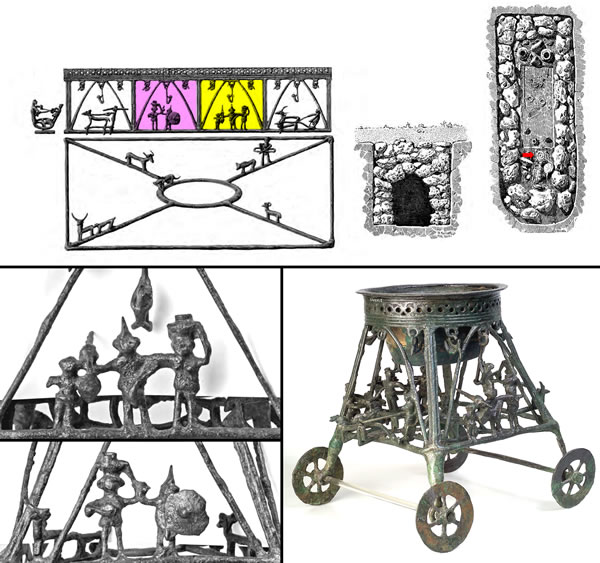
Observing the decorative elements adorning the Cart of Bisenzio, among the various groups of figures representing different daily life activities, one can notice a scene depicting a nuclear family consisting of wife, husband, and child (yellow square); and a scene of hierogamy (pink square). Hierogamy (from the Greek hieros gamos, "sacred marriage") is an ancient religious rite symbolizing the sexual union between two deities, or between a deity and a human (often kings or priests). Widespread in Mesopotamia, Egypt, and Greece, its purpose was to ensure fertility, prosperity, and cosmic order through the union of the masculine and feminine principles.
• In the yellow square, the nude woman carries a biconical container, typical of Etruscan culture since the Villanovan period, used for transporting water—an essential element for life and thus laden with symbolic value; the man is depicted as an ithyphallic warrior with a crested helmet and a spear; while the smaller figure wears a loincloth and holds a shield. Note how both the male and female figures are of the same height, demonstrating that they represent two social figures of equal importance: the man as warrior and hunter, pater familias, and the woman as wife, mother, and mistress of the household.
• In the adjacent square (pink), the woman appears larger than the man, in a gesture of welcoming and protection. She is depicted drawing milk from her breast and transferring it into the biconical container on her head. This gesture is to be understood as a ritual offering of nourishment to the young warrior, i.e., as a preparatory act for mating/hierogamy. Through her role, the woman becomes the guarantor of the cyclical order of reproduction, while the man is required to prove his skills in hunting and plowing and ultimately to demonstrate his valor in the supreme test of armed combat.
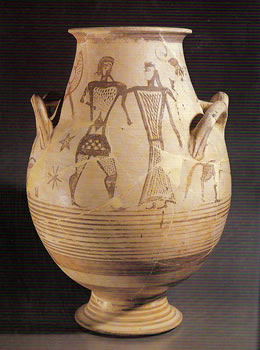
It could be surmised that the rise and death of the warrior are evoked in a single act inherent to the female function, the beginning and end of the biotic cycle. As an expression of female power, this necessarily also implied oversight of conception and sexual union which, in a funerary context, also takes on the significance of a procreative force in the sense of rebirth. Another example in which Etruscan men and women are depicted as being of equal height, and therefore equal dignity, is the biconical krater found in 1957 in tomb 297 at Monte Abatone and painted by the Painter of the Heptachord. They dance together. The figures are distinguished only by color: the men are black, the women red.
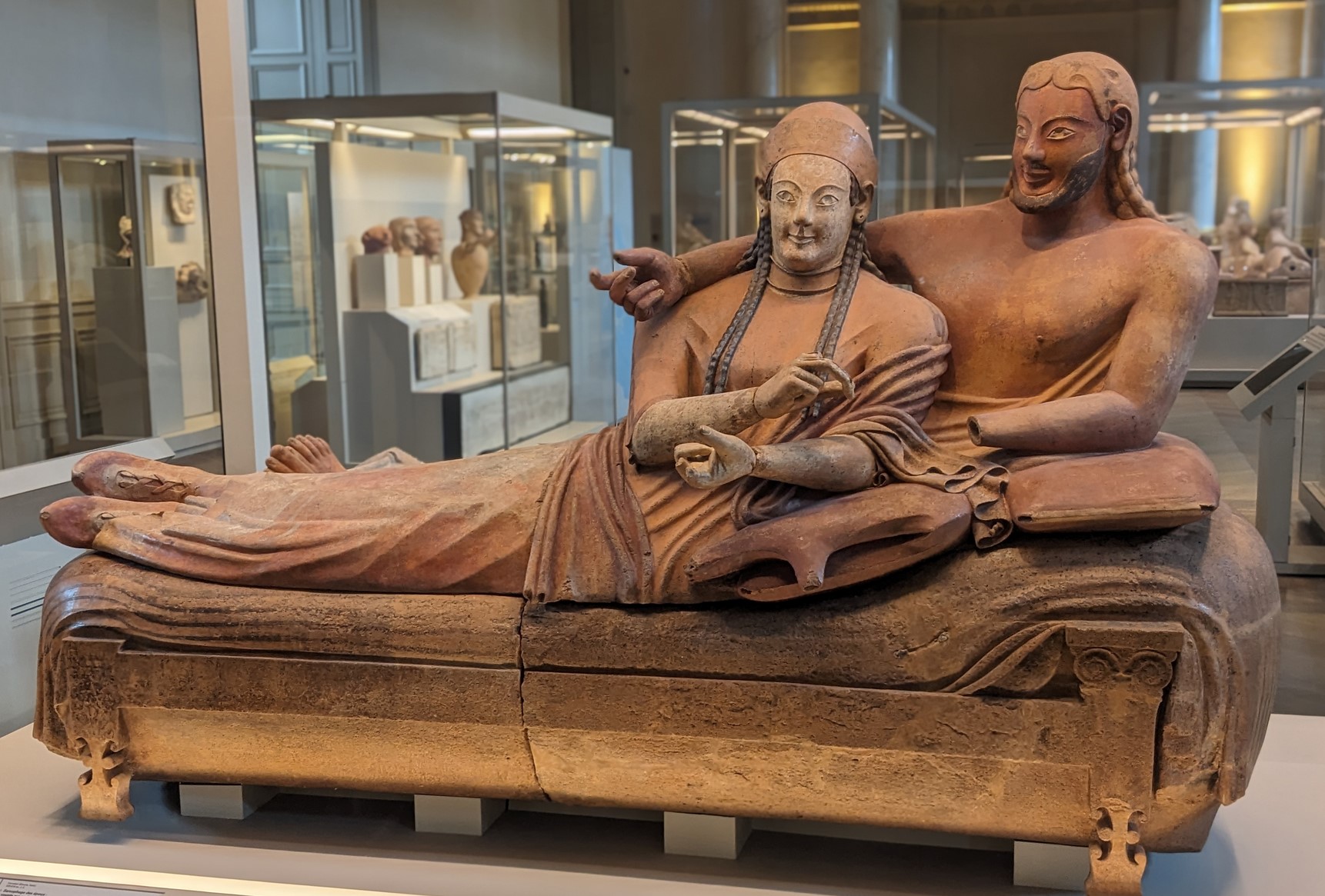
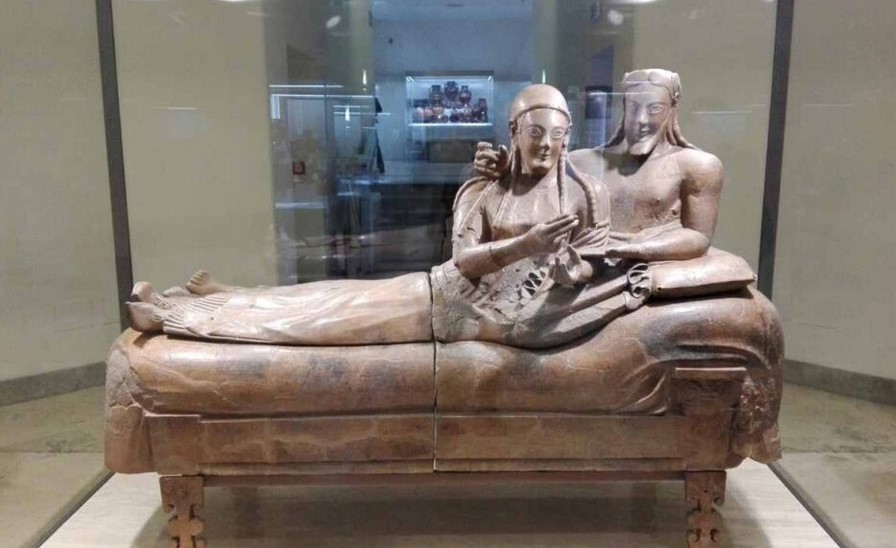
Scholars conventionally refer to the "Heptachord Painter" as an artisan active in Cerveteri between 680 and 660 BCE. The vase is unique, both in terms of its form and its narrative decoration: it represents one of the earliest episodes of an epic-mythological nature depicted in Etruscan art. On the main face, a woman, with a long braid and a rhomboid-patterned chiton, raises her right hand to touch the face of a warrior wearing a loincloth and greaves—a gesture that in Greek literary and iconographic tradition is associated with the act of supplication. The scene perhaps depicts the encounter between Helen and Menelaus after the fall of Troy. Etruscan women enjoyed a degree of freedom unheard of in the Greek and Roman worlds: they sang, danced, dined with men, and were (according to Greek sources) sexually liberated. A sense of joyous freedom radiates from two beautiful terracotta sarcophagi found at Banditaccia toward the end of the nineteenth century—one now in the Museum of Villa Giulia in Rome, the other in the Louvre Museum in Paris.
A sarcophagus is a box-like funerary receptacle for a corpse, most commonly carved in stone and displayed above ground.
The Sarcophagi of the Spouses from Banditaccia (Caere) are considered masterpieces of Etruscan art. They are quite similar and contemporary, suggesting they may be products of the same artistic workshop. They belong to practically the same generation as the marvelous Apollo of Veii.
Images of banquets appear as early as the sixth century BCE—the probable date of the Banditaccia sarcophagi—depicting husband and wife reclining as equals while participating in a banquet, likely a funerary banquet for the dead.
This would have been unimaginable in contemporary Greece, where courtesans—not wives—were the only women attending public banquets or symposia. These women, called hetairai, were prostitutes who danced and played pipes, posing no threat to men gathered for evenings of intellectual debate.
Roman women led similarly restricted lives, remaining sober and silent in men's presence. The affectionate gestures and tenderness between Etruscan couples convey a strikingly different attitude regarding women's status and their relative equality with husbands.
We can observe the freedoms Etruscan women enjoyed in life—dining alongside men, partaking freely of wine—and in death as well, with their burials rivaling those of their fathers, brothers, and uncles, filled with great quantities of luxurious goods. The body of the sarcophagus is styled to resemble a kline (the traditional convivial bed on which banquet guests reclined). The figures are half-sitting, half-reclining, resting on highly stylized cushions, and are finely detailed—for example, their hair is plaited with stylized braids hanging rather stiffly at the sides of the neck.
The husband appears as a grave and dignified personage, wearing long hair and a well-shaped beard but with his upper lip shaved clean.
The wife has long plaited tresses hanging upon her shoulders; she wears a soft cap atop her head—as did every lady of rank—and characteristically Etruscan shoes with pointed toes. She does not wear the jewelry and heavy ornaments she would have worn in life but which have been discovered in tombs.
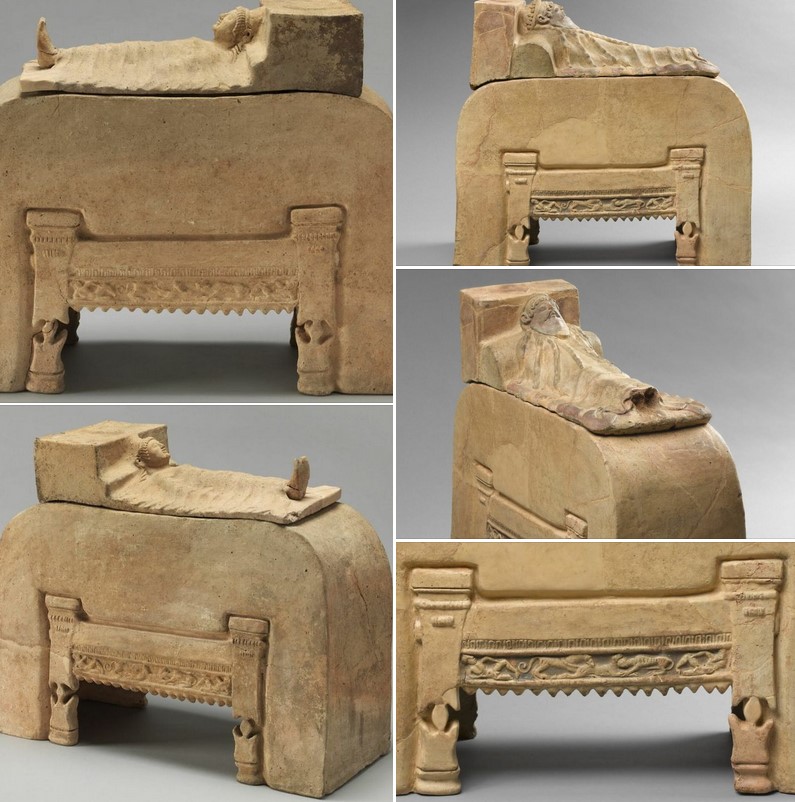
What remains unknown is what the figures held in their curled fingers. The arm positions of both figures suggest each must have held small objects. Since wife and husband recline on a banqueting couch, the objects could have been vessels associated with drinking, perhaps wine cups, or representations of food. Another possibility is that they held small vessels containing oil used for anointing the dead. Or perhaps they held all of these—food, drink, and oil, each a necessity for the journey from this life to the next. Whatever elements may be missing, the conviviality of the moment and the intimacy of the figures capture the life-affirming quality often seen in Etruscan art of this period, even in the face of death. Yet spouses were not always represented side by side. A pair of terracotta cinerary urns—also from the Banditaccia necropolis, dating to the 5th century BCE—containing the remains of two spouses depicts them individually on their kline (Tharnasna). The lower parts of the urns are identical, featuring bas-reliefs on the transverse of the beds showing two felines attacking their prey, along with two naked, semi-reclining male figures.
Note how the similarity of the urns (in both size and decoration) also testifies to the equality between wife and husband. Whatever missing elements, the conviviality of the moment and intimacy of the figures capture the life-affirming quality often seen in Etruscan art of this period, even in the face of death.