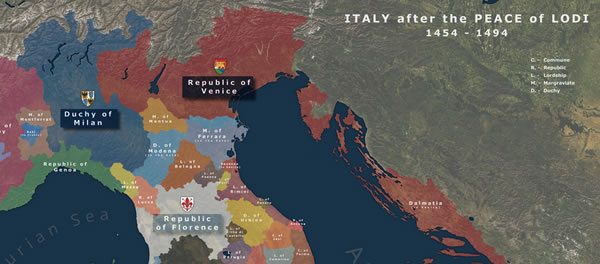
Italy after the Peace of Lodi, 1454-1494

Agnadello is a town in the province of Cremona, near which, in 1509, the tremendous battle took place in which the Republic of Venice was defeated by the French army of Louis XII (Louis of Orléans), thus losing its domains in Lombardy.
The battle was significant both in the general history of Europe and in numerous local ramifications. The news of the disaster caused such terror in Venice that the Senate released all the subject cities of the mainland from their oath, including Cremona: which, besieged by the French, surrendered almost without resistance.
At the very spot where the commander Bartolomeo d’Alviano, leading the militias of San Marco, positioned the Venetian artillery to repel the French attack, Louis XII had the church of Santa Maria della Vittoria (now abandoned) built to commemorate the triumph of his forces. Legend has it that the king himself, in a moment of fear as the battle’s outcome hung in the balance, buried a cannon there with its muzzle filled with gold coins. Over time, this tale has fueled persistent rumors, prompting some to undertake searches and others even to carry out clandestine digs in hopes of uncovering this hidden treasure. It is also said that on stormy, hail-filled nights, the ghosts of soldiers fallen in the famous battle awaken and roam the countryside, seeking vengeance. In the 15th century, the Republic of Venice, led by Doge Leonardo Loredan, was at the peak of its economic and military power: in possession of several bases in the Mediterranean Sea, it had begun a process of expansion into the Venetian and Lombard mainland through military conquests, acquisitions, and spontaneous dedications.
The first half of the 15th century is characterized by a series of wars pitting the two main Italian cities, Milan and Venice, against each other, both interested in political hegemony over north-central Italy. The interplay of alliances initially saw the formation of a Venetian-Florentine front against the Milanese faction, as both Venice and Florence were concerned about Milan's expansionist ambitions. After various vicissitudes, the rivalry was resolved in Venice's favor, while Florence, despite the aid provided to the Venetians, gained no political or territorial advantage. In the years between 1442 and 1454, the traditional alliances broke down and Florence, worried about Venice's numerous successes, allied itself with the new Duke of Milan, Francesco Sforza. Venice decided to desist from further wars to consolidate its hegemony over its Italian mainland possessions: it stipulated the 'Peace of Lodi' (1454), which definitively fixed the border between the Duchy of Milan and the Republic of Venice, and sanctioned the birth of the 'Italic League', tasked with ensuring a period of peace for the entire Italian territory.
This political landscape raised concerns among the rulers of the various states of the peninsula, particularly the papacy, which had watched helplessly in 1503 as it lost many important cities in Romagna. Through the 'League of Cambrai', all of Europe, with the exception of England, coalesced against the Serenissima. It was an international political-military alliance formed with the explicit aim of reducing Venetian ascendancy and the Republic's mainland dominion. It was promoted by Pope Julius II and was secretly constituted in Cambrai on December 10, 1508. The apologist for Louis XII, Claude de Seyssel, conferred upon the league and the anti-Venetian campaign the character almost of a crusade. Louis XII of France directly informed the Republic of San Marco of his hostile intentions on December 14, 1508, through the Venetian ambassador in France. Exactly 5 months later, the pitched battle of Agnadello took place, fought between the Republic of Venice and the French.
The army of the Venetian republic consisted of 2,000 men-at-arms, 3,000 cavalry, and 30,000 infantry with 29 siege cannons and 120 field cannons. The militias were commanded by Nicolò Orsini and Bartolomeo D'Alviano.
The French army was composed of 2,000 men-at-arms, 18,000 infantry, 600 cavalry, and 67 large artillery pieces. The French marched towards Treviglio, which was occupied by a substantial Venetian garrison. They crossed the Adda at Cassano with 600 infantry and several hundred cavalry and first occupied Rivolta, then decisively targeted Treviglio; they besieged the city and began to batter down the walls with heavy artillery. The city soon surrendered. Only 1,600 infantry remained to garrison Treviglio, while the bulk of the French army returned to Milan to await the arrival of Louis XII from France, who arrived there on May 1, 1509.
Cremona was thus left practically completely unguarded. The Venetians, noticing this, then decided to counterattack to reconquer the lost territories and, from Fontanella, where they were camped, marched towards Rivolta and occupied it. Then they moved quickly towards Treviglio; upon arrival, they bombarded its walls for an entire day, until they opened a breach and, despite the heroic defense by the French and the people of Treviglio, the city soon capitulated and surrendered. Treviglio was completely sacked and partly set on fire: neither property nor people were spared. However, the sack of Treviglio was a major error by commander Bartolomeo d'Alviano, because many of his soldiers abandoned the army to go and sell the looted goods.
On May 8, King Louis XII left Milan to go to the aid of Treviglio. The army was divided into three parts: the vanguard commanded by Charles II d'Amboise; the main battle line commanded by the king; and the rearguard commanded by Marshal Gian Giacomo Trivulzio. Upon reaching Cassano, the king had two bridges built over the Adda: the cavalry crossed on the first, the infantry on the other. The French camped three kilometers from the Venetians, and the king had the bridges over the Adda destroyed to prevent defections and flight by his soldiers. On May 11, the French recaptured Rivolta and sacked it. Meanwhile, the Venetian army left Treviglio to head towards Pandino and prepare defenses against the enemy. King Louis XII, informed by spies of the Venetians' intentions, immediately left Rivolta for Pandino to reach the town before his adversaries.
The Venetian army was also divided into three parts: the first, the vanguard; the second, the main battle line; and the third, the rearguard, commanded by Bartolomeo D'Alviano and consisting of 500 cavalry and 10,000 infantry.
In the early afternoon of May 14, the vanguard of the French army commanded by the Seigneur d'Amboise, arrived near Mirabello, a farmhouse outside Agnadello where the rearguard of the Venetian army was already encamped. The French then began to fire their artillery; the Venetian commander sent messengers to Pandino to ask for help from the rest of the army and in the meantime prepared his soldiers for combat. From Pandino, he was ordered not to attack but to retreat and rejoin them. Despite the orders received, d'Alviano engaged in battle.
Initially, the combat was dominated by the Venetians until the bulk of the French army commanded by the king arrived; the fortunes of the battle then changed, and the Venetians retreated to a place more favorable for positioning their artillery (the place where the Mirabellino farmhouse stands today); but noticing this intention, the French preceded them and arrived at the spot first. Furthermore, around 4 p.m., a terrifying rainstorm broke out, which contributed to increasing the difficulties of the Venetian infantry, bogged down and surrounded by enemy cavalry. After three hours of battle, the French troops gained the upper hand and broke through the Venetian defenses, shouting: "Victory! Victory!". At this cry, many Venetians broke ranks, fled, and the defeat was total. The battle lasted from 2 p.m. until 6 p.m.; at the end, 14,600 dead were counted on the field. The spoils obtained were considerable, and there were many prisoners, including commander Bartolomeo D'Alviano, wounded by a lance blow, who remained under arrest in France for four years.
On May 20, a herald from the King of France went to Crema to demand its immediate submission to the King of France, on pain of the city's ruin: after two days of debate, there being insufficient troops in the fortress to defend it, they had to yield to the advice of Socino Benzeni, a friend of the King of France, advocating the prompt submission of the city to Louis XII. This was a very sad period for the city, and many people from Crema were accused of conspiring to bring their homeland back under Venetian rule. The French occupied the city left free by the Venetians, and on June 24, Louis XII entered triumphantly, accompanied by seven cardinals, by the Duke of Ferrara, Alfonso d'Este, by the Marquises of Mantua and Monferrato, by the ambassadors of Pope Julius II and those of Emperor Maximilian, of Isabella of Castile, Queen of Spain, and many other princes adherents of the famous League, whose primary purpose was to annihilate Venetian power.
Louis XII was welcomed, as was customary at the time, by a triumphal scenic apparatus that included wooden triumphal arches decorated with Latin inscriptions and various temporary decorations intended to celebrate his importance. To testify to his passage through Cremona and his power, today it is possible to admire, under the portico of the Municipal Palace, a painted coat of arms from that time in which, together with the Visconti viper, the coat of arms with the lilies of the King of France was represented.
The Most Serene Republic ruled Cremona for only ten years, which it had to abandon—like most of its mainland states—because of the League of Cambrai, after the disastrous battle of Agnadello.
The Serenissima's skillful politics quickly disrupted the League's ranks, setting its main proponents against each other, namely the Pope against the French, the latter against the Imperial forces, so that everyone was up in arms. Already in 1510, Julius II dissolved his alliance with France, stipulating new agreements with Venice: the following year, Spain and the empire also joined the pope in a Holy League against France, and among the consequences of this further strategic shift was the collapse of the Florentine Republic.
Italy after the Peace of Lodi, 1454-1494
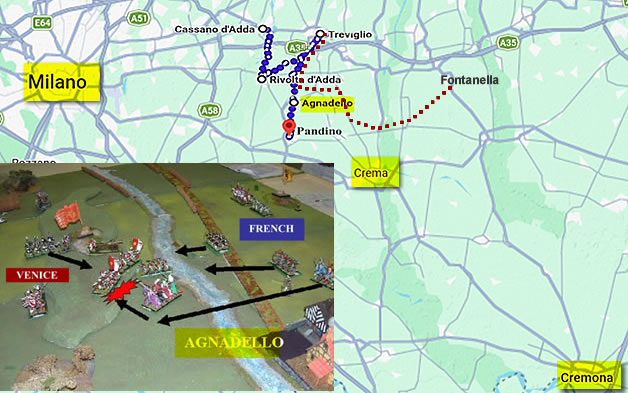
Sites of the Battle of Agnadello
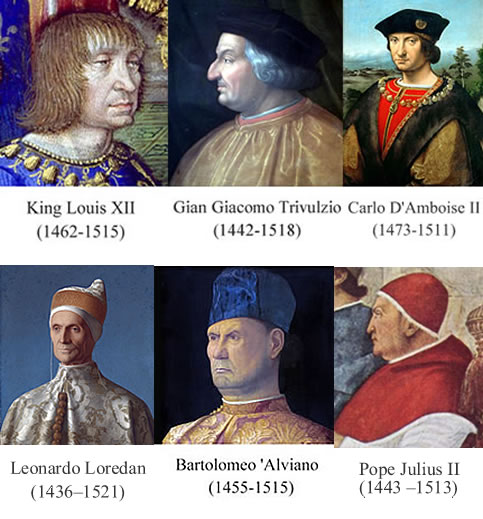
Figures of the Battle of Agnadello
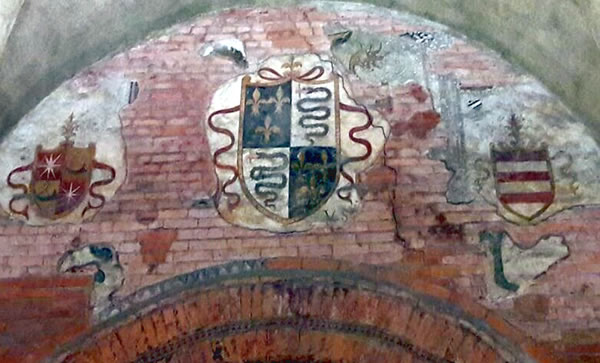
Visconti Viper and the coat of arms with the lilies of the King of France - Municipal Palace of Cremona (Italy)
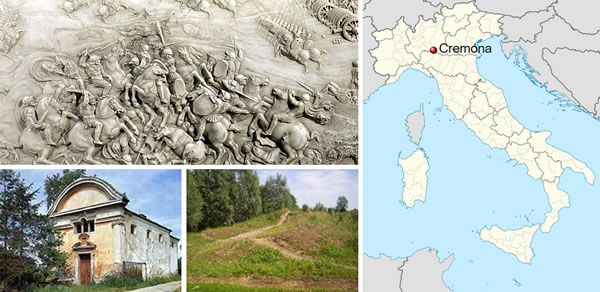
The Battle of Agnadello, 14th May, 1509, detail from the Tomb of Louis XII (1462-1515) and Anne of Brittany (1496-1533) 1515 (marble) - church of Santa Maria della Vittoria and site of the battle.
This page was last edited on 14 March 2026
© andmorestory.eu - All right reserved