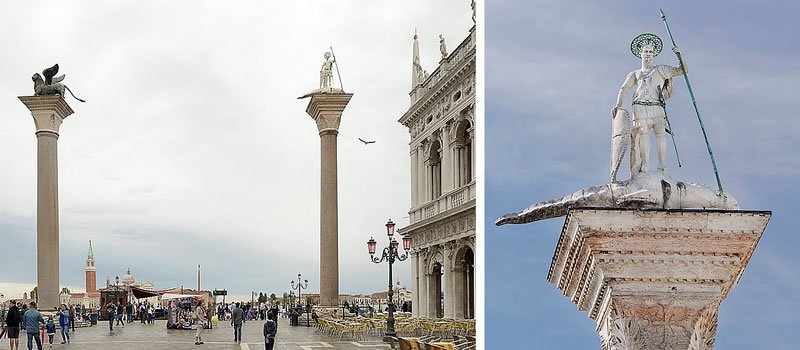
Statues of St. Mark and Theodore and Statue of St. Theodore on a crocodile/drake (Venice, Italy)

In the past, the figures of dragons, crocodiles, or serpents were often viewed with promiscuity and, in the Christian era, were frequently associated with evil, considered earthly personifications of the devil, animals that lead to sin. It was a common practice to place these animals in medieval churches. It may appear to most as a strange and unusual thing, but it holds a powerful symbolic meaning: prehistoric fossils, bones, or stuffed animals were chained to the church vault to render them ideally harmless. This was thought both to block the evil they represented and to provide a concrete warning for the faithful against humanity's predisposition to error or to the devil. There are even cases where the impossibility of obtaining a real crocodile, if only because the taxidermy process had gone wrong, led to the creation of carved and painted effigies to replace the original.
Almenno San Salvatore is a town in the province of Bergamo, washed by the Brembo River. Folk tales tell that the area was once infested by a crocodile that lived in the stream. Killed by volunteers, it was preserved in the church of San Giorgio, hung from the ceiling above the nave, to indicate that it had been captured, killed, and with it, the evil it represented. It is no longer visible today, but we can find other crocodiles in other churches not far away, such as the Sanctuary of the Graces. A popular story has it that in the 15th-16th century, a crocodile lived in a Gonzaga zoo near the Mincio River, that it escaped and decided to eat children, bother girls, and annoy anyone who passed near the lake. A hero, invoking Mary, killed the beast, bringing its remains to the sanctuary as an ex voto. The monks stuffed it and placed it in the sanctuary, hanging from an iron rod on the groin-vaulted ceiling. Analysis of the crocodile shows it never lived in the cold waters of the Mincio; it died in Egypt and was stuffed with marine algae (Posidonia) found only more than a hundred and fifty kilometers away, while straw was readily available. Furthermore, the C14 examination indicates that the animal was killed at the time of the construction of the sanctuary's new form, and therefore deliberately hung in the sacred space, not as a consequence of a heroic event. So, the tradition is more reliable that towards the end of the 14th century, for a received grace, Francesco Gonzaga I (1366-1407) had the church built in Curtatone (9 km from Mantua) dedicated to the Madonna who had ended the plague epidemic. Since then, pilgrimages to this place intensified, and along with the poor people from the surrounding villages, nobles also flocked there, such as Emperor Charles V of Habsburg or Austria's Joseph II of Habsburg-Lorraine. Thus began a whole series of donations used to make modifications to the original architectural structure: some important Mantuan families had private chapels built for prayer annexed to the convent or inside the church to bury their ancestors. The donations and bequests continued for about three centuries and allowed the church to be transformed into the large Sanctuary of the Graces seen today. San Teodoro di Amasea (St. Theodore) was a soldier and martyr, patron of Venice before the cult of St. Mark became established in 862. The effigies of the two saints are still visible today atop the two columns that form the monumental access to St. Mark's Square in the lagoon city for those coming from the sea. According to a legend reported by Sansovino in the 16th century, the lion of St. Mark looks east to symbolize Venice's role as protector of Christianity in the East, while the statue of St. Theodore facing west would symbolize the Serenissima's defensive stance towards the Mainland. The gigantic single-piece columns were transported as war booty from Constantinople between 1204 and 1261 and erected on the spot where they had been unloaded. Originally there were three, but the third column was lost along with the ship transporting it during unloading. The shipwrecked column must have sunk deep into the muddy seabed, so much so that "seeking it twenty years after the sinking by a master specifically commissioned, by feeling the bottom with a long pole, it could not be found in any way." The statue of St. Theodore is a copy (1948) of the original which is preserved inside the nearby Doge's Palace. It depicts the saint in the act of killing a dragon, but in local iconography, it appears with the features of a crocodile. The monster symbolizes the evil that the saint has defeated. St. Theodore gave way to St. Mark, and the crocodile to the lion. The statue is the result of an unusual assembly of different elements: the head would represent a portrait of Mithridates, the body would derive from a loricate statue of Emperor Hadrian, later integrated with arms and legs, a crocodile, a marble shield, bronze weapons, and an oak crown.
Statues of St. Mark and Theodore and Statue of St. Theodore on a crocodile/drake (Venice, Italy)
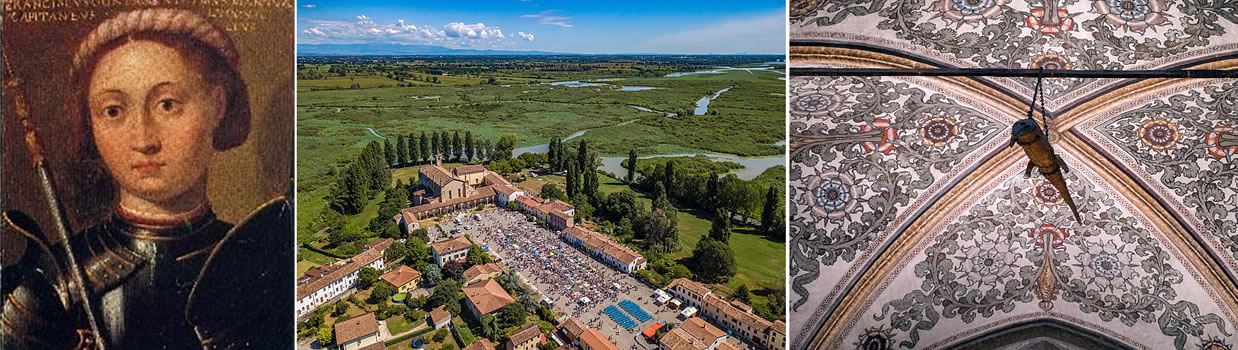
Sanctuary of the Graces in Curtatone (Mantua, Italy), detail of the crocodile - Portrait of Duke Francesco I Gonzaga
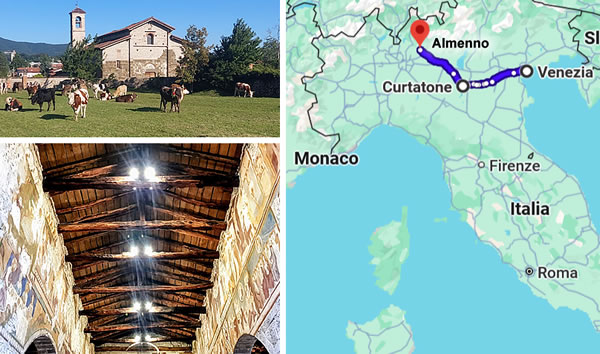
Church in Almenno San Salvatore, (Bergamo, Italy)
This page was last edited on 14 March 2026
© andmorestory.eu - All right reserved