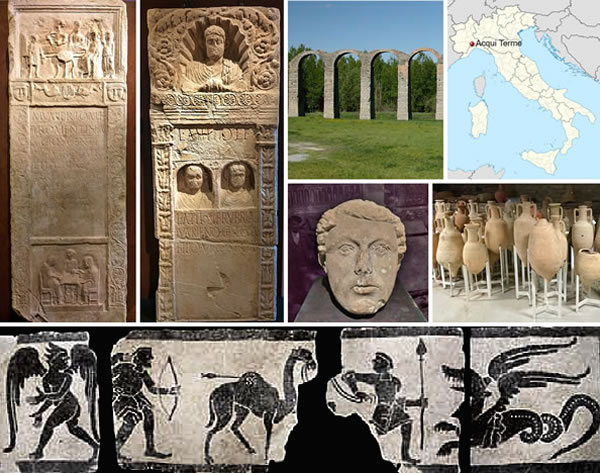
Roman aqueduct and archaeological finds, Acqui Terme (Alessandria, Italy)

Acqui Terme (Alessandria, Italy) is a small thermal town in Lower Piedmont, not far from the major cities of Genoa, Milan, and Turin. It may seem strange, but the first person to study the antiquities of the thermal city of Acqui was a learned physician, Antonio Guainerio, in the first half of the 15th century. In truth, he went there to study the medicinal properties of the waters. He was greatly impressed by the monumental remains of archaeological structures still standing in the town and by the richness of the discoveries that were frequently being made underground. This led him to make them the subject of his studies and to leave written accounts in his works. At the heart of the town flows a natural source of saline-bromide-iodine water, reaching a temperature of 74.5°C, with a flow rate of 560 liters per minute. The water possesses marked anti-inflammatory, analgesic, and muscle-relaxant properties. It is indicated for treating osteoarthritis, fibromyalgia, respiratory ailments, and promoting general well-being. In 1870, to highlight the importance of the spring, a small shrine in the form of a Greek temple was erected there. In 1538, Pope Paul III Farnese, during a visit, expressed his delight at having seen a boiling spring, the grass around it green, and a learned woman: Aquis tria mirabilia vidi: Aquas bullentes, herbas circa eas virentes et mulierem sapientem.
The woman was Ginevra Giovanna Maria Scatilazzi, who had welcomed him by addressing him eloquently in Latin. She was the daughter of Doctor Bartolomeo Scatilazzi and devoted herself to the study of Latin, rhetoric, and canon law. The town's history has ancient roots: although frequented since the Paleolithic era, the first settlements date back to the Neolithic period. During the Bronze Age, the area was inhabited by Ligurian tribes, the Statielli. Besieged and destroyed by the Romans in 173 BC, it was gradually Romanized, and the new city was named Aquae Statiellae. After 109 BC, with the construction of the Via Aemilia Scauri, the city—animated by fervent commercial, artisanal, and industrial activity—experienced economic and social prosperity for nearly three centuries. Evidence of this includes its monuments, partly still visible today (the baths, theater, amphitheater, commercial emporiums, and aqueduct), and a mention by Pliny the Elder. In his Naturalis Historia, he described it as a city founded by the waters and listed it among the most important thermal locations in the Roman world.
Roman aqueduct and archaeological finds, Acqui Terme (Alessandria, Italy)
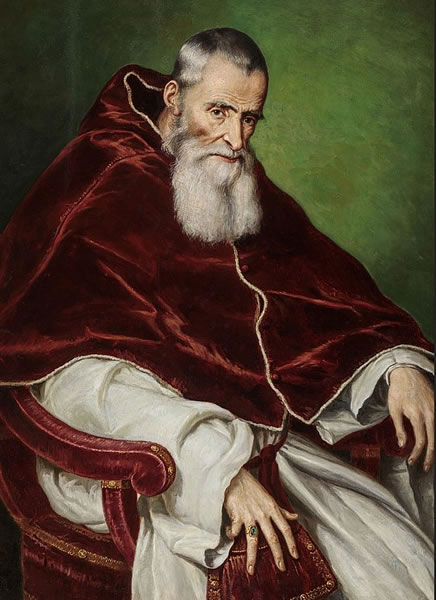
Portrait of Paul III Farnese (1468–1549)
This page was last edited on 14 March 2026
© andmorestory.eu - All right reserved