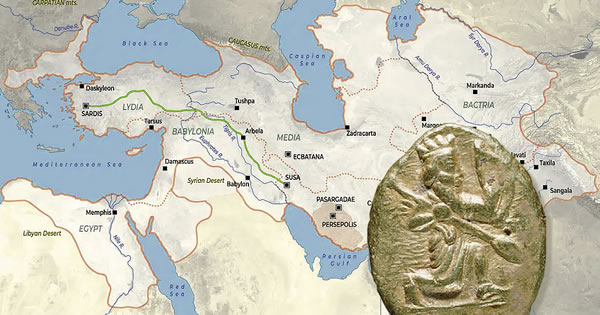
Map of the Achaemenid Empire at its peak (under Darius I) and Gold stater minted under Persian Achaemenid rule (5th century BC) - Israel Museum, Jerusalem.

The term "money" (in Greek nomisma; in Latin moneta) derives from the Latin epithet of Juno Moneta, at whose temple in Rome there existed a mint. Money appeared in the ancient world after a long pre-monetary phase, as it is essentially a piece of metal used as a means of exchange and payment, and simultaneously as an instrument for capital accumulation. The necessity for state control is therefore evident, manifested by the application of a mark guaranteeing its purchasing power. Money consists of a metal disc, of weight and value guaranteed by the state, bearing impressions and inscriptions (or just one of these elements). Money constitutes the evolution of forms of exchange in which the unit of value was made up of goods. Evidently, the barter stage was originally limited to the exchange of few goods among members of the same group. Following the transition from nomadism to a sedentary life, and thus the formation of villages and the development of agriculture, animal husbandry, and craftsmanship, barter turned towards needed goods and the sale of surplus goods. This led to the choice of some conventional values for exchange, that is, goods of general interest, such as dried fish or hides for northern countries, or livestock (cattle and sheep) for Mediterranean countries. In the Homeric age, the monetary base was the ox, and the epithet 'rich in oxen' equated to 'wealthy'; in Rome, from the word pecus = 'cattle', derived pecunia = 'money' or currency in general, and one of the fixed types stamped on the most ancient bronze ingots was precisely the ox. From the latter indeed comes the term capita = 'many head of cattle,' from which derives the word 'capital' = 'economic wealth.'
Despite its vibrant economy, Mesopotamian civilization had not yet invented true coinage and was based on silver, by weight, as an element of exchange; the unit of measure was the shekel, equal to 11 grams of silver, and this is still the name of the currency of the State of Israel today. In silver, and to a lesser extent in gold, tributes to kings and offerings to temples were also partly paid. Daily payments, from the wage of a commissioned artisan to the wine drunk at a tavern, were instead mostly made in measures of grain.
The Cretans were a great commercial civilization, the first born in the Mediterranean, which exploited their island's position and its natural resources. Minoan merchants traded mainly timber and pottery, but also the tin and copper necessary for bronze production. Coinage did not yet exist, but weights have been found, used to measure foodstuffs, and metal ingots used for payments.
Starting from barter, we then arrive at the choice of preferential exchange pieces and subsequently at the choice of metal exchanged by weight. Initially, copper was used; then silver, gold, and electrum (from Greek leukòs chrysos, 'white gold,' a native or artificial alloy of gold and silver). Subsequently, the weight-based value of the metal, used exclusively for manufacturing objects, was gradually abandoned in favor of nominal value. Used originally by weight, the metal was later melted into cakes of various sizes and shapes.
Precious metals, particularly electrum, gold, and silver, were also used in small globules with punch marks, initially by private individuals or bankers and later by the state, to guarantee the purity and weight of the metal. Evidently, these latter means of exchange, guaranteed by the authority and prestige of the state, could be used efficiently for coherent payments and large-scale commercial transactions.
Therefore, it is possible to distinguish the values used for exchange purposes in the pre-monetary era into three categories:
1- Natural money,
2- Metal money (raw, bars, rings, and ingots)
3 - Utensil money (tripods, spits, cauldrons, axes, and double picks)
It is also established that these pre-monetary forms coexisted simultaneously even within the same geographical area.
The origin of coinage is placed around the middle of the 7th century BC, in Asia Minor. Tradition (Xenophanes, Herodotus) attributes its invention to the Lydians: Lydia – a wealthy country facing the Mediterranean – was indeed the place of origin of electrum. The Achaemenids were the first empire in history to regularly mint coinage bearing the image of the sovereign holding a bow, which in Near Eastern tradition was the royal weapon par eccellence. But it is also likely that the kings of Lydia, including the famous Croesus (596-546 BCE), who passed into history as the richest man in the world, did not so much have the idea of favoring trade, but rather that of making their subjects feel their authority, imposing the use of the king's coin in exchanges and tax payments. Some of the earliest evidence concerns the time of Croesus, during which the first pure gold coins are said to have circulated, used and later also minted by the Persians. The emblems appearing on the earliest coins are a sort of 'mark' identifying a private individual or a city: it can be assumed that, given their high value, they originally served for large expenditures in commerce and the needs of great families (purchases of goods and services, remunerations, displays of prestige), but above all that the state later determined, with its own needs for supplies, services, administration, cult, etc., the existence of coins of a specific metal or alloy and a specific weight, both guaranteed by the state itself, marked by impressions and legends, and organized in a precise system of relationships. The weight was established based on the prevailing weight system; the most minted currency assumed the name 'stater'; although diversifying according to places of issue and monetary systems, it long remained of high weight. Darius I minted gold and silver coins; the latter were called sicli, by analogy with the shekel. Coins could have different values, depending on the states and the period of minting. Essentially, the coins were roughly rounded but crude pieces of electrum, minted on one side only; but their most important characteristic was that they had a regular weight. In the 6th century BC, the use of electrum was abandoned and the kings of Lydia began minting gold and silver coins; their successors, the Great Kings of Persia, imitated them, and from then until the 19th century, gold and silver remained the foundation of coinage. With King Cyrus the Great (?-530 BC), Persians and Medes merged into a single people. Cyrus conquered Lydia, including the Greek port cities, subdued all of Mesopotamia, and pushed east to the highlands of Central Asia.
The invention of coinage is one of the decisive advances that the Near Eastern world transmitted to Mediterranean and European civilization. It is in the world of the pòlis (Greek city-states) that coinage developed enormously. Probably the Ionian cities of Asia Minor, in direct contact with Lydia, were the first to mint coins, using, for their trade, the electrum supplied by Lydia. Precisely in an Ionian city, Ephesus, the 93 electrum coins that are the oldest surviving ones were found (in the foundations of the Temple of Artemis) and seem to come partly from Lydia, partly from Greek cities (like Ephesus itself or Phocaea). The Greeks had little access to gold, which remained a characteristic of Persian imperial coinage, but had important silver mines in Attica (the region of Athens), Thrace, and Macedonia. They produced such a quantity of silver coins that the spread of coinage in the Mediterranean around 500 BC is considered by historians to be an essentially Greek phenomenon. Each pòlis minted its own coin, and it is likely that civic pride and the ostentation of wealth were at the origin of the decision to mint coins, more so than the desire to facilitate exchange: this is also suggested by the fact that the first coins were of considerable weight and great value, therefore poorly suited to daily commerce. In the Greek world, casting constitutes an exception (series of Olbia or Borysthenes, on the Black Sea): Greek coins were in fact always struck on a die. In the case of striking, a metal disc was struck between two dies bearing in negative the design to be imprinted on the coin, so that the design itself appeared in relief on the two faces of the disc. One die was inserted into an 'anvil' (fixed die or anvil die), the other was held by a long tongs (mobile die or hammer die): one or more hammer blows on the mobile die (charaktir) caused the designs of the two dies to be imprinted on the disc placed on the anvil die. In some Greek series, particularly the archaic silver ones from the colonies of Magna Graecia (datable between the mid-6th century and the first quarter of the 5th century BC), the hammer die had the design in relief, so that the reverse face of the coin resulted incuse: these are the so-called 'incuse reverse series.' In Greece, the earliest coinages are attributed to Aegina, before 550 BC (with the emblem of the sea turtle), and to Corinth (with the image of Pegasus). Both cities adopted the stater, diversified in denomination and subdivisions; so did Athens, where the earliest coins bear the emblem of an amphora and immediately after the so-called heraldic symbols (shields, horse protomes, astragali, etc., interpreted precisely as coats of arms of great families); only later did the glaukes (owls) enter circulation, i.e., the tetradrachms on whose reverse Athena's owl is represented (the chronology of the earliest Athenian coinage is uncertain; the institution of a light drachma at the time of the weight system reform by Solon would lead to an early dating, which scholars, however, tend to lower significantly). Subsequently, around the mid-6th century BC, the use of coinage gradually spread in the Greek world, and later in the 5th century BC, the Greek colonies of Magna Graecia and Sicily also minted silver coinage, a coinage that reflected the influence of systems in use in the motherland. After the first archaic coins with the characteristic incuse square, for example, the Aegina stater weighing 6.1 grams, with a turtle and incuse square dated to the end of the 7th/beginning of the 6th century BC, drachmas later began to spread – like the Athens drachma weighing 4.3 grams – with their respective multiples and fractions. These are subdivisions, necessitated by the greater intensity of circulation (the use of small change was already widespread in Greece in the 5th century BC). The terminology of the new Greek coins betrays a clear derivation from utensil money: indeed dracme means 'a handful,' hence the equivalent of six obols since theoretically a hand could grasp six spits or obols. The drachma was minted according to different weight systems, resulting in the Attic, Corinthian, and Aeginetan drachma. The monetary systems of the ancient world were based on different weight units (characteristic of the Persian system is a shekel of 10.80-11.22 grams; of the Phoenician, a shekel of 14.53 grams; the Phocaean stater was about 16 grams, the Aeginetan 12.45 grams, the Corinthian 8.70 grams, the Hebrew and Athenian 17.40 grams); but the monetary systems adopted by Greek cities were articulated, in the classical period, in similar ways. Oriental bimetallism (gold-silver) had no following in archaic and classical Greece due to the scarcity of gold, which was used sporadically and in particular circumstances (for example, the emission of gold philippoi in the 4th century BC coincided with the discovery of deposits in Macedonia); furthermore, bronze was introduced relatively late. Greek coins were generally of rather small diameter but good thickness, with images in relief. The Athenian silver drachma, weighing about 4.36 grams, was subdivided into obols (1/6 drachma), tetrobols (4 obols), triobols (3), diobols (2), trihemiobols (1 1/2); there were also the hemiobol (1/2 obol) and the tetartemorion (1/4). Multiples of the drachma were the didrachm (2 drachmas) and the tetradrachm or silver stater (4 drachmas); the gold stater was worth 20 drachmas. Units of account were the mina (100 drachmas) and the talent (60 minas, i.e., 6000 drachmas). The depictions on coins (first on one side only, then on both; monetary technique) indirectly referred to the protective deity of the city, through an animal sacred to it or an attribute of the deity itself (a deer for Artemis the hunter at Ephesus, Apollo's lyre at Delos, etc.) or alluded to the city's name (these are the so-called 'speaking types,' with the seal for Phocaea, the dolphin for Delphi, the rose for Rhodes, the lion for Leontini, etc.) or represented it through objects or resources typical of the region (the wheat ear of Metapontum, the silphium of Cyrene, the horse and bull of Thessaly, the tuna of Cyzicus, the oyster of Cumae, etc.). Finally, images of deities appeared: Athena on the coins of Athens (owl on the reverse), Poseidon armed with a trident at Poseidonia (bull on the reverse), Dionysus at Naxos in Sicily (bunch of grapes on the reverse), etc. In some cases, coins were specific to a league of cities (coins with the concave shield of the Boeotian League); for some types, a 'historical' criterion was also adopted (the coins of Rhegion and Messana with the chariot refer to Anaxilas' victory at Olympia); in the Hellenistic age, sovereigns minted coins with their own effigy. Greek coinage often reflected the outcomes of great figurative art; in some coin types of Magna Graecia and especially Sicily, classical coinage found its maximum artistic expression, especially with engravers like Cimon and Euainetos, and Euclidas, Eumenes, Phrygillus, Euarchidas. Some coins managed to assume an international character, like the Persian daric, which had roughly the same value as the Attic stater and was later replaced by Alexander's stater; among city coins, for example, the drachmas of Marseille (in Gaul), the staters of Phocaea, Rhodes, Cyzicus (throughout the Aegean) had international circulation: but it was above all the Athenian tetradrachms and the didrachms of Corinth and Thebes that prevailed in international markets. Soon, Greek silver coinage began to be exported in large quantities to the Levant and Egypt and used for payments in international trade. For almost all so-called "barbarian" peoples, the discovery of coinage was due to the encounter with the Greeks. Among the Celtic populations of Gaul and northern Italy, for example, coinage penetrated thanks to the Greek colony of Marseille; and when the Gallic kings of the Po Valley wanted to mint their own coinage, the almost obligatory solution was to imitate the drachmas of Marseille. Map of Phoenician civilization in 331 BCE and Gold coin with Phoenician warship, 340 BC, found in Byblos - National Museum, Beirut. This coin bears the emblems of Phoenician power: a rowed ship and a group of soldiers with helmets and spears. The lower part of the coin is decorated with a mythological figure, a symbol of strength.
Phoenician civilization flourished in the coastal cities of the land of Canaan. The Phoenicians were a people of Semitic origin organized in city-states, whose wealth came from trade, which, for much of the 1st millennium BC, was in the hands of Phoenician merchants. Throughout the Iron Age, the Phoenicians dominated the naval trade of the Mediterranean, and in all the places they reached they founded colonies, the most famous of which was certainly Carthage. The dynamism of Phoenician navigators favored the circulation of goods and wealth, but also of culture and ideas, contributing decisively to the cultural and linguistic mixture typical of the Mediterranean. Frequent encounters between Phoenician and Greek sailors created the idea that the great protector of Tyre's sailors, the god Melqart, was the same deified hero the Greeks worshipped under the name of Heracles, i.e., the Hercules of the Romans. By the end of the 6th century BC, the growth of many cities and the intensification of trade was accentuated by the spread of coinage.
A similar situation is not detectable among the remaining populations of Italy, where the exchange of uncoined bronze (aes) by weight in the form of 'cakes' or small fragments persisted, which was already considered a store of value and could fulfill the dual function of a means of exchange and metal destined for melting to obtain other objects.
The minting process was similar to the Greek one, with dies mostly cylindrical in shape, few in iron, most in bronze; some of the latter are encased in an iron block. Instead, for the casting process, two molds in stone or clay were prepared, bearing the impressions of the obverse and reverse of the coin respectively; the molds bore multiple impressions connected to each other by small channels to allow the metal to flow. After tightly clamping the two molds together, molten metal was poured in through a channel communicating with the outside. The coins thus produced were joined to each other by the metal that had filled the internal channels; the separation of one piece from another sometimes gave rise to a metal protrusion (casting sprue) or a lack on the edge of the pieces thus obtained. This technique, by which both the monetary disc and the impression on the coin were obtained in the same operation, was used between the 4th and 3rd centuries BC, especially in Rome and central Italy for the series of Roman, Latin, Etruscan, Umbrian, Picene aes grave, etc.
• aes rude: rectangular and circular lumps, usually broken along radial cuts, widely documented in Emilia-Romagna at the end of the Bronze Age (1800-900 BC) and the beginning of the Iron Age (900-300 BC).
• aes signatum: bars or rectangular cast metal ingots on which a mark was stamped; that of the 'dry branch' might represent the distinctive mark of an Emilian workshop. The beginning of production of ingots with the "dry branch" is dated to the second quarter of the 6th century BC.
• aes grave: pieces of defined weight and lenticular shape, whose fundamental denomination, the as, had the weight equivalent to the libra. The libra was the weight unit widespread in Italy in two variants: the heavy libra of about 327 grams and the light libra of about 274 grams. Belonging to this first phase of aes grave are the so-called 'of the prow' series, attributed to Rome, and the 'Latin' series, attributed to Rome but issued by different mints.
In Rome, the use of coinage spread in the 4th century BC; previously the Romans had used coins minted elsewhere in the peninsula by other peoples and cultures (in Campania, Etruria, Samnium, and Apulia). At first, they used coins in the form of aes rude, then aes signatum and finally aes grave. Their first true coin was the as (as libral), of about 273 grams. The weight of the ancient Latin libra was subdivided according to a duodecimal system: the uncia was equivalent to 1/12 of the as; there were also the semis, triens, quadrans, sextans, respectively equivalent to 2, 3, 4, 6 ounces. The obverse shows the head of a deity and often the mark of value, which is also found on the reverse along with the prow of a ship. Silver coinage appeared towards the end of the 3rd century BC. The monetary unit from then on was constituted by the denarius, whose name means precisely "contains ten," with its divisions the quinarius and sestertius. The coins often bore on the obverse the image of Roma in profile, on the reverse that of other deities, like the Dioscuri galloping (this monetary type became generalized in the Republican age). The denarius was in a stable relationship with Greek coinage, given the extension of Roman domination over southern Italy and multiple relations with Greece (it corresponded roughly to the drachma). In 144 BCE, the denarius corresponded to 16 asses; from then on, the sestertius replaced the as as the money of account. During the Punic Wars, the emission of subaeratae coinage (i.e., with bronze aes found underneath, inside) was authorized. It was a bronze coin covered with a silver sheet, used particularly for trade with the East. This was an expedient adopted later as well, repeatedly. Another coin used in foreign trade was the victoriatus, with the double victoriatus and the half victoriatus. In the 1st century BC, gold coinage began to establish itself, at the time of Sulla and Pompey; but the regular circulation of gold occurred only with Caesar (46 BC). The gold denarius, or aureus, corresponded to 25 silver denarii (the silver denarius was worth 4 sestertii). Other gold coins are the quinarius (half aureus) and its multiples which are also called 'medallions'). From the origins until the late Imperial age, the weight of Roman coins progressively decreased: the as first passed to half its original weight, then to a sixth, a twelfth, finally to a twenty-fourth in 89 BC (this reduction led to the appearance of multiple pieces of 2, 3, 10 asses); the denarius was minted using always less silver; so the aureus, which went from about 8.17 grams to 7.30 at the beginning of the Empire, then falling to 6.5 and 4.55 (when, under Constantine, it was also called solidus). Caesar was the first to have his own effigy on coins. Starting from Augustus, Roman coins bore the portrait of the emperor on the obverse, and members of the imperial family were also depicted, while on the reverse the most varied themes appeared, from mythological scenes to historical events, to objects related to religion, political life, etc. The bronze coins minted during the Empire did not conform to the oldest system: the series were constituted by the as (with subdivisions), the sestertius, the dupondius; instead of bronze, orichalcum (alloy of copper and zinc) and copper were often used.
Map of the Achaemenid Empire at its peak (under Darius I) and Gold stater minted under Persian Achaemenid rule (5th century BC) - Israel Museum, Jerusalem.
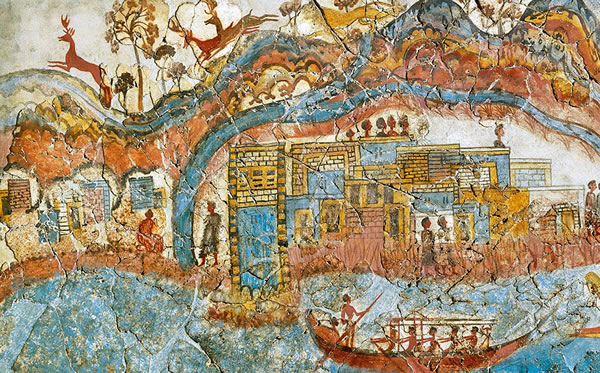
Mural painting found in the rubble of a house in Thera (modern Santorini) depicting the return to port of a Minoan ship, 16th century BC - National Archaeological Museum, Athens.
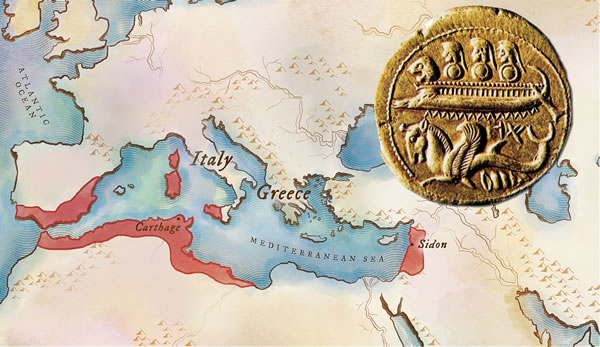
Map of Phoenician civilization in 331 BCE and Gold coin with Phoenician warship, 340 BC, found in Byblos - National Museum, Beirut. This coin bears the emblems of Phoenician power: a rowed ship and a group of soldiers with helmets and spears. The lower part of the coin is decorated with a mythological figure, a symbol of strength.
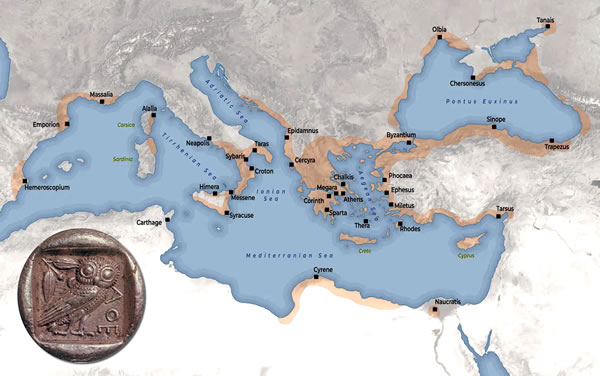
Map of ancient Greece and Greek colonies (8th-6th century BCE) and Tetradrachm of Athens, 5th century BC - Museum of Art and History, Geneva. - This four-drachma silver coin bears the mark of the owl, an animal symbolizing Athena, patron goddess of the city. The owl, whose scientific name is Athene noctua, is characteristic for its large and shining eye, which allows it clear and sharp vision especially at night. Reflected in the owl's skillful eye is one of the main characteristics of Athena, considered, not by chance, also the goddess of clarity, reason, and wisdom.
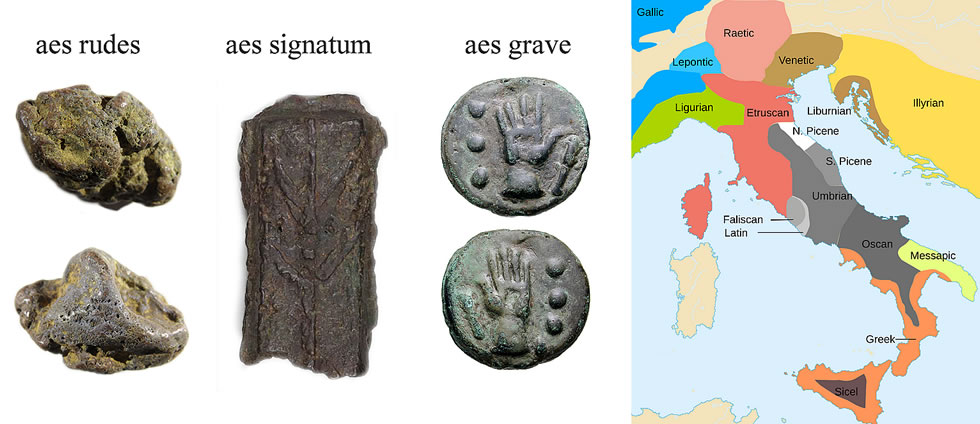
Ethnolinguistic map of Italy in the Iron Age, before the Roman expansion and conquest of Italy and Bronze aes rude from 5th-4th century BC, Italy - aes signatum bronze ingot with 'dry branch' imprint, 6th century BC, Civic Museum of Modena - Quadrans (c. 230–226 BC)
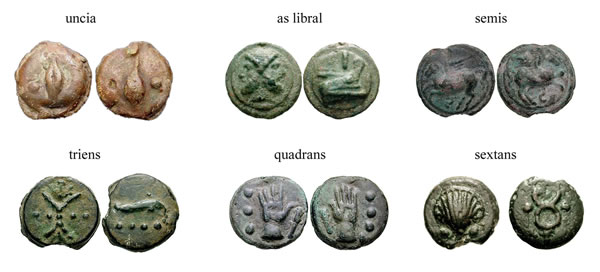
uncia, as libral, semis, triens, quadrans, sextans coins
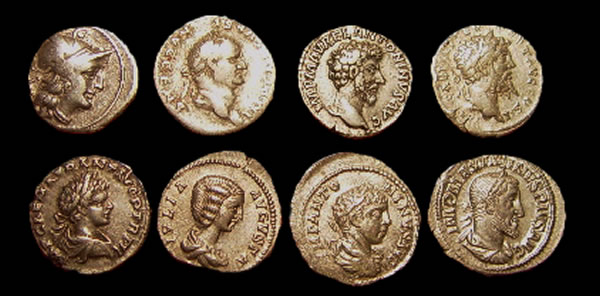
8 Roman denarii; left to right, row 1 : ca 157 BC Roman Republic, ca 73 AD Vespasian, ca 161 AD Marcus Aurelius, ca 194 AD Septimius Severus; row 2: ca 199 AD Caracalla, ca 200 AD Julia Domna, ca 219 AD Elagabalus, ca 236 AD Maximinus Thrax
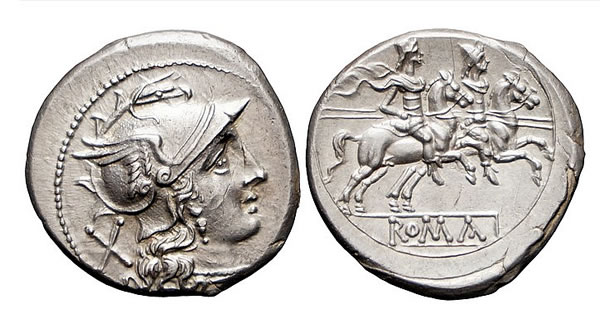
Head of Roma with winged Attic helmet; behind, X. Reverse: ROMA; the Dioscuri on horseback.
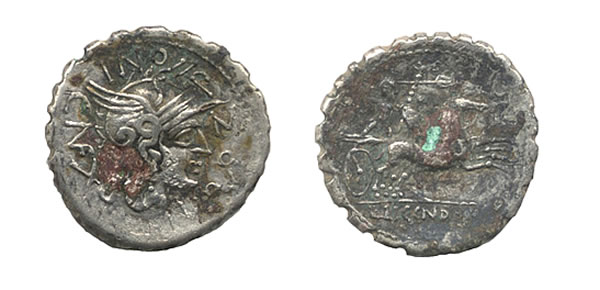
Denarius serratus subaeratus Lucius Pomponius Cn. f. (c. 118 BC). Head of Roma right. L. POMPONI. CNF around, X behind. Reverse: Bituitus in biga right. L•LIC•CN•DOM in exergue.
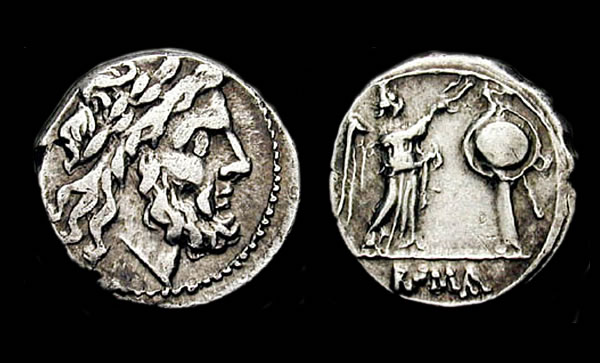
Victoriatus (after 211 BCE). Jupiter facing right; Victory standing crowning a trophy; ROMA in exergue.
![Zeus coin and minting tools image description] Zeus with laurel wreath, 6th century BC, and tools for minting a coin.](../news/coins-ancient-world-11.jpg)
Zeus coin and minting tools image description] Zeus with laurel wreath, 6th century BC, and tools for minting a coin.
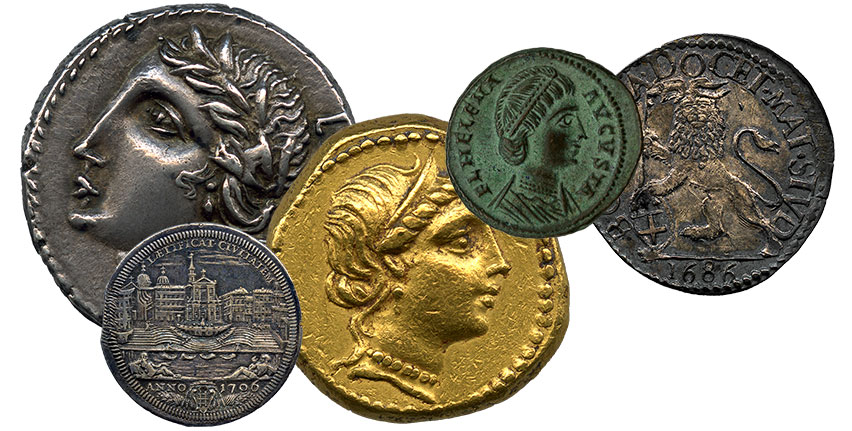
Some medal count of the National Roman Museum, Rome
This page was last edited on 14 March 2026
© andmorestory.eu - All right reserved