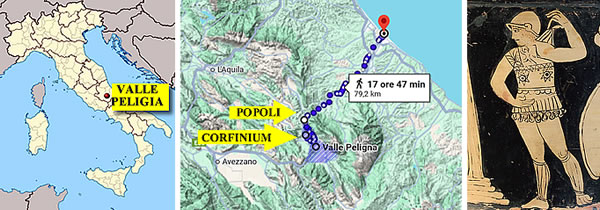
The Peligna Valley, inhabited by the Peligni; location of Corfinium and the Popoli Gorge

The Peligna Valley is a 100 km² high-seismicity basin located in present-day Abruzzo, in central Italy. Its name derives from the Greek peline (translated into Latin as pelagus) meaning "muddy" or "silty," as during the Pleistocene it was occupied by an extensive lake. Approximately 700,000 to 300,000 years ago, following disastrous earthquakes and floods, the rocky barrier obstructing the water's passage to the sea (the Popoli Gorge) collapsed, and the lake drained. The earliest signs of human presence in the Peligna Valley date back to the Paleolithic (4th millennium BC), when humans were nomadic and lived primarily from hunting and gathering. Starting in the Iron Age (10th century BC), human presence became settled. The valley thus became the homeland of the ancient Italic people, the Peligni (1st millennium BC), warriors primarily dedicated to pastoralism and agriculture, who spoke a dialect of the Oscan language. Corfinium was one of their most flourishing cities and the capital of the Italic League, an alliance of Italic peoples who rebelled against Rome in 91 BC.
The Peligni founded Corfinium (literally, "mother-city"), which would become their most important and prosperous city. This is evidenced by the discovery of objects related to very diverse and distant cultural spheres: Gallic torques (typical Celtic necklaces), Canosan small amphorae, Etruscan bronze mirrors and flasks, amber jewelry from the Baltic Sea, and the exceptionally fine funerary assemblage of a priestess of Kerri. Kerri (or Kerres or Kerria in Oscan; Ceres in Latin) is a name deriving from the Indo-European root ker and means "she who holds within herself the principle of growth." Thus, she was a maternal deity of the earth and fertility, the tutelary numen of harvests, but also a goddess of birth, since all flowers, fruits, and living beings were considered her gifts, so much so that it was believed she taught humans field cultivation. In the funerary assemblages from the 2nd century BC, related to female, male, and child pit tombs, some bronze objects stand out, including olpai with decorated handles and a patera with organic remains inside, alongside toiletry items and jewelry. In the extra-urban area of Fonte Sant'Ippolito, the remains of a sanctuary dedicated to Hercules and a female deity (perhaps Kerri) were found. It consisted of terraces on which stood a small temple, leaning against a long wall and surrounded by an altar and dedication cippi (pillars), along with various basins that collected and channeled water from a natural spring. The sanctuary was active between the 4th century BC and the 1st century AD. In addition to the structures, the votive deposit (stipe) of the temple was also investigated—the pit where terracotta and metal votive offerings brought by the faithful as gifts to the deities were periodically discarded. These included various anatomical human parts in terracotta related to propitiatory rites (hands, feet, small heads, full figures, phalluses, etc.); figures of cattle to protect livestock; an ox-head lamp; a pomegranate, a symbol of fortune and prosperity; a small altar; a married couple; various bronze figures of women making offerings, some seated on a chair; ritual vases; a glass perfume bottle; a small knife, etc. The votive cippi lined the road to the temple, where statuettes of Hercules Curinus were set into them above. The building represents the main place of worship for Italic Corfinium and an extremely rich source of finds thanks to the votive offerings left in the temple by devotees. The votive offerings, found in the votive deposit, were tokens of gratitude or propitiatory gifts: anatomical parts, artifacts symbolizing fertility and prosperity, animal figures, etc. Special mention deserves the bronze statuettes representing women making offerings and Hercules. The votive offerings of wealthier families (generally bronze statuettes of the deities) were placed on stone cippi, and fortunately for us, these are the best-preserved artifacts and those of the finest craftsmanship.
In the Roman period, the city's name Corfinium was changed to Pentima. It was allied with Rome until the 1st century BC and reached its peak splendor during the Social War (91-88 BC), when it was chosen as the capital of the Italic League. This was the alliance among all the Italic peoples, previously allies (Socii) of the Romans (Peligni, Marsi, Vestini, Marrucini, Piceni, Frentani, Samnites, Apuli, Lucani), who demanded citizenship rights from Rome. In 49 BC, having given refuge to Domitius Ahenobarbus, the city was besieged and conquered by Gaius Julius Caesar during the civil war against Pompey. Thanks to its strategic position for controlling the territory, particularly the Via Claudia Valeria, Pentima was especially dear to Emperor Claudius, under whose reign it became a flourishing municipium. Neither the Forum nor the public buildings dating to the Roman period have been identified with certainty, but knowledge of them comes also from epigraphic finds: some temples, the macellum (perhaps identifiable in a wall fragment found near Galli's house), the basilica, and finally an amphitheater deduced from a bas-relief mentioning gladiatorial games (Ludi gladiatori). The location of the bath complex erected by Servius Cornelius Dolabella in 113 AD also remains uncertain. In contrast, the location of the theater under the main town square is known, thanks to the interpretation of aerial photos, the subsequent discovery of parts of the radial walls of the cavea in the cellars of some houses, and a portrait of Emperor Claudius (1st century AD) likely originating from the decorated stage of the ancient theater. In the urban area of Piano San Giacomo, various archaeological finds have been recovered: objects of daily life, toiletry instruments, games, work and measuring tools, a mosaic fragment, fragments of decorated plaster, and other domestic and urban architectural decorations. With increasing urbanization, inhumation was replaced by cremation rituals. Consequently, the funerary assemblages that have reached us are deteriorated by the funeral pyre. Minted during the Social War (91-89 BC), this coin features on one side the personification of Italy crowned with laurel, and on the other eight warriors performing a military oath, who symbolize the eight peoples who were the first to rise up against Rome: the Marsi, Peligni, Marrucini, Vestini, Frentani, Picentini, Samnites, and Hirpini. - Corfinio (L'Aquila, Italy)
With the decline and fall of the Roman Empire, Corfinium also followed Rome's destiny and underwent progressive economic and demographic impoverishment. Indeed, finds from this period are of inferior quality and quantity. Later, also due to natural phenomena like earthquakes, the city was reduced to a heap of ruins, and the population dispersed into the surrounding areas. From the 5th century AD, Corfinio was a bishopric seat. In the 7th century AD, it became part of the Duchy of Spoleto as a Lombard gastaldato (administrative district). In the Early Middle Ages, the city changed its name to Valva. In the 12th century AD, the Cathedral of S. Pelino (or Basilica Valvense) was erected. Begun in 1075 on the commission of Bishop Trasmondo, probably as an adaptation of a pre-existing church near the site of the martyrdom of Saint Pelinus (4th century), it was consecrated in 1124. Some of its sculptural decorations are visible today in the city's museum or in the very walls of the Church of San Pelino. On the eastern part of the ancient city's rubble, in the 11th century AD, Abbot Trasmondo built and fortified a medieval village, obliterating every previous trace and naming the new city Pentima. Over the following centuries, the city was under Swabian, then Angevin, and later Aragonese rule.
Mentioned in documents from the late 1700s, during the French invasion, it began to depopulate in the following century with the widespread phenomenon of emigration.
Antonio De Nino (1833-1907) was an elementary school teacher, a renowned scholar of archaeology, history, and his region, Abruzzo. Starting in 1877, he began extensive excavation and archaeological research that allowed him to bring to light some necropolises and urban areas, with their related sacred and civil buildings, of ancient Corfinium. Over thirty years, he assembled about 6,000 artifacts, objects recovered not only during his excavations but also from farmers and common people, from whom he often repurchased them with his own funds (only in 1939 did a decree establish state ownership of any antiquity found in Italy). In 1878, De Nino exhibited the rich collection in the archaeological museum he established in the premises of the Oratory of Sant'Alessandro. During the German occupation in World War II, the Museum was looted. About sixty years later, a new Museum was opened in the restored 17th-century noble palace of the Trippitelli family, and the collection was enriched with artifacts found in the late 20th-century excavation campaigns. Starting in 1928, by a Royal Decree, the town was given back the name of Corfinio.
The Peligna Valley, inhabited by the Peligni; location of Corfinium and the Popoli Gorge
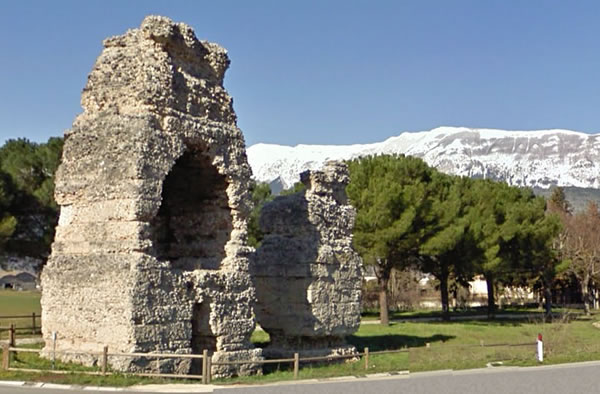
The two Roman funerary monuments (Morroni), with a quadrangular base and a "tower" structure, situated along the route that follows the ancient Via Claudia-Valeria. - Corfinio (L'Aquila, Italy)
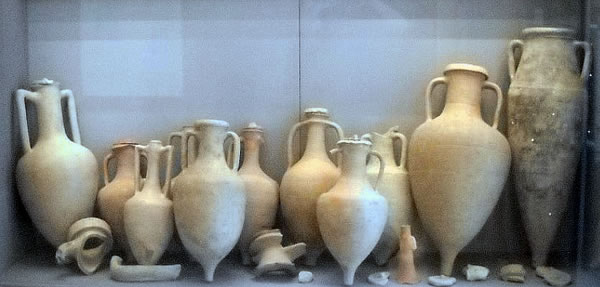
Showcase with numerous transport amphorae from merchants' tombs, testifying to Corfinium's flourishing commercial activity - Civic Archaeological Museum - Municipality of Corfinio (L'Aquila, Italy)
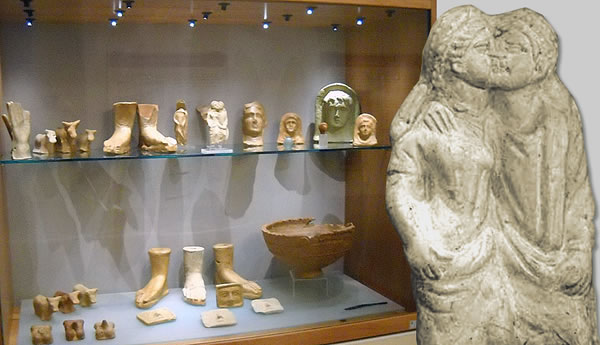
Finds from the extra-urban sanctuary of Sant'Ippolito and a votive offering depicting a married couple - Civic Archaeological Museum - Municipality of Corfinio (L'Aquila, Italy)
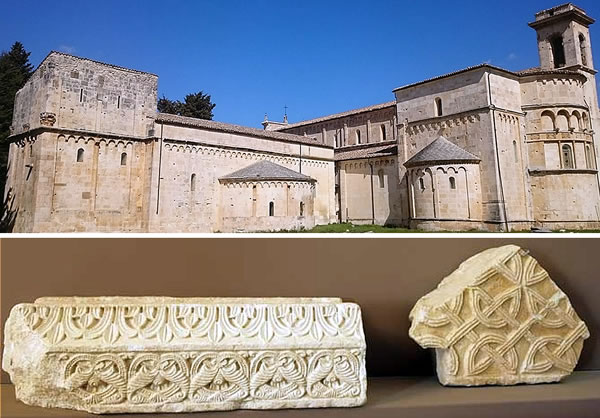
Sculptural fragments from the first construction of the Cathedral of San Pelino
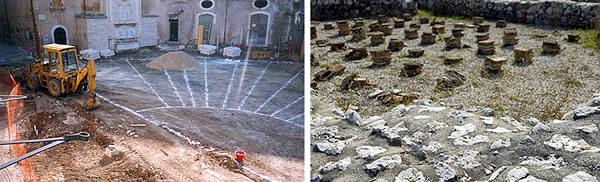
Location of the Roman theater under the main town square, and remains of the baths. - Corfinio (L'Aquila, Italy)
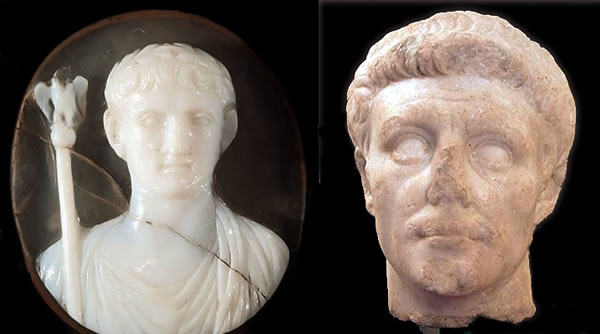
A cameo reproducing the head of Emperor Claudius, and the face from one of his statues - Civic Archaeological Museum - Municipality of Corfinio (L'Aquila, Italy)
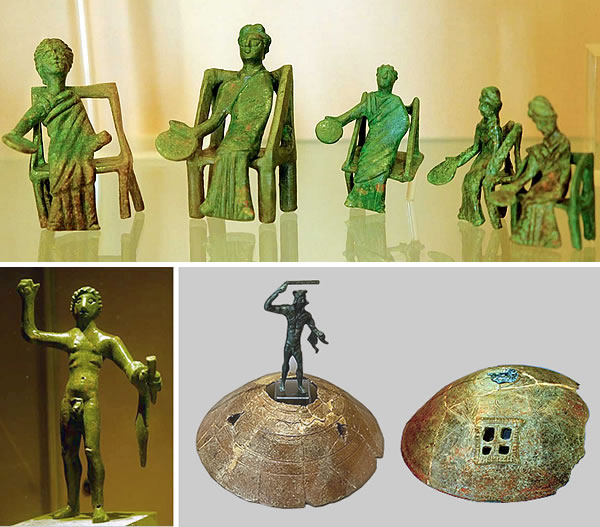
Bronze votive offerings depicting women making offerings, and Hercules Curinus with his attributes (club and lion skin) - Terracotta lids, one still surmounted by a statuette of the deity; incense was placed under the lid, producing smoke. - Civic Archaeological Museum - Municipality of Corfinio (L'Aquila, Italy)
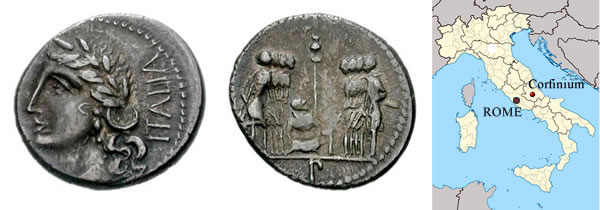
Silver coin of the Italic League, minted during the Social War (91-89 BC), in which the Italic peoples demanded citizenship rights against Rome and on which the name ITALIA was engraved for the first time. - Antonio De Nino Civic Archaeological Museum, Corfinio (L'Aquila, Italy)
This page was last edited on 14 March 2026
© andmorestory.eu - All right reserved