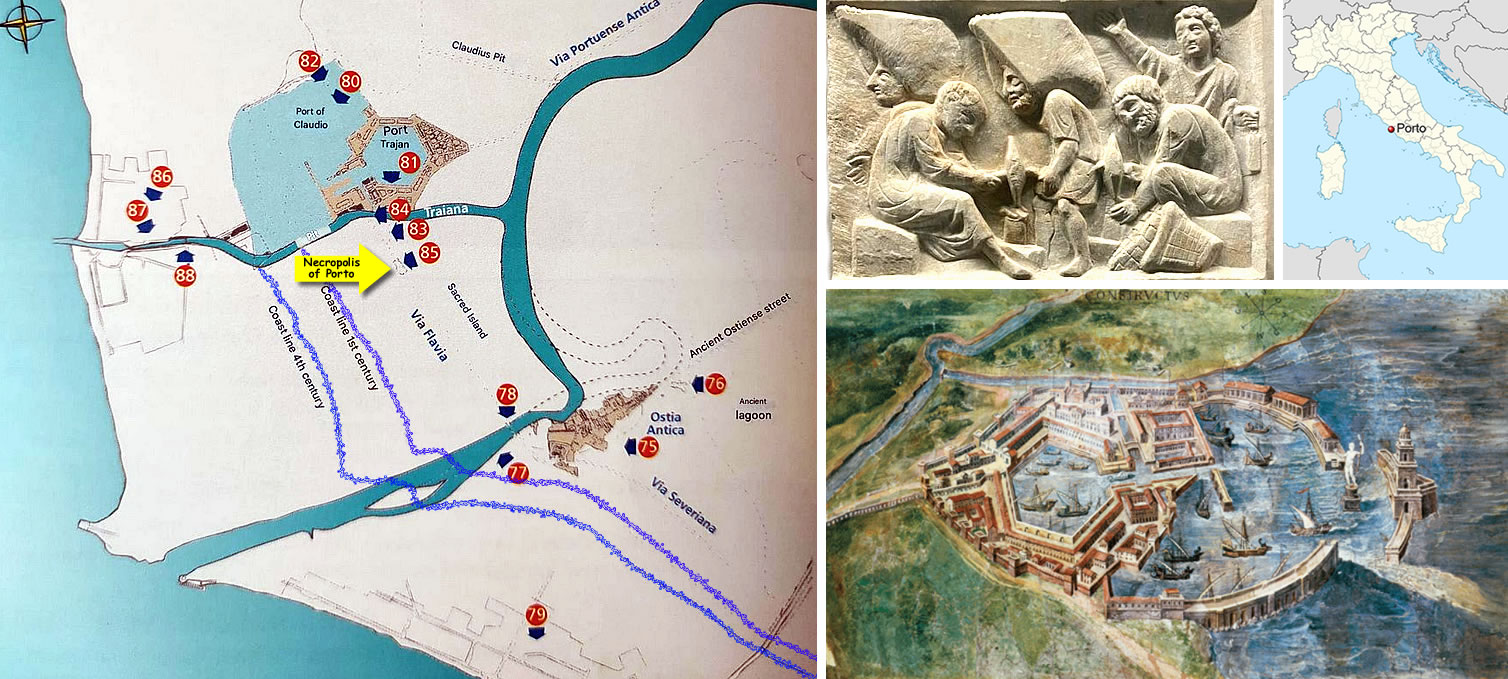
Portus and its Necropolis

A few kilometers from Rome, near ancient Ostia, lies one of the most evocative necropolises of the entire Roman world: the necropolis of Portus on the Isola Sacra. It is here that a funerary slab of Luni marble was discovered, depicting stonecutters engaged in making small square tiles called abaci. This very artifact will serve as our starting point for reflecting on the polysemy of a word that, in the ancient world, referred to many very different objects.
The foundation of the colony of Ostia (386 BCE) had already provided Rome with a first landing point for loading and unloading amphorae. However, the idea of equipping the capital with a larger and better-equipped harbour, envisioned by Julius Caesar (100-44 BCE), was only realized under the emperor Claudius (41-54 CE), who began construction in 42 CE in a marshy area north of the Tiber's mouth, about three kilometers from Ostia. The undertaking was titanic: the site was exposed to currents on both sides of the coast, a reason that, according to Suetonius, had held Caesar back. A commemorative inscription found at Portus in 1836, dated 46 CE, attests to the continuation of the work. Claudius also had two canals built connecting the Tiber to the sea, in order to protect Rome from flooding.
The official inauguration of the new Portus Ostienis is celebrated on a coin with a bird's-eye view, bearing the inscription POR[TVS] OST[IENSIS]. Since the coin was not minted before 64 CE, it is likely that the complex was only completed under Nero; however, Pliny and Tacitus confirm that the harbour was already in use before 64. It was Trajan (98-117 CE) who further expanded the structure, building a daring hexagonal basin, new canals and warehouses, as part of a broader project aimed at creating an alternative to the port of Puteoli (Pozzuoli) and new landing places in central Italy (Centumcellae, modern Civitavecchia, and Terracina). Portus thus became the safe and vital hub for trade across the entire Mediterranean, remaining Rome's main port even in the Byzantine period.
Trajan also had a new communication canal built with the Tiber (now buried), while one of Claudius's canals, the so-called Canal of Fiumicino, remained navigable at least until 1118. The area south of this canal – the Isola Sacra – gained great importance in the Trajanic period, connected to Portus and the Via Flavia by the Pons Matidiae (Matidia, Trajan's niece, was the mother of Sabina, Hadrian's wife). Portus, which in the early 4th century enjoyed its own municipal status and at the end of the 5th was included within the city walls, is mentioned in sources as Portus Urbis Romae, Portus Urbis Aeternae or Portus Romanus. The structures continued to function throughout the 5th century, despite the sack of 409 CE by Alaric's Goths. Recent excavations in the south-eastern area of the hexagonal basin have finally revealed the remains of a large building – initially mistaken for a xenodochium – which turns out to be the early Christian cathedral of Portus, active until the end of the 13th century.
The inhabitants of Portus began building their necropolis in the 1st century CE along the Via Flavia, which then ran parallel to a coastline much closer than today (the sea has since receded by about three kilometers). The Romans used to place tombs outside urban centers, but along very busy roads, so that passersby could see the tombs and remember the names of the deceased, keeping their memory alive. When all the space facing the road was occupied, the areas behind were used, where row tombs from the 2nd century CE arose. In the 3rd century, new burials were built on top of the older ones, which ended up buried (which is why the oldest tombs are not visible today). Overlaps and clusters were thus created.
This "city of the dead" housed the deceased of Ostia and Portus. After the fall of Rome (476 CE), barbarian incursions and silting, the immense burial ground was covered by marshes and forgotten. No source preserved its memory. Only in 1925, during land reclamation works (afflicted by malarial marshes), the necropolis was discovered and brought to light after over 1500 years. About 200 tombs were found, for a total of over two thousand individuals.
The tombs are mostly of a homogeneous type: a cell (sometimes with two floors) generally square, often with an attached enclosure. The coverings are barrel-vaulted or terrace-shaped, with a triangular pediment on the façade, enlivened by plinths, pilasters, columns and capitals; small windows and doors framed by travertine jambs open onto the façades. The representative value of the façade is confirmed by the inscriptions, placed above the door within frames of pumice and brick. They bear the name of the owner (or owner), the dimensions of the tomb, testamentary dispositions and rules for the use of the tomb, providing precious data on the social composition of the Portus population: merchants, freedmen and small entrepreneurs. It is precisely to these activities, and thus to the earthly identity of the deceased, that the scenes of trades – expressions of a vibrant folk art – depicted on the bricks flanking the inscription refer.
In the slab depicting the mosaicists' workshop, we see in the foreground stonecutters engaged in making square tiles (the abaci); behind them, slaves carrying heavy sacks on their shoulders; at the top right, the owner – presumably the deceased – supervising the work.
The term abacus (from the Semitic abq or Hebrew abaq, "dust") refers to several objects, all united by their square shape. We can distinguish at least five main meanings.
Returning to our funerary stele, what the stonecutters are producing is therefore an abacus in the second sense: a small square tile. But the word, as we have seen, encompasses an entire universe of objects and knowledge – from calculation to architecture, from daily life to the finest luxury – offering us a fascinating example of how a seemingly simple term can open unexpected windows onto the material and intellectual culture of the ancient world.
This page was last edited on 21 March 2026
Portus and its Necropolis
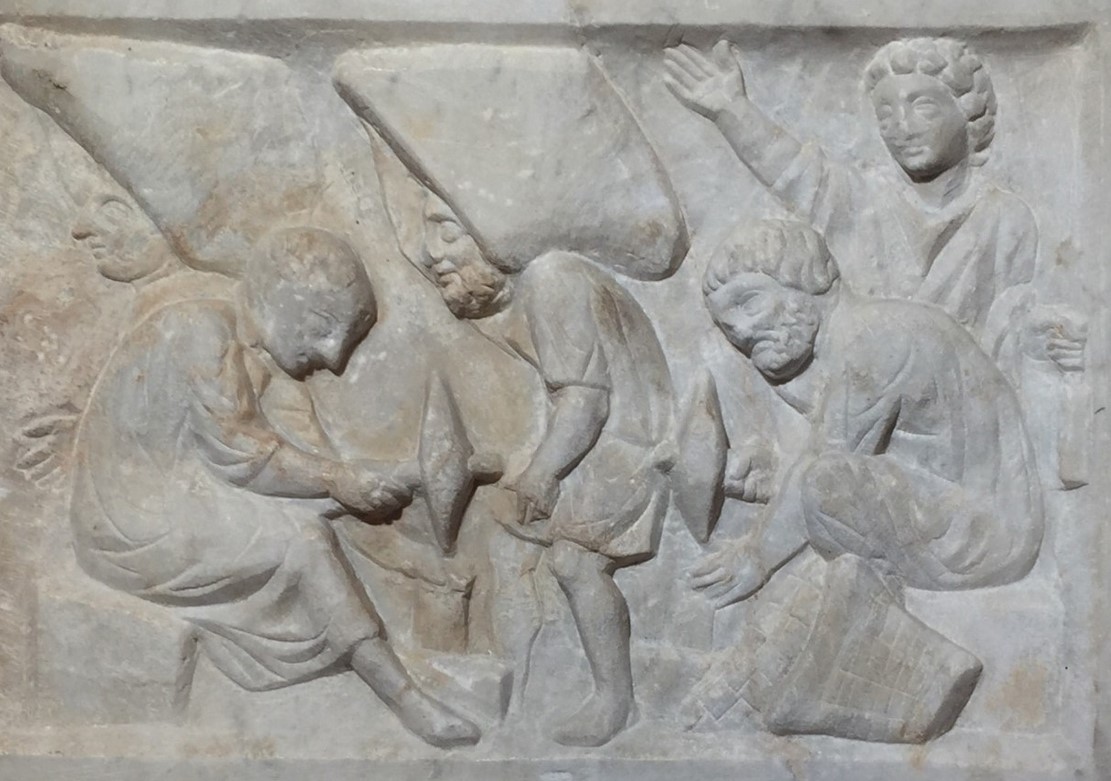
Marble funerary relief for a mosaic-maker, found at the necropolis of the Isola Sacra near ancient Ostia. Late IIIrd / early IVth century CE. The relief shows craftsmen at work cutting tesserae to set into a mosaic. - Ancient Ostia, Antiquarium at the Parco Archeologico di Ostia Antica. It was perhaps placed at the end of a locus and is supposed to show mosaicists preparing tesserae, in memory of the profession of the deceased.
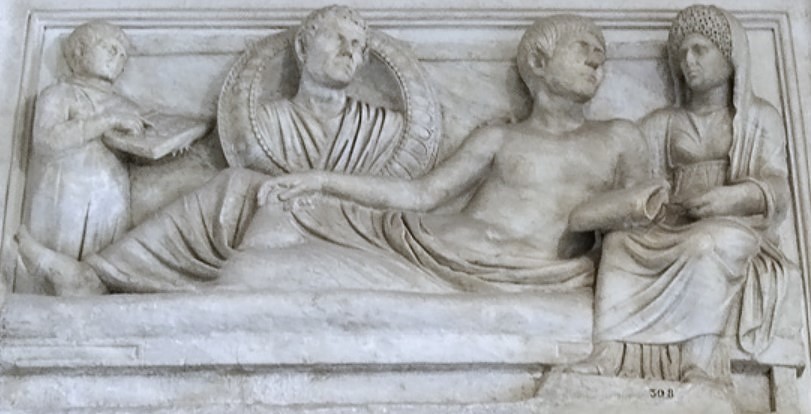
The marble funerary relief of young Roman man (early second century CE) found in the Monumentum Liviae, Rome
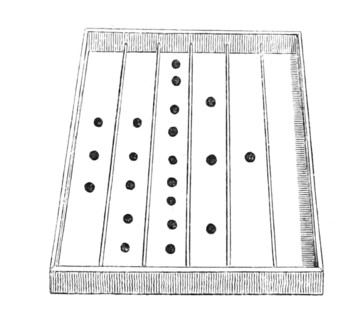
An abacus with stones (calculi)
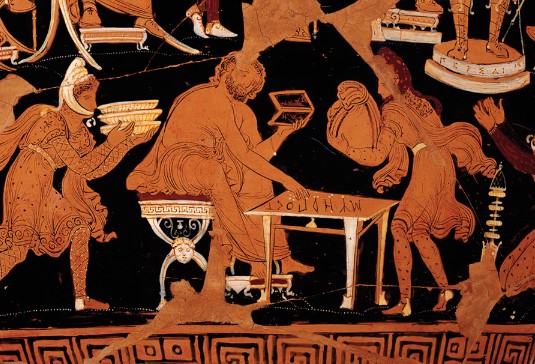
A detail of the treasurer depicted on the so-called Vase of Darius (4th century BCE), who uses a token abacus - Naples, National Archaeological Museum
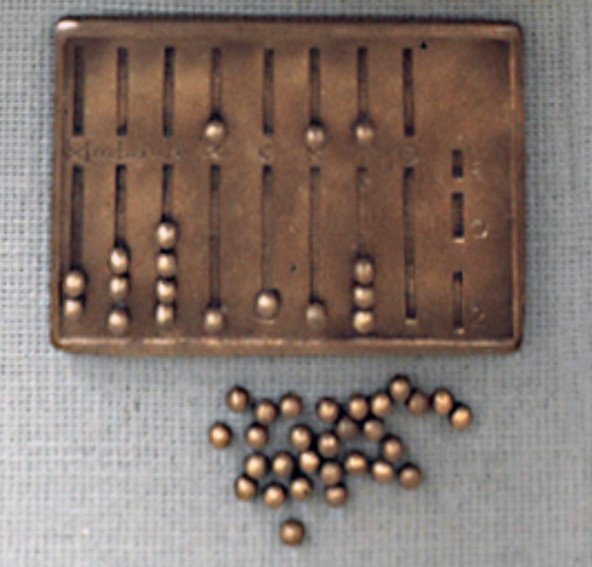
A reconstruction of a Roman Hand-Abacus , made by the RGZ Museum in Mainz, 1977 The original is bronze and is held by the Bibliothèque nationale de France, in Paris.
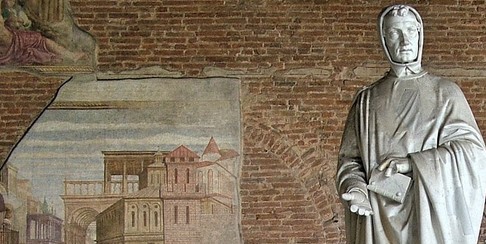
Statue of Leonardo Fibonacci (1170-1235) at the Monumental Cemetery, Pisa
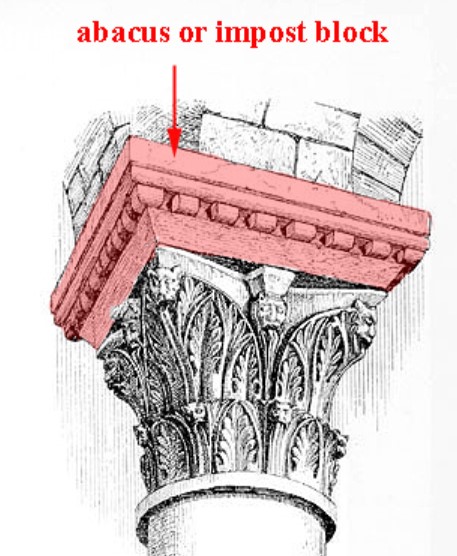
Abacus or impost block
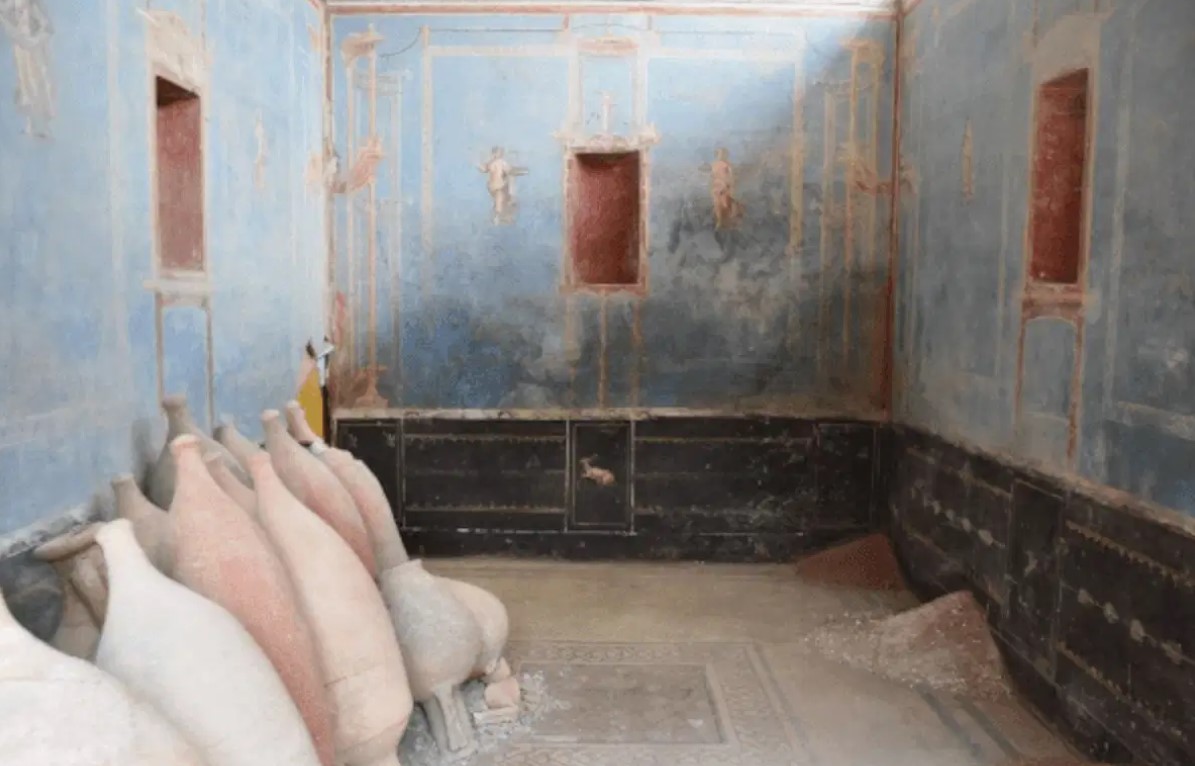
Pompeii: a shrine with blue walls discovered during excavations in Regio IX.
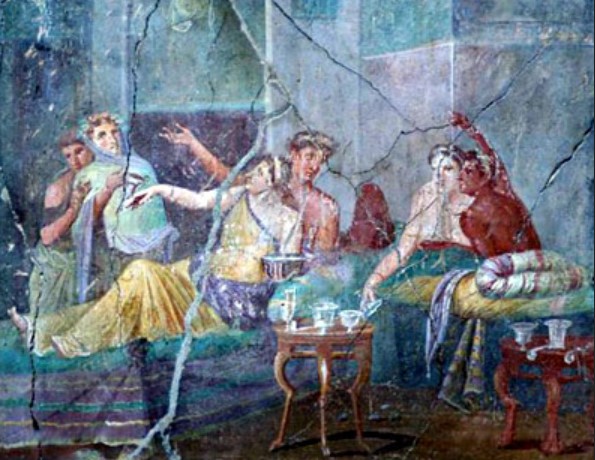
Banquet scene with two couples of lovers and abaci, imperial age. Fresco from the House of the Lovers in Pompeii.
© andmorestory.eu - All right reserved