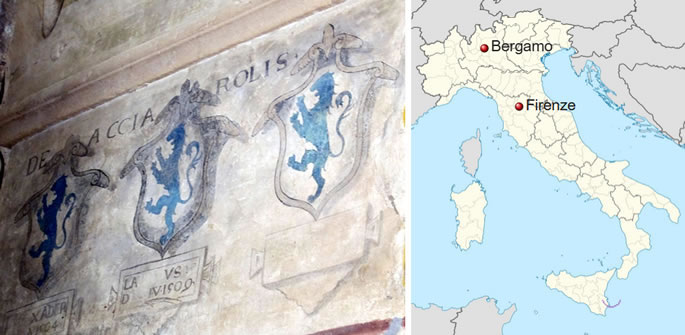
Palace of Vicars at Certaldo (Florence), coat of arms of the Acciaiuoli family

Acciaiuoli (also spelled Acciaioli, Acciajuoli, Accioli, Acioli or Accioly) was an important Italian banking family. According to legend, the patriarch Guigliarello Acciaiuoli fled Bergamo due to political persecution against the Guelphs, which he was part of, and seattled in Florence about 1160.
The Guelphs were a political faction in medieval Italy who supported the Pope's authority over the Holy Roman Emperor. Their rivalry with the Ghibellines, who backed the Emperor, shaped Italian politics for centuries, particularly from the 12th to 14th centuries.
The Acciaiuoli were 'popolani' (common people). Likely, they involved in the steel trade because the surname Acciaioli derives from word 'acciaio' meaning steel. It must be remembered that surnames were born in the Middle Ages in Italy. Until the year 1000, people had only one name. In some documents at the time, somepeople had two names, one of baptism and one nickname. After the Thousands, nobles had a family surname associated with the place where they had their castle (example: Firidolfi from Meleto, while another division of the family will tie their name to the history of other zones); in the cities, the nobles indicated the palace or the tower where they lived (Donati tower in Florence).
Instead, common people had only one name. To distinguish themselves from their homonyms, they associated their craft (i.e., Bartholomew the blacksmith) or the name of their father (i.e., Bartholomew of Michael) or, if they were immigrants, the name of the village of origin (i.e., Bartholomew from Vinci). The farmers specified the place where their family cultivated the land.
Guigliarello Acciaiuoli enrolled in the Art of Exchange in Florence. The Corporations of Arts and Crafts were associations formed from the twelfth century in many European cities, in order to regulate and protect the activities of members of the same professional category.
The word corporation was coined in the eighteenth century, but when they existed they were variously described: for example, métiers in France or guilds in England. In Italy they had different names such as arti in Florence or scole in Venice.
The Art of Exchange ('Cambio') of Florence was born around 1202 and brought together the money changers, traders of stones and precious metals, and all those who practiced the deposit and/or the local and foreign credit. In 1352, its headquarters was moved to Piazza della Signoria under the so-called Loggia dei Pisani (which was demolished in the nineteenth century during the period of Florence Capital, and today there is the Palazzo delle Assicurazioni Generali).
After the year 1000, the importance of commerce significantly increased and the commercial life of the cities started to guarantee them certain political autonomy. So, the Italian cities transformed into independent city-states ruled by a council of male citizens elected for various offices.
The merchants occupied a relevant place in their city because they belonged to the local middle-class and were the centre of the economical and political life. The Acciaiuoli family became one of the most important in medieval and Renaissance Florence. In a short time it became Florentines in all respects, also participating in political life. They were Priors, Gonfaloniers of Justice, and Consuls of the Arts.
Guigliarello Acciaiuoli settled in Borgo dei Santi Apostoli, in the Florentine quarter of Santa Maria Novella.
'Santi Apostoli' (the Holy Apostles) is a small Romanesque church (11th century) nearby the Lungarno Acciaioli, which faces the Piazza del Limbo. This square is so-called because, in Medieval times, it housed a cemetery for children and infants who had died before being baptized, and who were believed to live in the afterlife in this 'intermediate place' or limbo (from the Latin limbus, edge). It seems that Dante was inspired by this ancient square when imagining his Limbo.
Divine Comedy, Inferno, Canto 4.
Dante is borne across the river Acheron in his sleep, and awakes on the brink of the dolorous valley of the abyss. He enters the First Circle of the Inferno; the Limbo of the Unbaptized, the border land, as the name denotes.
There, as it seemed to me from listening,
Were lamentations none, but only sighs,
That tremble made the everlasting air.
And this arose from sorrow without torment,
Which the crowds had, that many were and great
Of infants and of women and of men.
To me the Master good: “Thou dost not ask
What spirits these, which thou beholdest, are?
Now will I have thee know, ere thou go farther,
That they sinned not; and if they merit had,
’Tis not enough, because they had not baptism
Which is the portal of the Faith thou holdest;
The Church of the Holy Apostles is between Ponte Vecchio (Old Bridge) and Piazza della Repubblica (Republic Square), and once stood outside the city walls. Today, it is one of the oldest churches in Florence. It was never a cathedral, but the people called it the Old Duomo of Florence for its importance and ancient origins. Just think that, for centuries, outstanding Florentine families like Acciaioli contributed to its restoration and, some their members were buried beneath the floor of the church.
The family built its towers and palaces in Borgo dei Santi Apostoli. The palace at Lungarno degli Acciaiuoli had a façade on the Arno river. It was destroyed by the retreating German soldiers in the summer of 1944, who undermined the access areas to the Ponte Vecchio. The only palace still visible is at 9, via Borgo dei Santi Apostoli. It is a building in medieval style. It was built by the Buondelmonti around 1280, and belonged to Niccolò Acciaiuoli in 1341. At the end of the 16th century, it passed to the Colle di Val d'Elsa family of Usimbardi.
Niccolò Acciaiuoli (1310-1365) was protector and friend of Francesco Petrarca and Giovanni Boccaccio. The Acciaioli founded a powerful bank in the 13th century (Compagna di Ser Leone degli Acciaioli e de' suoi consorti) which had branches from Greece to Western Europe. At the time, the Acciaiuoli served as papal bankers and Niccolò Acciaiuoli was appointed Grand Siniscalco of the Kingdom of Naples. He was buried in the Florence Charterhouse (Certosa di Firenze or Certosa del Galluzzo) which he himself had built.
Palace of Vicars at Certaldo (Florence), coat of arms of the Acciaiuoli family
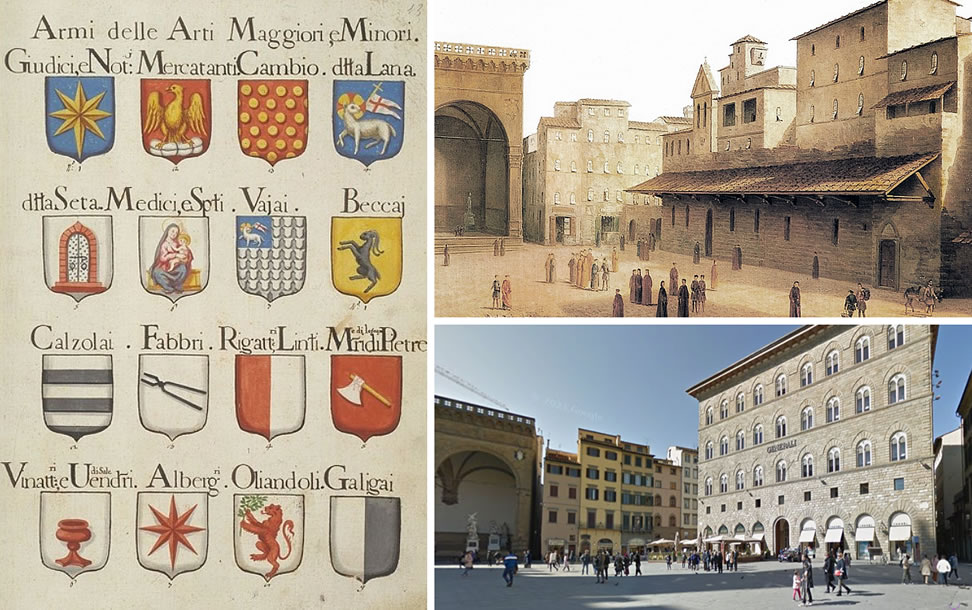
Emblems of the major and minor Florentine Arts (AS Firenze, Fondo Manoscritti, 471, c. 13, XVIII century) The third emblem on the top is those of the Art of Exchange (Cambio) - View of Ancient Florence by Fabio Borbottoni (1820-1902), 1850 and today. The destroyed canopy of the Pisans that covered the seat of the Art of Exchange, on the right.
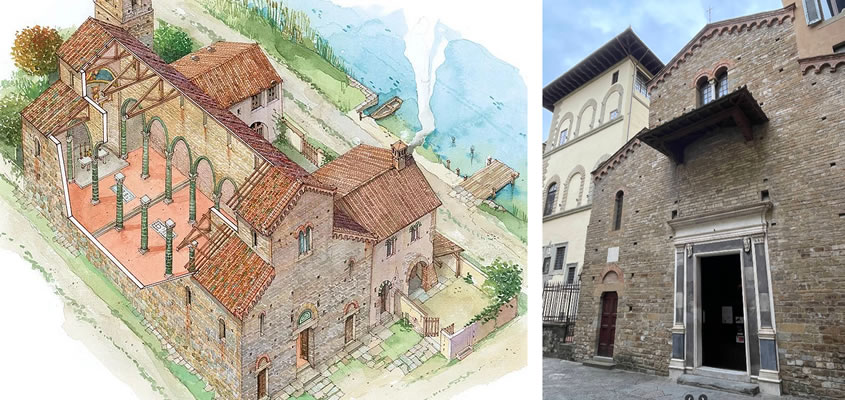
Piazza del Limbo: the image is a hypothetical reconstruction of the Church of the Holy Apostles in the Middle Ages and highlights the its vicinity to the Arno river; an aspect that isn’t gathered easily, since the church, due to its small size, is almost partly hidden by the modern buildings of the Lungarno.
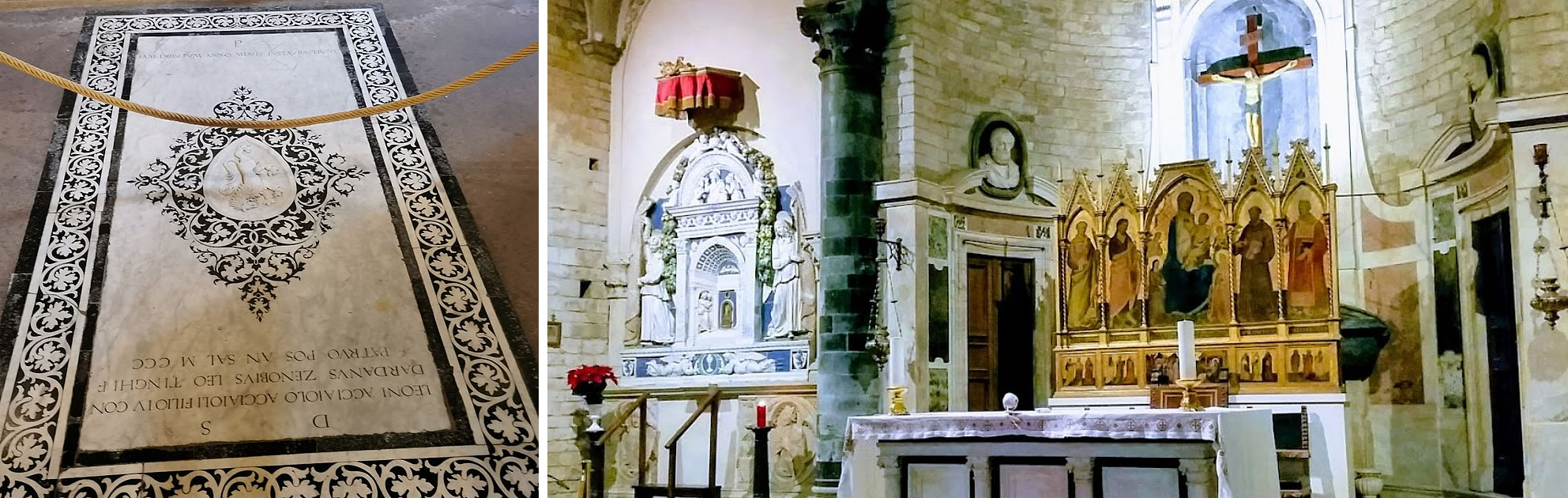
The tombstone of Leone Acciaiuoli (Ortona, 1220 ca. – Florence, 1300) in the Church of the Holy Apostles, Florence. He was a Gugliarello's son and become a famous sailor: he reached the island of Chios by three galleys and brought to Ortona the relics of the Apostle Thomas, during 1258. Chios was considered the island where the Apostle Thomas, after his death in India, had been buried. - Eucharistic tabernacle (ca 1512) by Andrea Della Robbia, on left. Around 1512, Giovanni Acciaiuoli commissioned Andrea della Robbia to do the Eucharistic Tabernacle in polychrome glazed terracotta for the Church of the Holy Apostles. The tabernacle was placed on the left aisle of the church, above the tomb of Donato Acciaioli the old (?-1333), great-grandson of Gugliarello, which was made by an unknown sculptor in 1333. Giovanni Acciaiuoli (1460-1527) - son of Pietro - participated actively in political life of his city, and was a bitter opponent of Medici. He died of plague in Florence in 1527.
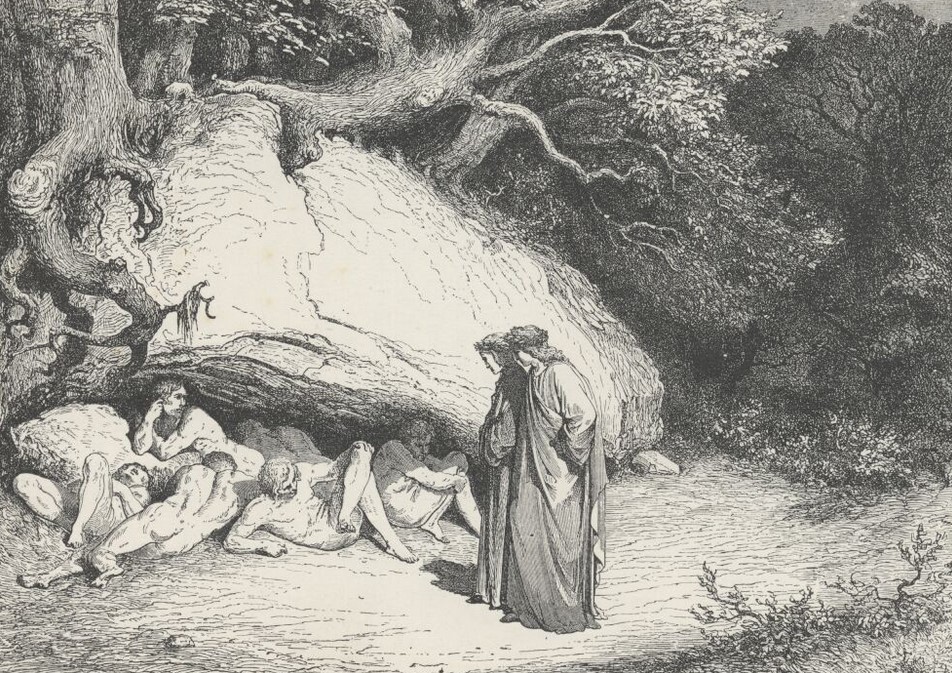
'Only so far afflicted, that we live / Desiring without hope.' (Inferno, Canto IV, lines 38,39) An illustration of Gustave Doré (1832 – 1883). Plate XI: Canto IV: The Virtuous pagans.
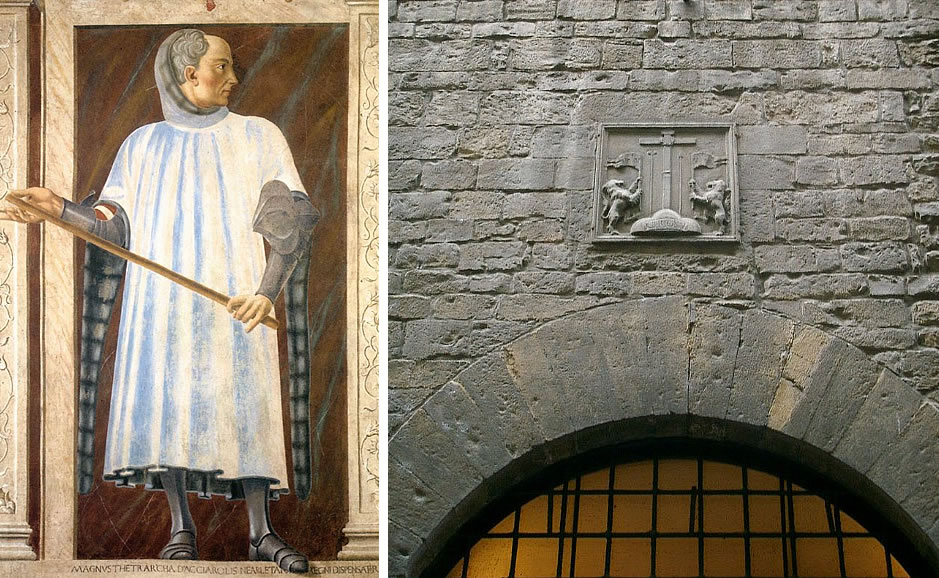
Fresco of Niccolò Acciaiuoli by Andrea del Castagno in the Uffizi. - A detail of Acciaiuoli's Palace at 8, via Borgo dei Santi Apostoli, the Certosa plaque.
This page was last edited on 14 March 2026
© andmorestory.eu - All right reserved