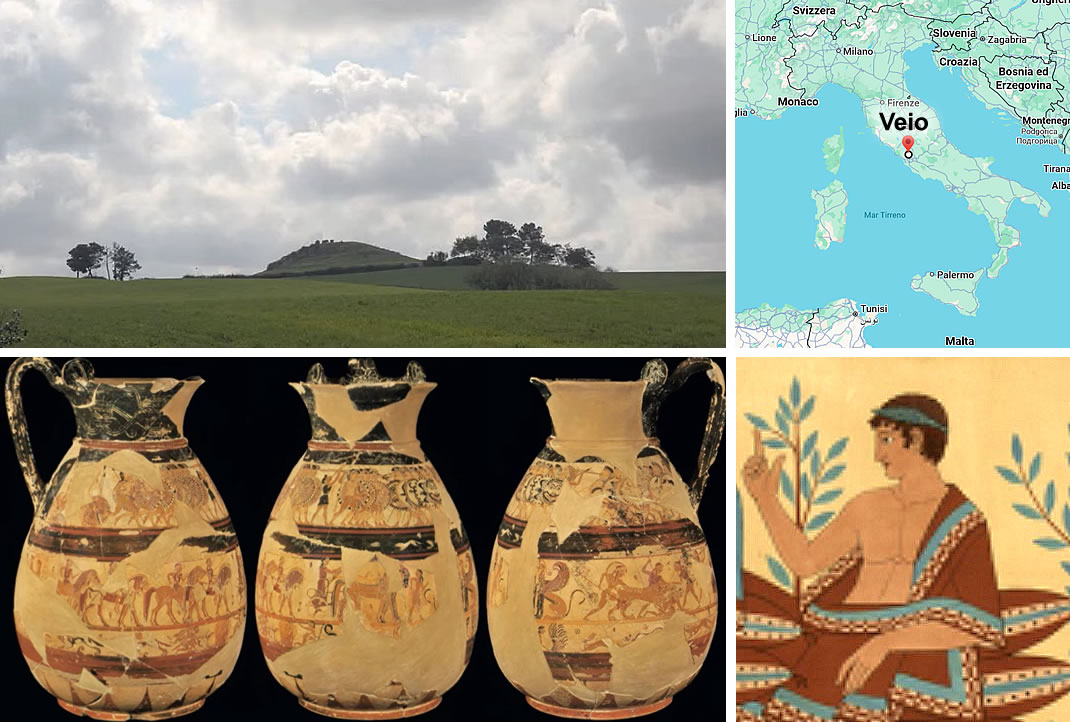
The Chigi Tumulus and the entrance section of an Etruscan chamber tomb

Less than 20 km from Rome stood Veii (Latin Veii, Etruscan Vei), a powerful and sophisticated rival of the ancient Urbe. Today, the town of Formello stretches over that area, deriving its name from forma (shape), a toponym already attested in a document from 1041, referring to channels or conduits present in its subsoil. This is a network of underground Etruscan tunnels carved into the tuff for drainage and water regulation.
Veii was an important Etruscan city founded during the 10th century BCE, not far from the right bank of the Tiber River. From the 8th century BCE onwards, it entered into competition with Rome for control of the septem pagi (seven hamlets) and the salt pans at the river's mouth (campus salinarum), on which part of its prosperity depended.
Defined as pulcherrima urbs ("splendid city") by the Latin historian Livy, considered by Dionysius of Halicarnassus as "the most powerful city of the Tyrrhenians" at the time of Romulus and "as great as Athens," it was among the major political and cultural centers of central Italy, particularly between the 7th and 6th centuries BCE. Along with Caere (today Cerveteri), it was the most populous city of southern Etruria. Suetonius reminds us that as early as the 1st century CE, when Nero was transforming the center of Rome into his grandiose residence, Veii offered the hope of an still uncontaminated landscape:
Rome will become a single great house: move to Veii, citizens, provided that this house does not expand all the way there!
- (Suet., Nero, 39).
According to tradition, the Romans contested control of the right bank of the Tiber with their powerful neighbor from the time of Romulus, but there were also occasions for encounter, such as when the Veientine masters of terracotta sculpture were summoned to decorate the Temple of Jupiter Optimus Maximus on the Capitoline Hill during the era of the Etruscan kings of Rome. The Vibenna brothers, warlords seeking glory who favored the rise to the throne of the future king Servius Tullius, passed through Veii, and it was to Veii that Tarquin the Superb first fled when exiled by the founders of the Republic. Later, when the Etruscan city fell to Marcus Furius Camillus, the Roman plebs wanted to move there rather than rebuild the city devastated by the Gauls: only the intervention of the victorious general prevented that proposal from being accepted, steering the course of future history in a very different direction.
Between the end of the 8th and the first half of the 7th century BCE, the territory of Veii (about 15,formello-chigi-olpe-venel hectares) experienced a progressive demographic increase. Social differences between various family units and the aristocracy became more pronounced. The most powerful families of Veii flaunted their status through the adoption of cultural and artistic models from the Near East, and in the second half of the 7th century BCE, they flaunted their rank not only with wealth and lands but also with their funerary monuments.
The tumulus tomb represents the highest expression of the Etruscan aristocratic elites, who based much of their wealth and prestige on land ownership. It was not a simple burial but an artificial hill, visible for kilometers.
The tumuli are located along important roads to signal land ownership and control of communication routes by a powerful aristocratic *gens* (family). Their varying distance from the city allows them to be divided into two distinct groups. The first includes tumuli located less than 1 km from the Veii plateau, situated near contemporary burial areas or areas in use since earlier times. These characteristics have been attributed to the antiquity and continuity of certain families' ownership of specific areas. The other group includes tumuli outside the necropolises, such as the oldest, the Chigi Tumulus, located 5 km from the inhabited area along one of the road routes towards the Faliscan-Capenate territory.
It is a monumental tomb, 25 meters high, built on the hill of Aguzzo Mount, an isolated relief, a cone of scoria from the Sacrofano volcano, which dominates and characterizes the landscape south of Formello. Its toponym derives from the particular shape of its summit (Aguzzo, meaning sharp or pointed), determined by the presence of the tumulus.
Alongside the Aguzzo Mount Tumulus, in the second half of the 7th century, parallel to the widespread reoccupation of the territory, a series of tumuli or small necropolises arose over an area of 10 or 12 km in diameter. A buffer zone distinct from the city and the rest of the Veientine territory, containing some tombs of a gentilicial character, and others more modest that could be attributed to individuals linked to the *gens* buried at Aguzzo Mount by kinship or clientele relationships.
Time and vegetation buried it for centuries, until, by chance in 1882, thanks to a pozzolana quarry (a volcanic sand used for making cement) in the locality of Aguzzo Mount, the quarrymen noticed a hole on the top of the tumulus that led directly inside the tomb. Unfortunately, they were not the first to arrive: the tomb had already been looted and stripped of almost all its metal objects and personal ornaments – certainly present in large numbers in such a gentilicial context – however, a substantial ceramic assemblage remained, saved from the tomb robbers perhaps because it was largely shattered by the collapse of the ceiling.
The famous archaeologist-engineer Rodolfo Lanciani (1845-1929), then secretary of the Municipal Archaeological Commission and professor of "Roman Topography" at the University of Rome, was contacted to oversee the excavations. Among the shards, he identified those of an olpe of rare beauty, a luxury object in painted pottery produced in Greece, in Corinth, between 650 and 640 BCE. The fact that an Etruscan family of Veii possessed such a precious object places them at the highest levels of power and Mediterranean trade.
Corinth (Ancient Greek Kórinthos) was a polis of ancient Greece located on the isthmus of the same name. Inhabited since Neolithic times and the Early Bronze Age, it is proven that the city was destroyed around 2formello-chigi-olpe-venel BCE, and it seems it was a Mycenaean Bronze Age palace-city, like Mycenae, Tiryns, or Pylos. According to legend, the city was founded by Sisyphus in the 15th century BCE, specifically in 1429 BCE. Between the 15th and 12th centuries BCE, at the height of the Mycenaean civilization, Corinth was one of the main cities in the Corinthia but was later conquered by the Dorians, who came down from the north and settled in the Peloponnese. Having become kings of Corinth during the Archaic period, the Bacchiadae later decided to abolish the monarchy and replace it with a family oligarchy headed by an elected *prytanis*. It was during the power of this family (between 747 and 657 BCE) that very important colonies in Sicily, such as Syracuse, were founded. Colonization was a consequence of the enrichment of the polis through trade, particularly the flourishing export of pottery vessels, then in the Protocorinthian style. And it is precisely to the end of this period of colonization in the Italian peninsula that the Aguzzo Mount Olpe dates.
Protocorinthian pottery is a class of Corinthian vases of a predominantly Orientalizing style, whose production spans approximately from 725 BCE to 625 BCE, named Protocorinthian to distinguish it from the subsequent series called Corinthian. It was exported throughout the ancient world and frequently imitated: Greece, Asia Minor, North Africa, the western colonies, and among the native populations of Sicily and southern Italy. The latest Protocorinthian phase dates to 650-640 BCE. Its works are indisputable masterpieces characterized by exceptional perfection in drawing and high technical skill in the use of black-figure, the expression of movement, composition, and grouping of figures. The overlapping of figures, typical of Late Protocorinthian, is unparalleled in its time and in all Archaic art.
Belonging to this phase are only a handful of small vases with animal friezes and figured scenes, including the Chigi olpe, a Greek jug 26 cm high with a capacity of at least 1.5 liters. After this unique work comes the transition period (c. 640-625 BCE), followed by the transition to the Corinthian style (625-550 BCE) with a return to the prevalence of the continuous animal frieze in black-figure.
The lands where the tomb was located belonged to the noble Chigi family, from which the tomb took its name (Chigi Tumulus or Aguzzo Mount Tumulus). The rest of the abundant grave goods found ended up in the family's extensive antiquarian collection. This was an important princely family of Sienese origin (15th-16th century), which includes several popes and cardinals, particularly Pope Alexander VII (1599-1667), art collectors, patrons of Italian artists, and philanthropists.
We know that the deceased of the tumulus was named Venel Pepunas. He was a fragile young man, who died prematurely before marrying, belonging to a very powerful, almost princely, family, capable of importing from Greece one of the most beautiful vases of the ancient world known to date. His funerary equipment included finds of extraordinary value, partly donated by his mother Anaia (perhaps herself buried in the same tumulus, as suggested by a spindle whorl, a woman's tool) to accompany her son on his final journey. Among these was an abecedarium, a small bucchero amphora (black Etruscan pottery) engraved with a sequence of letters, among the earliest evidence of writing in Etruria, which means that perhaps Venel could read and write. And then the beautiful olpe, a decorated vase of Corinthian production datable to around 650-640 BCE, intended for pouring wine at symposia. Depicted on it are scenes related to *paideia*, the celebration of education and the transition to adulthood that he had not been able to experience fully. It was a mother's gift for the son who had not had time to become a man.
However, according to Matteo D’Acunto (Il mondo del vaso Chigi. Pittura, guerra e società a Corinto alla metà del VII secolo a.C. – The World of the Chigi Vase. Painting, War, and Society in Corinth in the Mid-7th Century BCE), the Chigi olpe was given as a gift from a nobleman who arrived in Tarquinia from Corinth with Demaratus (exiled by the tyrant Cypselus) to a member of the princely family of Veii, eventually ending its history in his monumental tomb. Therefore, the central theme of the social ascent of the young aristocrat is expressed through scenes that encapsulate the value system of Corinthian society, translating the model of Homeric heroes and Near Eastern rulers. Thus depicted are the lion and hare hunt, hoplite combat (with close-ranked phalanxes of warriors armed with spear, breastplate, and round shield), and the crucial nature of marital choice synthesized by the Judgment of Paris.
The various scenes on the vase should allude to the activities and ideals underlying the education of young Corinthian aristocrats: hunting, war, but also the encounter with Aphrodite, which prepares for marriage. Indeed, the frieze on the shoulder of the vase shows two lines of warriors advancing against each other, while a flutist marks the march's rhythm. Each line consists of a vanguard about to clash and a rearguard arriving behind. The vanguards are composed of four men on the left and five on the right. The rearguards have nine and seven armed men, respectively. The soldiers are hoplites, characterized by a large round shield (*hoplon* in Greek), and take position next to each other.
The Chigi Olpe offers precious evidence of the establishment of this close-rank combat technique. The men are depicted in profile, overlapping and staggered to give depth to the scene. Each soldier carries a shield, a helmet with a multi-colored crest, two spears, a bronze breastplate protecting the chest, and bronze greaves to protect the legs below the knees. The various symbols painted on the outside of the shields attract attention: recognizable examples include a Gorgon's face, birds with spread wings, and a turtle.
The deme of Acharnae belonged to the Oineis tribe and was one of the most populous in Attica. According to Thucydides (II, 20, 4), this allowed Acharnae to provide the highest number of hoplites, over 3,formello-chigi-olpe-venel of the 13,formello-chigi-olpe-venel-14,formello-chigi-olpe-venel Athenian total, though this number is now believed to have been closer to 1,formello-chigi-olpe-venel.
During the initial phase of the Peloponnesian War, the Spartan army, led by King Archidamus II, advanced to Acharnae, where they ravaged the land in an attempt to draw the Athenians into open battle. The destruction, including the abandonment of the temple of Ares, contributed to the Acharnians’ reputation for ferocity, a trait highlighted by Aristophanes in <>Lysistrata.
In the aftermath of the Peloponnesian War, a decisive battle took place in Acharnae between democratic forces led by Thrasybulus and the Thirty Tyrants supported by Sparta. Thrasybulus’s 700 men and two cavalry divisions succeeded in cutting off the Spartans’ supplies, resulting in a victory for the democrats.
In the 4th century BCE, the city held a prominent position in the Athenian council, providing 22 out of the 500 council members, more than any other deme.
Acharnae (in Greek Archarnai) was a deme of ancient Attica located east of the pass between Mount Parnes and Mount Egaleo. Its name is possibly of pre-Greek origin and may mean "sea bass" due to the plain’s resemblance to the shape of a fish. Another theory suggests it derives from Acharnas, a mythical hero and alleged founder of this town.
The earliest evidence of continuous settlement in Acharnae dates back to the Neolithic. Near the Lykopetra neighborhood, a Mycenaean tholos tomb has been uncovered, along with traces of another Bronze Age tomb in the modern-day area of Nemesis. Excavations across Acharnae have led to speculation that it may have been a politically autonomous region during the Mycenaean era. Most archaeological findings come from the Classical and Hellenistic periods (5th-2nd centuries BCE), including necropolises spread across the area, remnants of the road network, and 4th-century BCE hydraulic infrastructure, which provide insights into local public and private life.
Acharnae had numerous sanctuaries and altars dedicated to gods like Apollo Aguieus, Heracles, Athena Hygieia, Athena Hippia, Dionysus Melpomenus, and Dionysus Kisseus (the latter named for the ivy plant, which the Acharnians claimed first grew in their deme).
Acharnae produced no particularly famous figures, but was renowned for its fertile lands, especially its vineyards and olive groves, which stretched as far as the banks of the Ilissos River and were irrigated by channels. The Acharnians were also known for cultivating cereals and for their charcoal production. They had a characteristic appearance: they were easily recognized in the market of Athens because they were accompanied by donkeys which carried the goods. Notably, the donkeys of Acharnae were famous for their size, perhaps humorously so. The oligarch Peisander, who was from Acharnae, was even nicknamed "the donkey" due to this local association. Their rough, stubborn character was famously depicted by Aristophanes in his comedy *The Acharnians*. But according to Pindar, they were reputedly brave.
This page was last edited on 22 April 2026
The Chigi Tumulus and the entrance section of an Etruscan chamber tomb
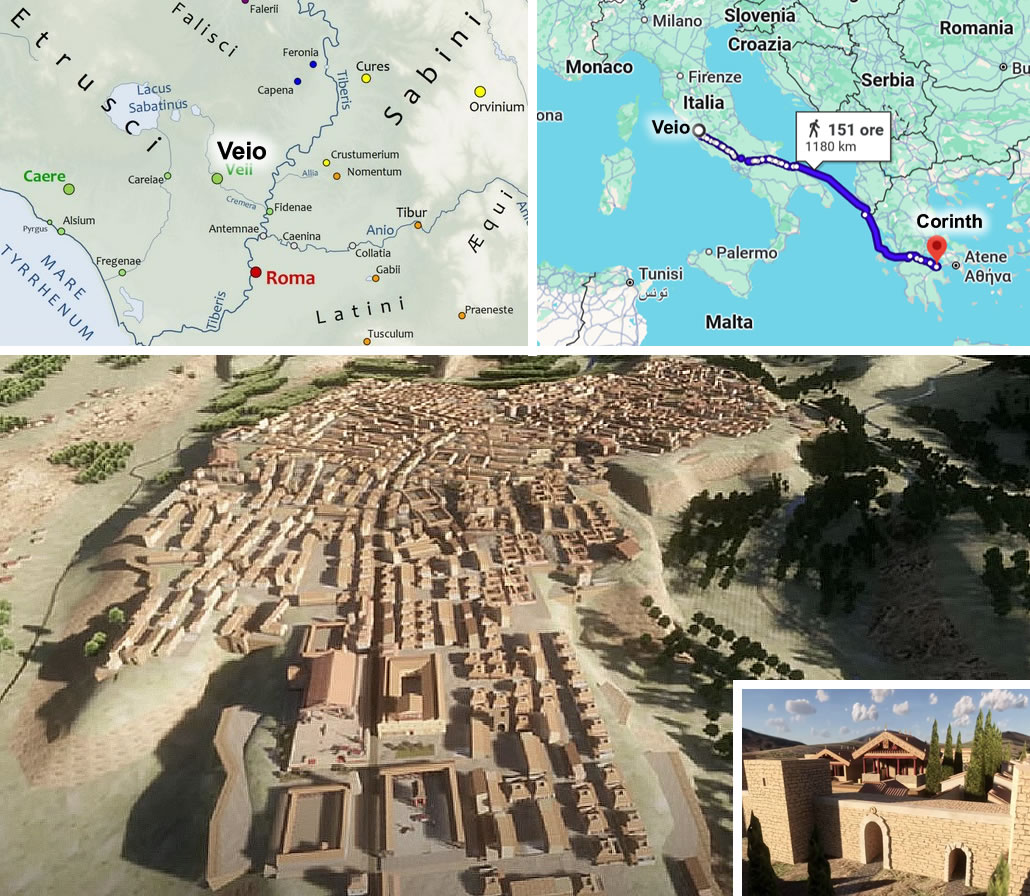
The ancient Etruscan city of Veii reconstructed in 3D by Marco Mellac
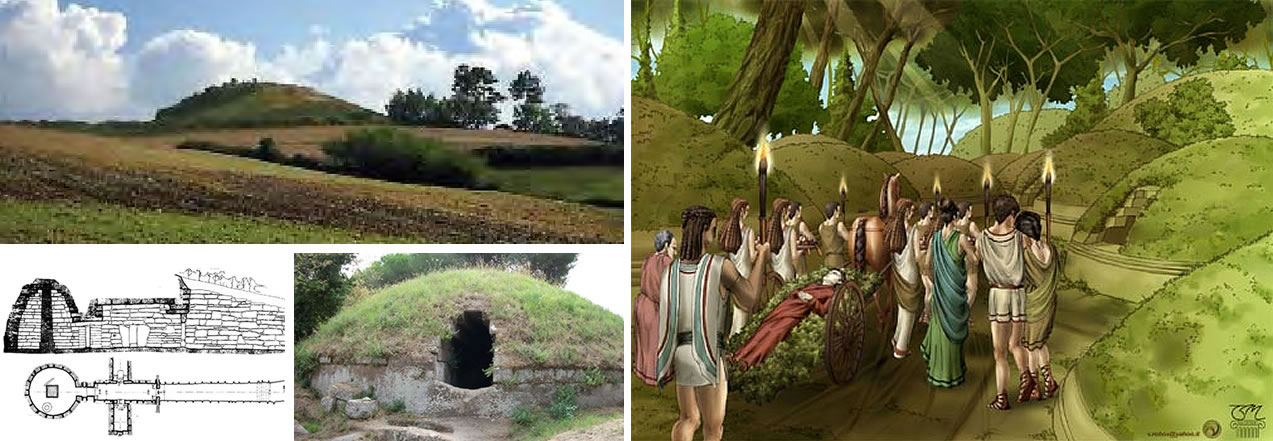
The Chigi Tumulus and section of an Etruscan tumulus and its hypothetical entrance
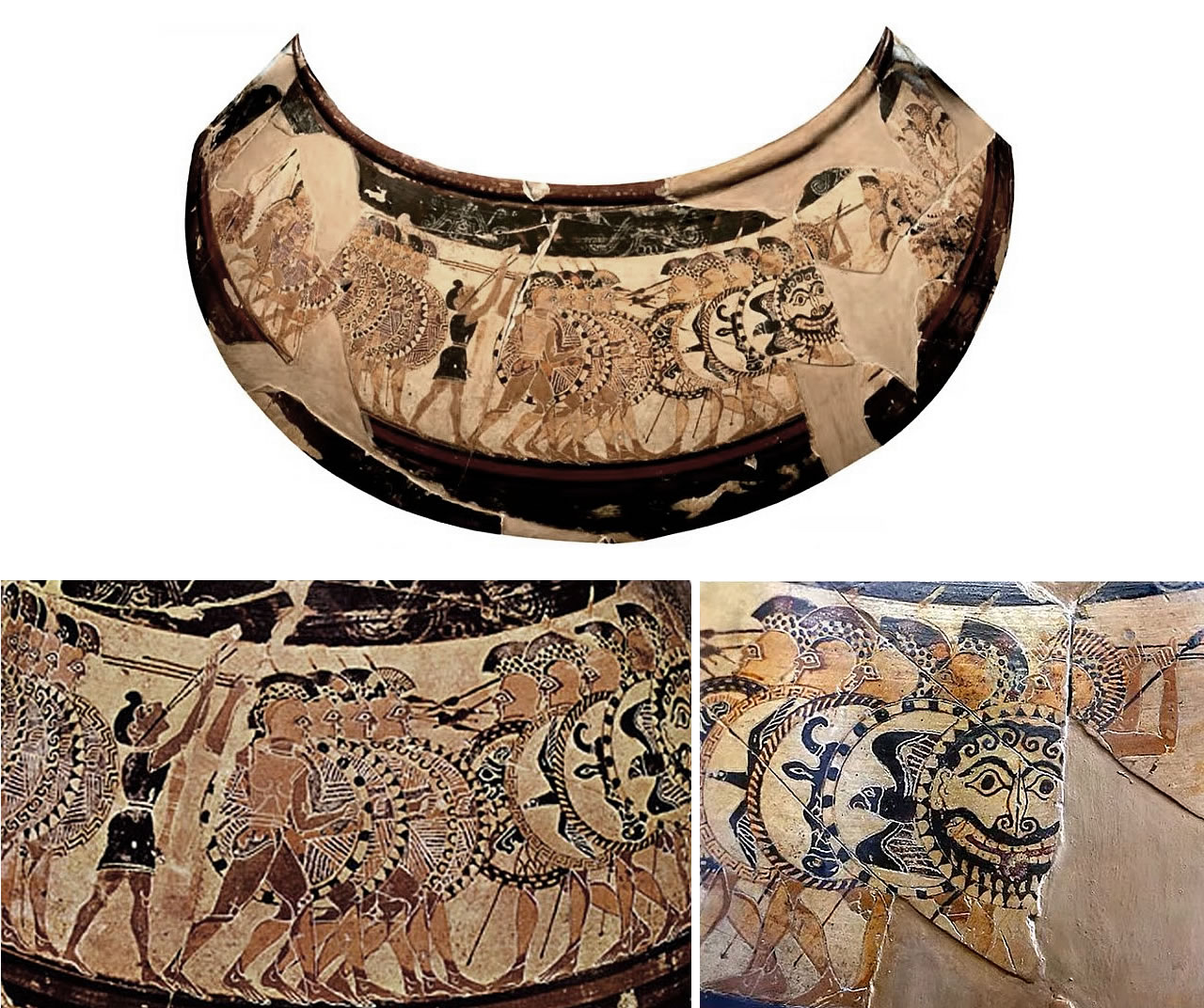
Details of the Chigi olpe – hoplite combat
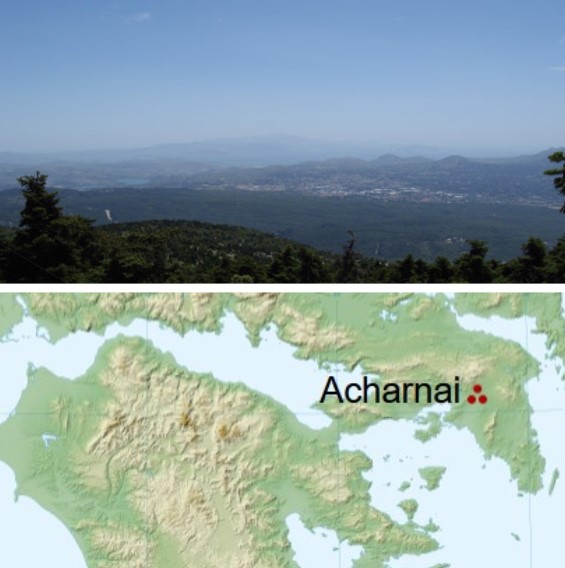
Acharnai is located in Peloponnese
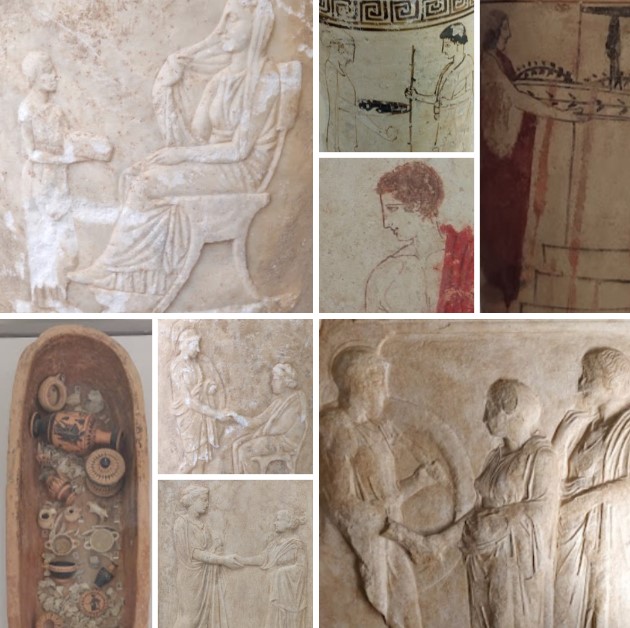
Finds from grave goods - Archaeological Collection of Acharnae's Museum
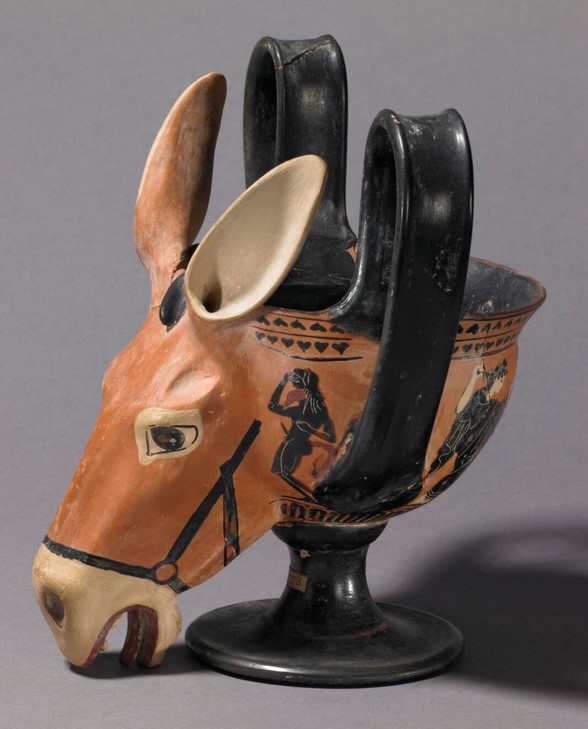
Kantharos with Donkey-Head Attachment. Greek, Attica, c. 520-500 BCE. Black-Figure Pottery. British Museum, London
© andmorestory.eu - All right reserved