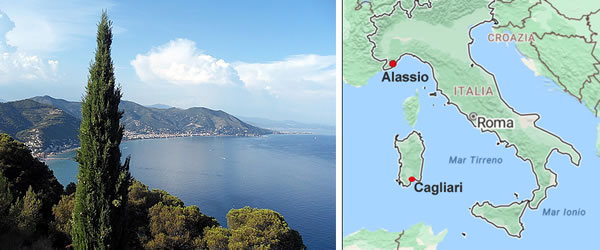
Panorama of Alassio from Capo Mele (Savona, Italy)

One of the most beautiful and poetic legends of feudal times, reminiscent of cloisters and chivalric romances, hovers over Adalaxia (Alassio). It is the legend of Aleramo, a 10th-century adventurer, valiant in arms and gracious in manner, the feudal progenitor of the great Aleramici dynasty. He served as a brave squire (or cupbearer) to Emperor Otto I, known as "the Great," and fell in love with the Emperor's daughter, Adelasia. The couple faced intricate challenges arising from their stark social disparity and the Emperor's severe disapproval. For love, they decided to flee: the two lovers undertook an audacious escape from Germany, traversing the regions of the Holy Roman Empire until they reached the shores of the Mediterranean. Their journey led them to the Ligurian lands, at the foot of Mount Tirasso (or Tirazzo), where a Roman military station already stood along the Julia Augusta road. This place is now identified as the site of the "Madonna della Guardia." There, they lived a simple, strenuous life in a village of charcoal burners (Lamiun): the husband sold charcoal at the market in the nearby city of Albenga, hiding his true identity for years, while the wife took on small embroidery jobs. Over time, accumulating resources, the couple was able to build a home in the woods, where, soon, many children began to be born. Meanwhile, the Bishop of Albenga received Aleramo's confession and united them in marriage. Through a turn of strange events, they were discovered and pardoned by Emperor Otto, who had come to Italy to fight the Saracens (967). Aleramo, at the head of his troops, rushed to his side, and with his acts of valor, he earned the Emperor's admiration. In the end, with the intercession of the Bishop of Albenga, Otto forgave him. Aleramo received from his father-in-law the investiture of vast feudal states, from which originated the extensive possessions of the Aleramica March, from Saluzzo to Ceva, to Savona and Albenga. Adelasia, in turn, had a settlement built, baptizing it with the name Alaxia, which later developed into Alassio. According to another legend, Adelasia, guilty of adultery, was imprisoned by her husband in Alassio, who as punishment locked her in a tower (hence the town's coat of arms, depicting precisely a tower with a locked door). The adulteress tried to flee, but being too heavy, she remained half in and half out of the tower. Aleramo eventually freed her from that uncomfortable imprisonment. We know that in the 10th century, the County of Albenga belonged, with Ventimiglia, to the Arduinica March, and passed to the Aleramici with Savona only at the end of the 11th century. While these legends confirm that in the 9th century the lineage of the Aleramici held a lordship in Liguria and Piedmont, and that the name Alassio derives from a woman named Adelasia—who, if not Aleramo's wife, was a namesake, perhaps the same Adelaide, Marchioness of Susa, from a century later. Alassio (in Latin Alaxium) is a maritime Ligurian center of exceptional vitality and prosperity. With a temperate climate, it is located on the western Riviera of Genoa, with a very elongated shape between the mountain slopes and the sea. Its name appears written for the first time in 1123 as Alaxe, but it underwent lexical variations over the centuries until the unification of Italy (1861), when the current denomination was adopted.
Panorama of Alassio from Capo Mele (Savona, Italy)
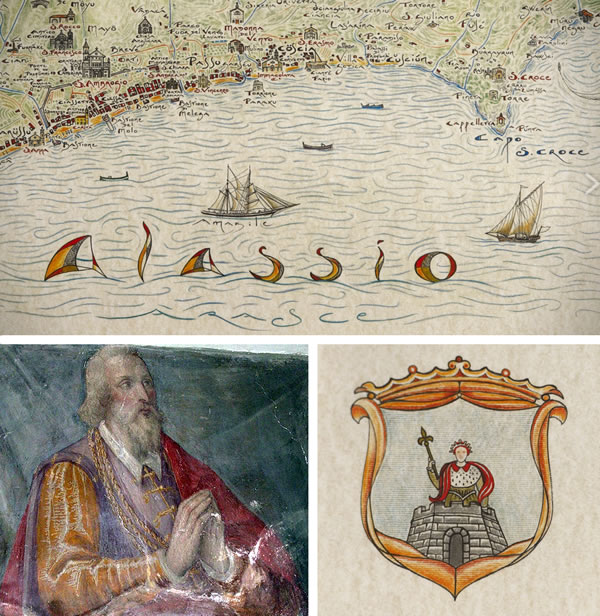
Historical map of Alassio by Giovanni Pazzano; Painting of Aleramo by Guglielmo Caccia, known as "il Moncalvo," 17th century, preserved in the church of Grazzano Badoglio (Asti); Coat of arms of Alassio.
This page was last edited on 14 March 2026
© andmorestory.eu - All right reserved