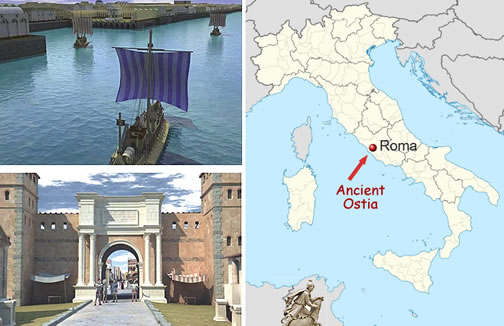
3D reconstruction of ancient Ostia

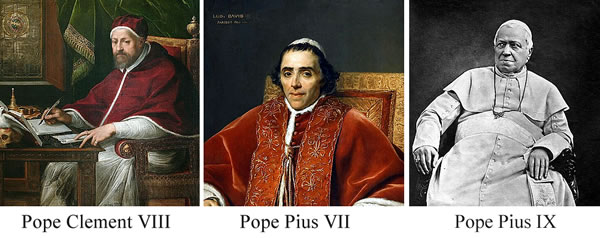
Ostia (from the Latin ostium, meaning river mouth) is historically considered the "Gateway to Rome." Situated at the mouth of the Tiber River, 30 km west of the city, it was a kind of miniature version of Rome itself. Its proximity to the sea, the Tiber mouth, and the coastal salt flats determined its destiny. It was founded around the 4th century BC as a military camp, essentially to control the mouth of the Tiber and the nearby salt pans. It was Rome's first colony, initially built to serve as a base for the Roman fleet. It experienced significant expansion, particularly during the peak of the Empire (1st-2nd centuries AD), surpassing 75,000 inhabitants, while Rome housed over a million. Ostia's importance was tied to its vocation as a commercial port hub, crucial for the grain supply to the capital. The city was indeed Rome's river port, and for centuries, food and goods, marbles from every corner of the Mediterranean, passed through it. With Rome's expansion, Ostia's river port proved insufficient for the capital's growing needs. For this reason, Emperor Claudius (10 BCE - 54 CE) had another port built—a maritime one—further north, where modern-day Fiumicino is now located. It was capable of allowing large ships to dock without the need to transfer cargo offshore, and via an artificial canal connected to the Tiber, access to Rome was faster. Claudius's port gained increasing importance, and Ostia gradually became secondary. Starting from the middle of the 3rd century AD, parallel to a more general crisis of the Empire, Ostia's irreversible decline began. Towards the end of the 6th century AD, only 20,000 inhabitants remained in Rome, survivors of sacks, wars, famines, and plagues: merchants, sailors, prostitutes, artisans, plebeians, and nobility sailed for Constantinople. Ostia was also in a state of abandonment: the Goths, who had occupied the entire coast, and pirates endangered the population, forcing them to move inland for safety. Thus, Ostia's ruins were buried by time for centuries. About a thousand years later, with the Renaissance, the search for treasures of ancient art in Rome and its surroundings began. With Pope Clement VIII (1536-1605) in 1598, the right to extract marbles from the ruins of Ostia for use in the construction of St. Peter's and, in general, for building works in the city was established. After a more or less long period of disinterest in Ostia's ruins, a new cycle began in the 18th century with various excavations, until in the early 19th century, Pope Pius VII (1742-1843) prohibited them because:
... they were carried out tumultuously here and there by people, who for the most part had no other aim than to find valuable items for trade, without any real benefit for antiquity, for erudition, and for history.
The Pope established public excavations for the knowledge of the city, though he was also motivated by economic-political reasons, primarily to increase the collections of the papal museums. The truly serious beginning of archaeological research in Ostia occurred starting in 1855 with Pope Pius IX (1792-1878). Since then, slowly up to the present day, about 50 hectares of the entire urban area have been brought to light. These excavations have allowed the discovery of several sacred places where rites of different religions were celebrated in antiquity. Indeed, Ostia at that time was a multi-ethnic, unprejudiced city where all cults coexisted: from the deities of the Roman Pantheon, to Egyptian ones (Isis), to Persian (Mithras) and Jewish ones. The cult of the Persian god Mithras was particularly celebrated in Ostia, especially among soldiers and merchants from the East. Indeed, it was propagated in the West, like other cults, especially by military men, whether they were from the regions where the cult flourished or legionaries who had come into contact with it during their campaigns. Eastern slaves and merchants were also missionaries of this mystical cult, which found wide masses of followers and, with its mystique of rebirth and salvation, was to become a formidable adversary for nascent Christianity. In Ostia, so far, more than 75 statues, over 100 Mithraic inscriptions, and 20 Mithraea have been found, testifying not only to the religious ferment experienced in the city, as in Rome, before the affirmation of Christianity, but also to how the Eastern belief did not foresee large communities with numerous adherents, but rather small autonomous groups with their own spiritual guide. In 1924, a Mithraeum was discovered 150 meters north of the Porta Romana, located on the private estate of the Aldobrandini family. It is attached, with its north-facing rear wall, to a Roman lookout tower, placed on the perimeter of the walls and dating back to the 1st century. Against the wall, an altar was found bearing an inscription from which it is deduced that there was an image of Mithras depicted on a cloth, which had been severely damaged by humidity, and that Sextus Pompeius Maximus had replaced it at his own expense with a marble representation.
DEVM VETVSTA RELIGIONE
IN VELO FORMATVM ET VMORE OBNVBI
LATVM MARMOREVM CVM
THRONO OMNIBVSQ(ue) ORNAMENTIS
A SOLO OMNI IMPENDIO SVO FECIT
SEX(tus) POMPEIVS MAXIMVS PATER
Q S S EST
ET PRAESEPIA MARMORAVIT P(edes) LXVIII IDEM S(ua) P(ecunia)
The god, fashioned in ancient manner on a cloth and obscured by moisture, [he] made in marble with a throne and all ornaments from the ground up entirely at his own expense. Sextus Pompeius Maximus, Father, who is Quinquennalis of the Sodales. And he also paved the feeding troughs for 68 feet, likewise at his own expense.
In the Mithraeum, a bronze slab was also found bearing an inscription beneath the depiction of a bust of the Sun god, currently preserved at the British Museum. On the upper part, on both sides of the bust of the god, are depicted a sacrificial knife and a patera (mixing bowl), that is, a bowl for ritual libations. The inscription reads a dedication by all the priests of the cult of Mithras in Ostia to Sextus Pompeius Maximus, defined as "the Father of the Fathers." This suggests that he was the head of the entire Mithraic community of Ostia and the area of the Port of Rome:
SEX ~POMPEIO~ SEX~FIL~ MAXIMO~ SACERDOTI~SOLIS~ IN VICTI~MT~PATRI~PATRUM QQ~ CORP ~TREIECT~TOGA TENSIUM~SACERDO TES~SOLIS~INVICTI~MT OB~AMOREM~ET~MERI TA~EIUS~SEMPER~HA BET
Sexto Pompeio Sexti filio Maximo Sacerdoti Solis Invicti Mithrae Patri Patrum Quinquennali Corporis Treiectis Togatensium Sacordotes Solis Invicti Mithrae Ob amorem et merita eius. Semper habet.
Dedicated to Sextus Pompeius Maximus, son of Sextus, High Priest of the Sun God, Mithras, all powerful, and Father of Fathers, President of the Guild of Master Ferrymen. We, Priests of the all powerful Sun God, Mithras, do this on account of the high regard and affection we hold for him and his worthy deeds. He has this for ever.
The cult reserved for the god Mithras, born in Iran, arrives in Ostia in 67 BC when Pompey the Great (106-48 BCE) defeated and captured the Cilician pirates in the eastern Mediterranean, bringing them with his fleet to Rome. It was indeed the soldiers from Pompey's garrisons, veterans of campaigns in Asia Minor, who spread it in a short time among the humbler classes of the population.
The pirates no longer sailed in small groups, but in large fleets, and had their commanders, who increased their fame [for their exploits]. They plundered and pillaged first those who sailed, leaving them no peace even in winter [...]; then also those who were in ports. And if anyone dared to challenge them on the open sea, they were usually defeated and destroyed. If, however, he managed to defeat them, he was unable to capture them, due to the speed of their ships. Thus the pirates immediately turned back to plunder and burn not only villages and farms, but entire cities, while they made others their allies, so much so that they wintered there and created bases for new operations, as if it were a friendly country.
- Cassius Dio Cocceianus, Roman History, XXXVI, 21.1-3.
After the conquest of the East and the destruction of Carthage, the Romans, occupied with civil wars, had neglected the fleet, so that the pirates now ruled as masters over the entire Mediterranean. They had established their own bases along the southern coasts of Asia Minor (Cilicia, etc.), on the island of Crete, in the Gulf of Alexandria, in Sicily, and elsewhere, so that they also intercepted ships loaded with grain from Asia and Egypt headed for Italian ports. The senate had ordered several expeditions against them, but without any result.
In 67 BC, the tribune Aulus Gabinius proposed a law (lex Gabinia), which entrusted Pompey with command of the war against the pirates, with full powers, for a duration of three years, over the seas and coasts up to 50 miles inland.
The senate, now distrustful of Pompey, attempted to deny him such an important assignment but had to yield to the will of the people. Pompey, on the other hand, proved completely worthy of the trust placed in him. He assembled a fleet of 200 ships, enlisted an army of 120,000 soldiers, and divided the entire Mediterranean into 13 sectors.
In this way, enveloping the pirates almost in a vast net, he drove them out of the entire western Mediterranean in 40 days; then, moving to the eastern Mediterranean, he forced them, with a superb encircling maneuver, to gather along the coasts of Cilicia, where in a great battle he destroyed all their ships. The enterprise, which lasted only three months, was rightly celebrated as Pompey's finest.
Pompey showed great clemency towards the vanquished, founding with them, on the coasts of Asia Minor, Greece, and Italy, small rural colonies.
The cult of Mithras arrived in Rome in the centuries around the birth of Christ, when the Roman Republic was beginning to change its appearance to assume that of a cosmopolitan empire. It was a time of economic and social crisis, in which the Roman political-administrative order no longer offered roles and objectives with which citizens could identify; they turned to religions that offered them the prospect of otherworldly salvation. More precisely, the cult arrived during the Flavian age (69-96 AD). It is attested by a bust depicting Emperor Trajan (53-117 AD) with a Phrygian cap, a symbol of the Iranian god, from Ostia. Various cults from the eastern regions spread. New deities like Cybele, Serapis, and Isis were assimilated into Roman religious practices. None of these, however, assumed the prominence held by Mithras between the 1st and 3rd centuries AD: the sanctuaries dedicated to him numbered over a hundred in the capital alone, with about 1,200 followers in Ostia, a city that in the first centuries AD had about 75,000 inhabitants.
The cult spread especially from the 2nd century onward under Septimius Severus (145-212 AD), who had married the Syrian Julia Domna. Even before the Severan dynasty, Commodus (161-192 AD) had been initiated into the Mithraic rites, and other later emperors, up to Julian the Apostate (331-363 AD), contributed to the prestige of the cult.
But it was with Geta (189-211 AD) and Caracalla (188-217 AD) that the cult received new impetus and the Iranian cult began to spread more widely both in the city of Rome and in the homeland of the Severans, i.e., Africa.
The initial distrust of Trajan, who had not allowed much space for this oriental cult, by the end of the 3rd century AD was completely swept away by Aurelian (214-275 AD) and subsequent rulers, who increasingly associated themselves with Eastern despots. Mithraism penetrated, though not in its strict form of mysteries, even into public religion, where it became identified with the cult of the Sun. It was a powerful rival to Christianity, and between the two religions, there was probably some reciprocal influence (the Mithraic Natalis Solis, for example, set on December 25, the winter solstice, passed into Christianity as 'Christmas'; but the Last Supper attributed, it seems, to Mithras as the basis of the Mithraic ritual banquet seems to be a pagan copy of the Last Supper of Jesus Christ).
The cult of Mithras lasted at least until the entire 4th century AD. With Emperor Constantine (?-337 AD), however, in the aftermath of his victory and the decision to extend freedom to every cult, including the Christian one, a decline of the Mithraic cult occurred: only with Julian between 361 and 363 AD was there an attempt to restore pagan beliefs, especially Eastern ones, to favor, but this remained an isolated and very brief test. With Theodosius (347-395 AD) and the proclamation of Christianity as the sole religion of the Empire, the definitive death of the Mithraic cult occurred: Mithraea were destroyed, statues overturned, and very often, above the caves used as sacred places, churches were built. Traces of Mithraism persisted still in the 5th century AD, but soon after, followers converted to Manichaeism, which seemed to have similarities with the Eastern belief.
Its origins are still not entirely clear because while in Eastern countries the sources are exclusively written documents, in Western countries only historical remains have survived. The result of this lack of sources is that our knowledge about Mithras is incomplete and fragmented, and scholars are divided among numerous hypotheses.
We know that the Aryans of the Indo-Iranian branch, before arriving on the Iranian plateau and the Indian subcontinent, followed the cult of Mithra (Mehr). This cult, after their migration and settlement in different regions, remained common until the arrival of the new religion. The religion they followed was a multifaceted cult, in which Mehr (Mithra) was the supreme god. According to Mithraic doctrine, Zervan (Zarvan or Zorvan), the primordial god, created Mithra. This cult was widespread in Iran until the emergence of Zoroaster and the Zoroastrian religion, and the oldest testimony we possess dates back to at least 1500 years before Christ. If we consider Zoroaster's period to have been around 1200 BC, Mithraism was widespread in Iran about 3,500 years ago. Mehr is mentioned in the Avesta and in the inscriptions of the Achaemenid kings as Mithra and in Sanskrit as Mitra. In Pahlavi, his name became Mitr, which today we know as Mehr.
Having reached, with Persian expansion, Babylon, Mithra entered into a syncretic formation with the Babylonian sun god Shamash; then, during the disintegration of the Persian Empire, he became, in Asia Minor, the object of a particular cult (Mithraism), which offered the hope, after death, of a renewal of life.
Contacts between the Iranian world and Western Mithraism indicate the presence of memories of the ancient pre-Zoroastrian religion also in Mithraic cults; but it appears evident that in the West, just as the cult was reworked, so too the figurative motifs that accompanied it must have been re-elaborated in the expression of new ideas, or sometimes concepts no longer understood.
Written sources and iconographic documents attest to the presence of the deity Mithras in the West starting from the 1st century BC. Indeed, it developed during the Parthian period in Iran and Europe, coinciding with the beginning of Christian preaching, and subsequently spread in the Roman Empire, in the form of mysteries, from Persian communities surviving in Asia Minor. Essentially, the cult of Mithras (Mehr) offered the hope, after death, of a renewal of life.
This religious system was a mystery cult, whose mysteries are clearly distinguished from those of Eastern origin especially by three fundamental characteristics:
• The initiate does not claim to identify with the god, as he is a model and his protector;
• The god does not die and does not rise again;
• Alongside the god, no great female deity appears.
The sacred myth of Mithraism is reconstructed especially based on the numerous depictions found in Mithraea: Mithras is born from a rock (petra genetrix) with a torch and a knife in his hands; he initiates the Sun into his own mysteries; the god ascends the chariot of the Sun; with an arrow shot, he makes water gush from a rock; finally, and this is his central act, he kills the cosmic bull, a symbol of life because by dying it gives life to the universe. The cosmic character of Mithras is emphasized by the presence in his sanctuaries of two figures, Cautes and Cautopates (names of Mithras himself), one with the torch held high, the other with the torch lowered, and placed in relation to dawn and spring the first, with sunset and autumn the second.
In Mithraism, there was an initiatory hierarchy of seven grades, each referring to one of the seven planetary spheres. The latter also have importance in Mithraic eschatology: with the help of Mithras, the soul of the initiate passes through the seven spheres, depositing in each one of the human passions, to arrive pure in heaven. The victorious (invictus) character of the god, the hierarchical discipline of initiation, the ancient Persian idea of the eternal fight against evil give these mysteries a warrior character that explains the favor they found in the army and with the emperors themselves.
The place where the Mithraic cult took place in the Hellenistic-Roman world was the Mithraeum, called in Latin spelaeum, by analogy with the primitive natal cave of the god. Being able to rarely have caves available to perform the cult, the initiates at least sought to exploit underground environments (hypogea) like those of baths or semi-underground (crypts) like cryptoporticos in urban centers, rectangular in plan, with two benches for the faithful along the longer sides, an altar in the middle, and, at the back, opposite the entrance, a marble slab on which the culminating feat of the god was represented, i.e., the 'tauroctony', the killing of the bull. Mithras kills the bull with a sword and blood gushes from the wound; some animals, namely the dog and the serpent lick it, while the scorpion and the ant try to strike the bull's genitals. The dog is a useful animal and belongs to the order of Ahura-Mazda, an ancient Persian deity of good linked to Zoroastrianism and creator of the earthly and astral worlds, while the serpent, scorpion, and ant are harmful animals, especially to vegetation, and belong to the order of Ahriman, the spirit of evil linked to the same religion, prince of demons. The bull, from whose upright tail ears of wheat sprout, is the cosmic bull that, by dying, gives origin to life: indeed, from its blood life is born, from its spinal cord wheat, from its seed animal species, according to a tradition preserved in Zoroastrian scriptures, with direct reference to agrarian rites.
In the reliefs and full-round groups found in Mithraea, Mithras appears youthful with a beardless and curly head surmounted by the Phrygian cap. He wears Eastern costume with a long-sleeved tunic and tight-fitting breeches, has a fluttering cloak studded with the seven stars. He is mostly depicted in the act of killing the crouching bull, on whose back he rests his left knee, in a triadic composition with Cautes and Cautopates at the sides of the beast.
3D reconstruction of ancient Ostia
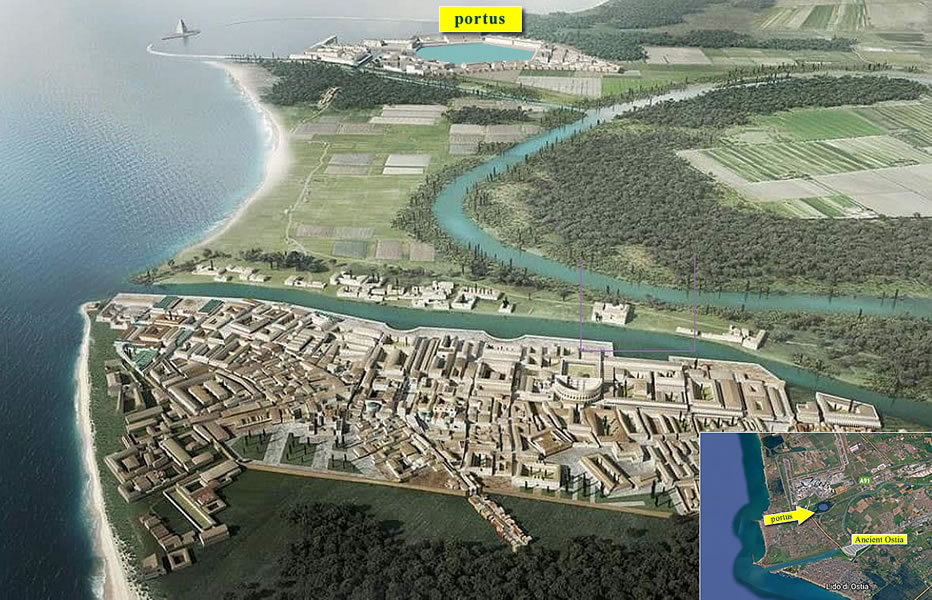
3D reconstruction of ancient Ostia
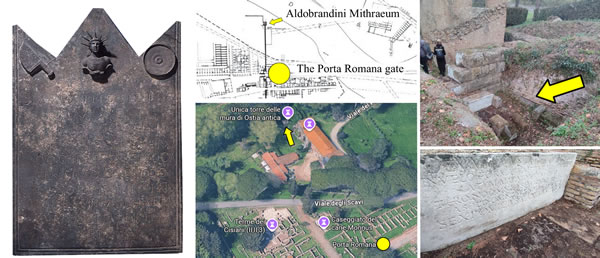
Aldobrandini Mithraeum, its inscription and its bronze tablet. - ancient Ostia, Rome
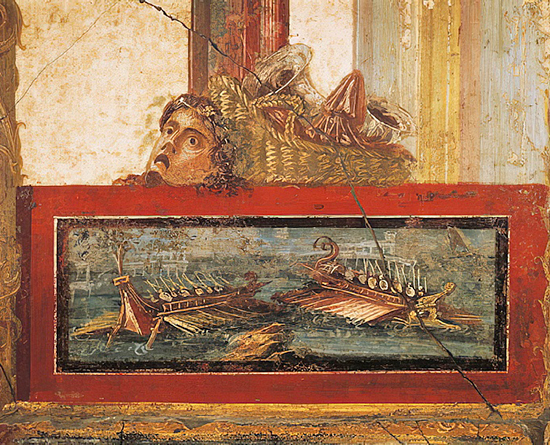
Cilician pirates assault ships on the open sea. 1st century AD. Fresco from the House of the Vettii, Pompeii.
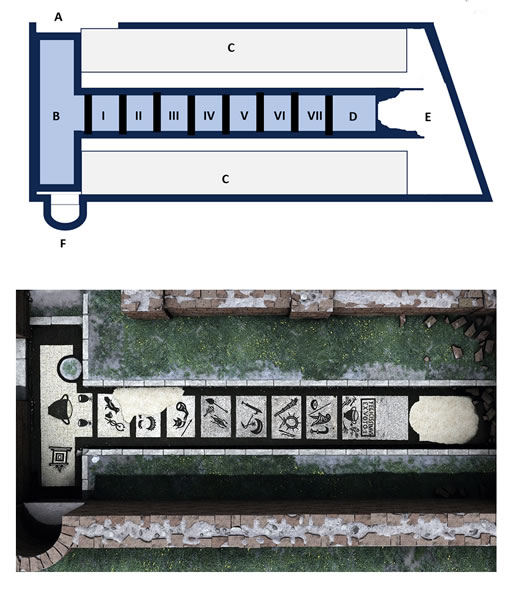
Mosaic representing the seven grades of initiation into the cult decorating the floor of the Mithraeum of Felicissimus at ancient Ostia.
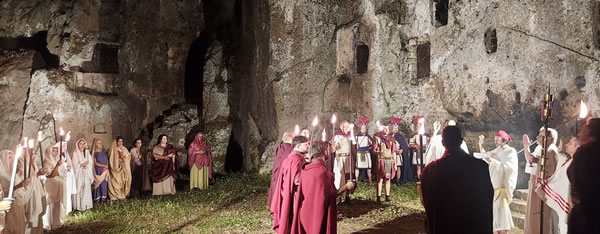
Mithraic ritual in the Mithraeum of Sutri - Pietas Gentile Community
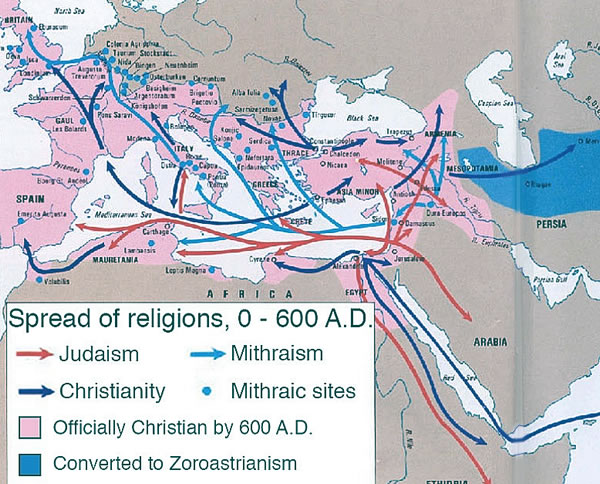
This page was last edited on 14 March 2026
© andmorestory.eu - All right reserved