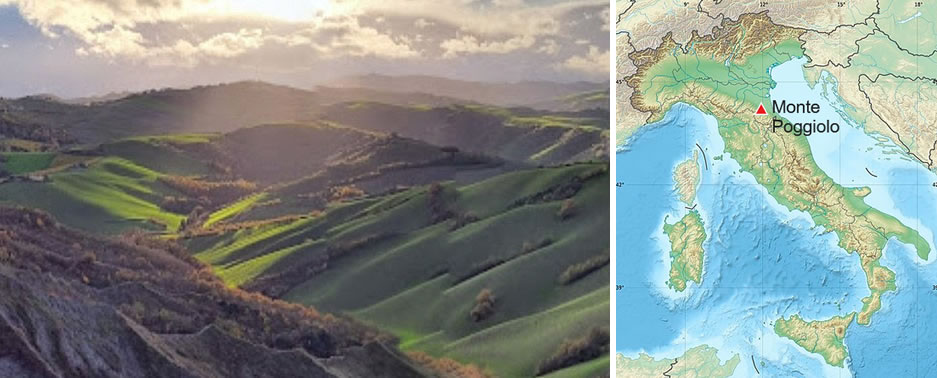
A view from Monte Poggiolo

In the 1960s, the anthropologist Gerlando Bianchini found the oldest human remains (skull fragments and several teeth) of the earliest hominid ancestor of humankind (an Australopithecus Siculus or gracilis) on the Capo Rossello promontory; but about 20 years after, a group of researchers found thousands of artifacts dated to around 850,000 years ago at Monte Poggiolo. They are the oldest evidence of human habitation in Italy. From this research, it can be deduced that in the territory, there was a settlement 800,000–1,000,000 years ago, and that this dates back to the time when the first humans were coming from Africa, where 3,000,000 years earlier, leaving the forests and adopting an upright posture, they had spread across the southeastern savanna. Around 2,500,000 years ago, we find their first tools; about 1,500,000 years ago, a particular form of human appeared—upright man (Homo erectus)—who spread throughout Africa and into the Eurasian continent. It is hypothesized that he arrived in Europe no earlier than 1,000,000 years ago. We have a great scarcity of information about his physical appearance; however, we can imagine that upright man was more or less as tall as we are (about 1.70 m), with a body mass similar to ours, upper limbs completely freed from locomotor constraints, an ability to make tools, and a cranial capacity—in the more evolved individuals—of 1,200 cm³, and in the less evolved ones, of 800–1,000 cm3. The size of the skull is proportional to body mass, just as the smaller skull of women is compared to that of men. Compared to apes, humans have some important characteristics: upright posture, tool use, a larger brain, and a social structure based on the pair bond.
Monte Poggiolo is a hill near Forlì, Italy in the Emilia-Romagna area. The hill has a dome-shaped at the end of the watershed between the Montone and Petrignone rivers and overlooks the Montone River valley from an elevation of 212 m. Now Monte Poggiolo is a modest rise of the Apennine relief before the plain, but eight hundred thousand years ago, the sea came here and the Paleolithic men chipped the stone between the quiet sands and gravel of a delta.
The site of Ca’ Belvedere was discovered in 1983. Today, it is located at about 20 metres above sea-level on the upper part of the northern slope of Monte Poggiolo. The excavation has concentrated on the upper part of the slope immediately to the west of Ca’ Belvedere where it revealed an in situ Palaeolithic industry. The deposit has been affected by frequent curved fractures which are evidence of a past landslide. The sedimentological and palaeontological analyses carried out on the site have led to the distinction of
1) a lower part with the environment was that of a beach littoral;
2) an upper part with a fluvial aspect and marine influences: the presence of pulmonate gastropods and fragments of Ostrea. Among the pulmonate gastropods found, Cochlodina laminata in particular indicates a cold and temperate climate. The pollen found in the sediment, although it is quite scarce, documents a cold type vegetation with conifers (pine and spruce) and the presence of typical steppe animal species.
The lithic artifacts have been found have sharp edges. They seem to be the result of a simple and opportunistic lithic technology based above all on the necessity to break the original pebble, often with violent blows. The presence of particular artifacts made on pebbles, such as choppers and chopping-tools, therefore seems to represent the first phase of the exploitation of the raw material and not the final product of a particular activity. In fact, there is no clear distinction between these tools and the real cores, but rather a substantial continuity which excludes any possible clasterisation. Therefore it is an industry of which the basic elements are represented only by flakes and cores. The data available lead to the hypothesis that at Ca’ Belvedere the palaeoenvironment was characterised by a low sandy coast which was interrupted by a gravelly beach at the mouth of a river, in a general situation of a marine transgression which was also related to phenomena of glacial eustacism. Since the Palaeolithic industry is contained within gravels rich in flint, which were deposited close to the river mouth or the water-line (which are normally high-energy situations), the absence of water rolling on the artifacts may be explained by admitting the presence of a river delta or connecting canals which were characterised by frequent changes in the positions of the river channels and by more or less temporary occlusions of the canals and the rapid formation of localised deposits. In such a situation the artifacts, which were produced along the banks or on the emerged bars, may have been buried and saved from further transport. An alternative hypothesis is that the artifacts were produced on the river escarpment or even on the gravelly beach. In this case the artifacts, abandoned among the gravel on the beach, could have been progressively buried by clasts coming from the slopes above before being definitively buried by new fluvial deposits.
A view from Monte Poggiolo
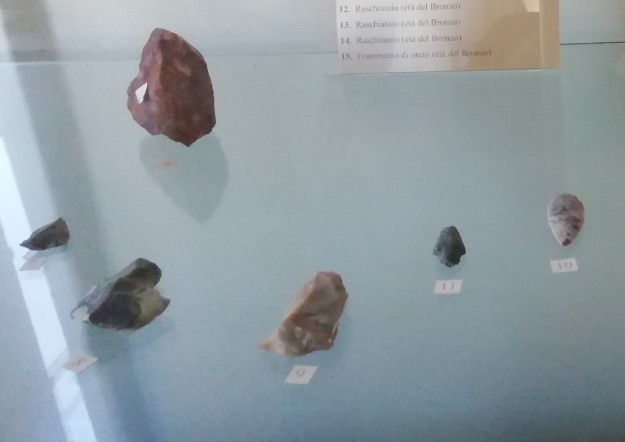
Some artifacts have been found at Monte Poggiolo- Museum of man and environment, Palazzo Pretorio, Terra del Sole, Castrocaro Terme and Terra del Sole (FC)
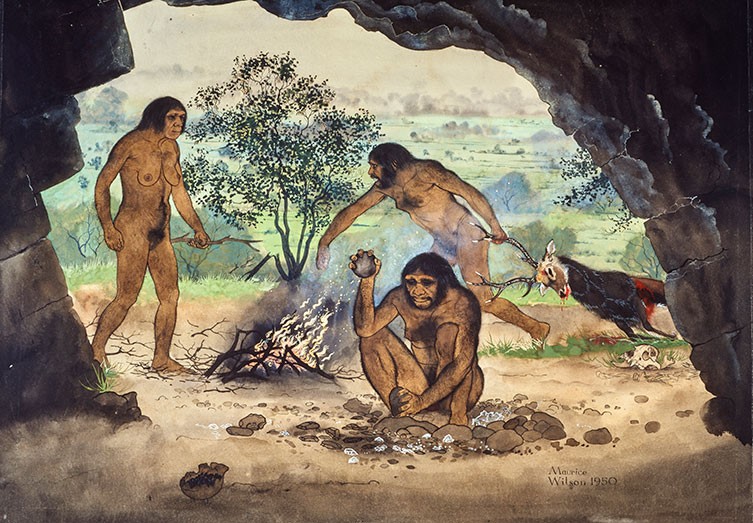
Illustration by Maurice Wilson showing Homo erectus using fire and preparing tools
This page was last edited on 15 March 2026
© andmorestory.eu - All right reserved