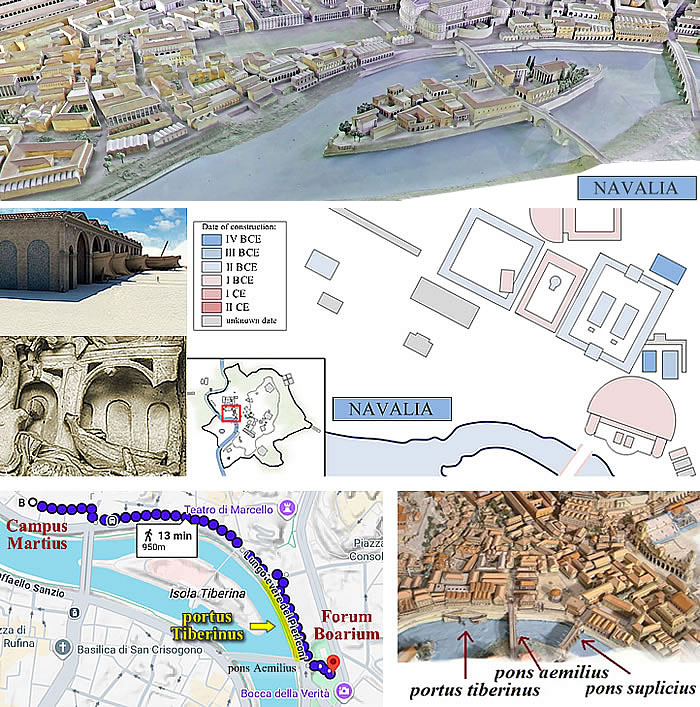
Area of Navalia in Rome

The Navalia was the oldest military port of Rome: a complex that served both as an arsenal and a naval base, with the dual function of sheltering ships and providing workshops for the maintenance and repair of military vessels. It is commonly accepted that there were two Navalia installations on the left bank of the Tiber River in Rome: the superius and the inferius. The superius was located on the bank of the Campus Martius, in the section facing the Tiber Island, an area that remained free of buildings until the Augustan age. This location was certainly not random: upstream from the island, the river formed a small, fine-sand beach on the left bank called arenula, a term preserved to this day in urban toponymy (Via Arenula). It is reasonable to assume that this very beach was used to haul ashore the penteconters used by the Romans from approximately the 6th century BC. The subsequent installation of wooden slipways and a roof must have progressively made the site functional. The timber needed for shipbuilding, cut in the Apennine forests and floated downstream, arrived here. The inferius was further downstream, in the Forum Boarium and near the commercial port (portus Tiberinus), as also evidenced by a fragment of the Forma Urbis (marble city plan). Furthermore, its existence is confirmed by several historically documented events: Livy recounts that in 338 BC, the Romans captured ships from the Antiates during the Battle of the Astura River; some were burned, and others were brought to Rome specifically to the Navalia, while their rostra (rams) were transferred to the Roman Forum to adorn the orators' platform. Another event was the attack launched here by Paullus Aemilius in 167 BC against the royal ship of Perseus, of extraordinary size and laden with Macedonian spoils. Finally, in 57 BC, Cato the Younger disembarked here the exceptional bounty of gold and silver taken from Cyprus. From the 4th century BC, the Navalia were developed and primarily housed the Roman military fleet. Later, they only served to moor ships present in Rome for state purposes. Indeed, during the Republic, the Romans never maintained permanent fleets but preferred to build them when needed or refit old ships that remained in the capital's shipyards or those of allied colonies and cities. In the 3rd century BC, a decisive expansion of the Navalia was undertaken due to the considerable need for ships to confront the Carthaginians at sea. Fleets of up to 350 quinqueremes were built during the First Punic War; 200 units in the subsequent Illyrian War; and 220 at the beginning of the Second Punic War. Unfortunately, ancient sources do not specify which military port these fleets departed from or returned to, as they generically refer to Rome each time. It is also likely that not all those ships wintered in the Navalia of the Urbs, as it has been estimated they could accommodate no more than 100 ships. A portion of them were probably stationed in the Navalia of Ostia and perhaps elsewhere. Precisely because of this, the Navalia were extended northward towards the Campus Martius (where the Ponte Vittorio stands today) and, likely to meet the demand for building long military ships (quinqueremes), multiple shipyards were constructed along the banks of the Tiber and its tributaries inland, in areas rich in timber. One such shipyard appears to have been identified in a canal carved into the rock on the bank of the Nera River, not far from Narni. The quinqueremes, in order to be sufficiently fast, were built with very light hulls, which, however, risked serious damage from shipworms (wood-boring mollusks) if kept submerged too long in stagnant waters. Pitch used as a "wax" to coat ships was described by Pliny the Elder (23–79 AD) as a remedy for waterproofing ship planking against shipworms—a method widely employed by the Romans. Hulls were hauled ashore, tilted first to one side, then to the other, to remove algae and crustaceans. Afterwards, a compound known as spalmo (to spread) was applied, made from tallow, fish oil, sulfur, and cerussa (white lead) mixed together, or alternatively a compound of lime and arsenic, to prevent attack by wood-boring worms that would penetrate the planking and consume the timber. When the Servian Walls were reorganized towards the Tiber, the portus Tiberinus was included within the new circuit, while the Navalia remained outside. To allow access from the city, the Porta Navalis, was opened in the wall circuit, mentioned by Sextus Pompeius Festus in the 2nd century CE and probably visible until the 15th century near the Theatre of Marcellus. However, the actual seat of the naval arsenal gradually shifted to Ostia for practical reasons: greater freedom of movement and control over the Mediterranean. Not only that, it was Augustus who established two permanent naval bases for the military fleet in key locations for Mediterranean control: Ravenna and Misenum. In the 1st century BC, the Navalia in Rome still maintained significant operational capacity, as seen during the various wars against pirates. Between the late 2nd and early 1st century BC, during the war against the Cilician pirates led by Praetor Marcus Antonius, the Navalia were restored, and later in 59 BC by Hermodorus of Salamis. At that time, the Navalia were also used for transporting wild beasts destined for public games. Pliny the Elder recounts in the 1st century CE (Nat. hist., XXXVI 40) that the Magna Graecian sculptor Pasiteles (1st century BC) went one day to the Navalia where there were ferae Africanae, evidently recently disembarked in the city and destined for some exhibition. He went there to draw a lion from life, but while he was observing it, a panther escaped from a nearby cage, putting the artist in grave danger. The Navalia were downsized in the Augustan era. For the first time in Rome's history, Augustus established permanent armed forces. Until then, fleets, like legions, had been raised out of necessity and disbanded when the need ceased. The large naval forces that fought at Actium, however, were kept operational, divided among three new naval bases placed to defend the Italian peninsula: Misenum, Ravenna, and Forum Iulii (Fréjus). Consequently, the Navalia of the Urbs lost their function as the main naval base of the Roman fleet, a role that had already been diminishing during the civil wars. Nevertheless, there remained a limited need to maintain a small detachment of ships from the fleets of Misenum and Ravenna in the city, both for state requirements and to serve as a reserve for the light vessels stationed in the Navalia of Ostia to protect the mouth of the Tiber (the Romans had a certain distrust regarding the security of coastal cities, considering them very exposed to sudden attacks), as well as for the needs of the emperors and their legates. Indeed, they found it more convenient to travel on the Tiber: Augustus did so systematically, as he preferred to make all his journeys by ship whenever possible; Tiberius had retreated to Capri but after Sejanus's death, he sailed up the Tiber to the outskirts of Rome before changing his mind and returning to his Villa Iovis; the young Caligula began his principate by retrieving the ashes of his mother and brother from the Pontine Islands and, with them, sailed up the Tiber to deposit them in the Mausoleum of Augustus; Claudius set sail from Rome on a warship, with which he descended the Tiber, passed Marseilles, ascended the Rhône and Saône, crossed onto the Seine, crossed the English Channel, and landed in Britain; Nero loved sailing on the Tiber to Ostia, stopping along the banks at taverns that catered to his artistic and transgressive tastes. In the 2nd century CE, they were restored by the Greek Hermodorus and still existed under the Empire, although their already diminished importance decreased further with the construction of military ports elsewhere. After Actium, with every other maritime power gone from the Mediterranean, the Romans no longer maintained fleets of large battle units, only of small, fast vessels, for which military ports were built at Misenum, Ravenna, and elsewhere. In the Augustan age (27 BC-14 CE), the Navalia still existed, but with the construction of Claudius's port and especially Trajan's port at Fiumicino, they went into irreversible decline and were used only to moor ships present in Rome for state needs. In the 6th century CE, the Byzantine historian Procopius of Caesarea visited the Navalia and could see an archaic ship that tradition identified as the ship of Aeneas. It was an archaic pentecontoros, as demonstrated by its dimensions, proportions, and the existence of a single bank of oars, still present well into the 4th century CE. The navalia consisted of an extended sequence of covered sheds—that is, shelters in which the long warships were hauled ashore. They were equipped with everything: slipways directly onto the river; mooring docks; hauling facilities; winter storage facilities for vessels; construction yards; ship repair yards with an attached textrinum (shipyard, the place where ships are made); indeed, according to Ennius, there was a textrinum for long ships in the Campus Martius. They also included areas for the maintenance and supply of materials and equipment, not only naval but also specific to military use, such as armaments; storage areas; warehouses; offices; barracks; various services; and perimeter defenses. The ancient military port of Rome was a structure quite different from the various commercial river ports the Urbs enjoyed from antiquity to the modern era. While merchant docks could accommodate both "long" (warships) and onerariae (cargo ships), the navalia structures were specifically designed for the storage of the former. Combat ships, in fact, had a rather light hull to be sufficiently fast, which risked serious damage from shipworms if kept immersed in water for too long. The navalia therefore consisted of a series of covered hauling ramps on which the units were pulled ashore, kept with the bow facing the water to allow for a prompt departure. They thus had functions equivalent to those of arsenals, being able to handle maintenance and sometimes even shipbuilding.
Area of Navalia in Rome
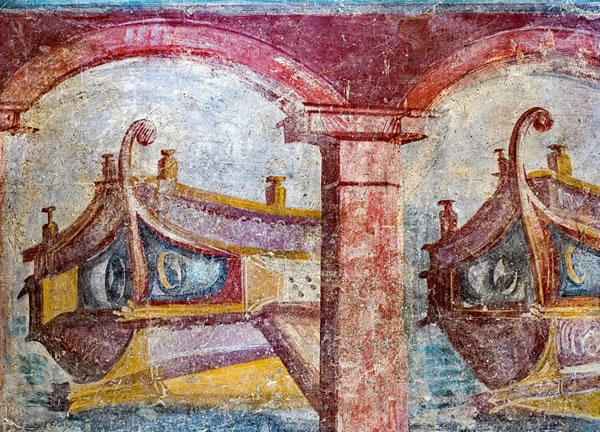
Roman warships ashore in the navalia. Fresco from Pompeii (VI 17 9-11) - National Archaeological Museum of Naples.
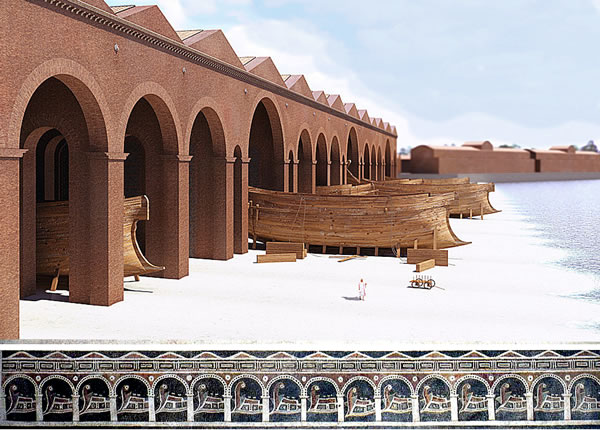
A 3d reconstruction of the building, and a depiction of shipsheds on a mosaic from Rome, Via Ardeatina (1st century BC) - Vatican Museums.
This page was last edited on 14 March 2026
© andmorestory.eu - All right reserved