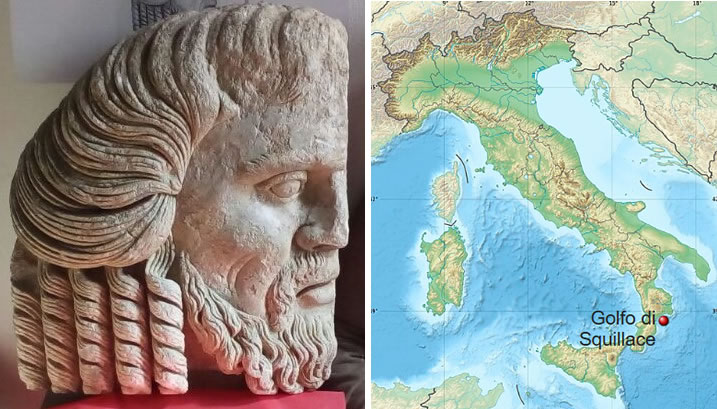
Head of King Italo - Museum of the Bourbon Royal Ironworks, Mongiana (Vibo Valentia, Italy)

Italy, located at the center of the Mediterranean Sea, between the Balkan Peninsula to the east, the Iberian Peninsula to the west, continental Europe to the north, and Africa to the south, has always been the most convenient bridge between all these regions. Consequently, it has been open not only to the intense exchange of material goods and culture among the coastal peoples of the Mediterranean but also to immigration and colonization, both by land (where the Alps offer numerous and accessible passes) and by sea. Since the Mediterranean, with its temperate climate, rugged coasts favorable to navigation, and the fertility of the lands it touches, provided humankind with the most suitable conditions for the development of civilization, Italy soon found itself at the center of the ancient world.
It happened that at the beginning of its history, Rome found itself fighting against the other pre-existing Latin populations; in particular, it had to subdue many of their cities, while still allowing them the possibility of self-administration, becoming allies who fought alongside the Romans. The problem was that they did not have the same rights as the Romans, and among them, there were disparities in treatment. Some allies, although having to contribute like the others to the maintenance of the army, enjoyed even fewer rights. They wanted Roman citizenship with all the advantages it entailed. The civis romanus (Roman citizen) had full political and legal rights, but above all civil, fiscal, and patrimonial advantages, and could run for public office. In the case of a Roman citizen abroad (in a Roman province), the advantages were even greater: he was exempt from paying many tributes and, finally, if arrested, he could not be subjected to corporal punishment. At the end of victorious wars, the Senate recognized soldiers with "Roman citizenship" a part of the booty and conquered territories. The situation degenerated into widespread discontent that led to the revolt of some populations. They armed an army, at the head of which they placed the Samnite Papius Mutilus, and to reaffirm their identity, they also created a new capital in Samnium during 90 BCE, in the city of Corfinium (Corfinio), which was renamed Italica. During the insurrection, the confederated Italic tribes gave themselves a unitary political structure modeled on that of the Urbe: they elected two Consuls (one from the Marsi and one from the Samnites, the two preeminent tribes), an assembly of as many as 500 senators. To legitimize this new political identity, the Italic peoples chose to mint their own coinage, which was not merely an economic instrument but a manifesto of independence and a symbol of rebellion. Indeed, in antiquity, coins were emblems of cultural identity and political declarations. Every element engraved on a coin—from images to inscriptions—communicated values, alliances, and ideologies. It is within this framework that the Italic decision to mint coins must be understood, and to assert their identity more incisively, inscriptions in the Oscan language were a central feature. The use of the Oscan alphabet, rather than the Latin one, represented a clear act of cultural resistance: a rejection of Roman linguistic domination and an affirmation of Italic identity. Moreover, the inscription “Italia”—the name of the confederation—was in itself a political declaration. For the first time in history, the term “Italy” was used to identify not merely a geographical region, but a united political community. Thus, the coin became a tangible symbol of cohesion among diverse peoples, united by the desire to obtain equal rights with Rome. The imagery, too, spoke of unity and hope. On the obverse, the personification of Italy wearing a laurel crown symbolized victory. On the reverse, the scene of warriors taking an oath visually expressed the alliance among the various Italic peoples. The Italic coin thus became not only a medium of exchange but a powerful tool of political communication. With every transaction, it carried the message of the Italic Confederation to all who used it, reinforcing a common identity and openly challenging the hegemony of Rome.
The origin of the name Italy remains uncertain: over time, it has been the subject of hypothetical reconstructions by linguists and historians, often bordering on myth. What is certain is that initially, the Greeks used "Italy" to refer only to the southern tip of the peninsula south of the gulfs of St. Eufemia and Squillace, known as Bruttium (Calabria). Then, in later centuries, the Greeks, trading along the Italic coasts even before the colonization later called Magna Graecia (Megále Hellás), gradually applied the name "Italy" to an ever-wider region until, at the time of the Roman conquest, it was extended to the entire peninsula. In fact, by the time of the First Punic War between Rome and Carthage (264–241 BC), the name already designated the entire Italic peninsula as far as the Arno and Rubicon rivers; and in 49 BC, after Cisalpine Gaul (which until then had been a province) obtained Roman citizenship, the name Italy was extended to the entire peninsula as far as the Alps. The Greeks called their compatriots in the colonies of Magna Graecia Italiótai, while they called the inhabitants of the Italic peninsula (Umbrian-Sabellians, Aequi, Volsci, Samnites, Campanians, Lucanians, Bruttians, Picenes, etc.) Italói. It is not certain whether the Greeks included the Romans among the Italic peoples, while it is certain that they did not include the Etruscans. The word Italy is mentioned for the first time by Herodotus (Halicarnassus, 484 BC – Thurii, c. 425 BC).
It is said that Arion, who spent most of his time with Periander, had a strong desire to sail to Italy and Sicily; there he became wealthy and then decided to return to Corinth. When it was time to depart from Tarentum, since he trusted no one more than the Corinthians, he hired a Corinthian ship; but once in the open sea, the crew plotted to get rid of Arion and seize his riches. Arion became aware of this and began to plead with them: he was willing to give up his possessions but asked for his life to be spared; however, he could not convince them, and the sailors ordered him to take his own life to be buried on land or to throw himself into the sea as soon as possible. Arion, seeing no escape, asked for permission, since they had so decided, to sing standing among the rowers in full stage attire: he promised to take his own life after the song. The sailors, pleasantly attracted by the idea of hearing the best singer in the world, moved from the stern to the center of the ship. Arion put on his stage costume, took his lyre, and performed a song in a high tone, standing among the rowers; at the end of the song, he threw himself into the sea just as he was, in full costume. According to the story, the sailors then set course for Corinth, while Arion was picked up by a dolphin and carried to Taenarum; there he landed and from there headed to Corinth, still in his stage attire; upon arrival, he recounted everything that had happened to Periander, who, somewhat incredulous, decided to keep Arion under surveillance and focus his attention on the ship's crew. Thus, when the sailors were available, he summoned them and asked if they could give him news of Arion; they replied that he was alive and well in Italy, that they had left him in Tarentum in full and happy activity; but Arion appeared before them, still dressed as when he had jumped from the ship, and they, astonished and now exposed, could no longer deny it. This is what the Corinthians and Lesbians recount; moreover, at Taenarum, there is a small bronze votive statue of Arion, representing a man riding a dolphin.
— Herodotus, Histories (1.24.1)
For the Greeks, the word Italy assumed different meanings primarily related to fire. Indeed, the Italic peninsula was nicknamed Italós, meaning "smoking" or "fiery," for various reasons: due to the metal furnaces on the island of Elba, the active volcanoes, the agricultural practice of "debbiatura," i.e., burning the land first to clear it of forests and then to prepare it for subsequent plowing and sowing, or because of the sunset, which seemed to be on fire.
For the ancient Greeks, volcanic eruptions were caused by the Titans. The Titans fought with the Olympian gods, and in their terrible battles, they shook the Earth, which in response could only vomit the fire hidden within its depths. The greatest of the Titans was Typhon, son of Tartarus and Gaia (the legendary name of planet Earth). The gods, to punish his insolence for wanting to fight them, imprisoned him under Mount Etna. But Titan did not give up. His screams and roars could be heard for kilometers; he shook and moved the earth in anger, and his incandescent breath finally emerged from the volcano's mouth. According to legend, the volcanoes hid a workshop. Hephaestus, god of fire and volcanoes, forged weapons for the gods under the Mediterranean. Lightning bolts for Jupiter and weapons and a shield for Achilles. Finally, the Cyclopes, whose single eye symbolized the mouth of a volcano, while their stature and strength were compared to that of mountains. What emerged from the Mediterranean volcanoes was therefore the smoke and sparks produced by the work of Hephaestus and the Cyclopes. The Romans inherited these legends and fears, initially replacing the names of the protagonists: Typhon became Enceladus, and Hephaestus became Vulcan, the Roman god of fire. Some linguists support a hypothesis, which has yet to find material evidence, that the first Greeks who arrived in the Italian peninsula called it Aithalìa (flaming and sooty), where the initial part Aith- would contain a reference to the volcanic dimension of the lands of the peninsula. This meaning would persist, for example, in the name of Etna, in ancient Greek Aitna, or in the island of Elba, Aithále ("the Smoky or Smoking One") because of the numerous metal furnaces existing there.
According to another hypothesis, the term "Italy" derives from the Akkadian word Atalu, which would mean "land of the sunset" (Hesperia). This thesis can be correlated with those that emphasize the Greek origin of the first inhabitants of the South, namely the Oenotrians, due to the geographical location of the Italian peninsula relative to Greece, which is indeed to the west, i.e., toward the sunset relative to it. In this sense, the choronym of the Italian peninsula would have the same origin as that of the Greek island of Ithaca. According to legend, the Sun (also called Helios) daily concluded the race of his fiery chariot pulled by restless horses. And the Eridanus (the Po River in northern Italy) was practically the bed where the great god plunged to sleep. One day, Phaethon, son of the Sun and Clymene, asked his father if he could drive the flaming chariot at least once. The Sun initially opposed it, knowing the difficulties involved, but then gave in. Phaethon, eager to prove his worth, took the reins. But the horses became unruly and made the chariot run here and there across the sky, greatly endangering planet Earth, which either burned from excessive heat or became frozen. It was then that Zeus, pitying humankind, hurled a lightning bolt at the chariot, and Phaethon, in flames, fell into the Eridanus River. The Heliades, sisters of the unfortunate youth, rushed to the spot and wept so much for their beloved brother that Zeus, moved, transformed them into poplar trees and their tears into shining amber. As always, behind every legend, there is a bit of reality. If the Po is certainly not the river where amber was collected, its Delta (Hesperia) was a crucial hub in the commercial traffic of fossil resin from the shores of the Baltic Sea, appreciated for its beauty and fragrance. Here in the Polesine ("Land that emerges from the waters"), delineated by the Po and Adige rivers, the local people sorted and worked it, and it was here that the Greeks came to collect it after a long journey, buying it already worked and reselling it along the Mediterranean coasts. The Polesine was a strip of land one hundred kilometers long and eighteen wide, defined as "the Mesopotamia of Italy" because, thanks to its waters, it has almost always been a source of economy. Because of amber, a great economic and commercial flow occurred here, along which many other artifacts and raw materials traveled. Here, not only goods were exchanged but above all ideas and cultures. Many amber artifacts dating back to the Bronze Age (12th–11th century BC) have been found at Frattesina di Fratta Polesine, testifying to the relationships between the Adriatic coasts and the Aegean world (www.museograndifiumi.it).
In the 1st century BC, Virgil (Andes, October 15, 70 BC – Brindisi, September 21, 19 BC) designated Italy with the name Saturnia tellus (Saturnia from Saturn, who would have reigned there) in Roman religion:
Salve magna parens frugum, Saturnia tellus, magna virum...
Hail, great mother of fruits, Saturnian land, great mother of men...
- Virgil, Georgics (II, 137 ff.)
It was the realm of the god Saturn during the mythical Golden Age, which he himself initiated after being expelled from Olympus. The god was first dethroned by his son Jupiter and exiled to Italy, where he found refuge in Latium and established his kingdom there. The land of Saturn was first identified with Latium and then generally with the rest of the peninsula, of which Saturn himself was considered the first king. According to Dionysius of Halicarnassus, "Saturnia" was the name by which Italy was known to the indigenous peoples. Saturn would have shared power with the indigenous god Janus and taken up residence in a castle near that of the local god, inaugurating the Golden Age and the Saturnia regna in these lands. The localization of the story in inner southern Latium and the attribution to Saturn of the foundation of Anagni, Alatri, Ferentino, Arpino, and Atina are believed to be inventions of modern scholars, based solely on the idea of the great antiquity of the walls. To the Saturnian tradition, the same scholars then combined that relating to the Cyclopes, the giants who were already in antiquity considered the authors of the Mycenaean fortresses (Pausanias, Description of Greece, II, 16.5; 25.8): the very ancient technique would have been brought to Italian soil by the Pelasgians, mythical primordial inhabitants of Greece who later arrived on the coasts of Latium and were considered, among other things, the ancestors of the Hernici (Macrobius, Saturnalia, V, 18, 13 ff.).
According to the first historian of the Greek West, Antiochus of Syracuse (Syracuse, 460 BC – ?), the name Italy would derive from the mythical King Italus, who would have ruled the Oenotrian people in southern Italy 16 generations before the Trojan War. According to Greek mythology, the Oenotrians derive their name from Oenotrus, son of Lycaon, sovereign of Arcadia (Peloponnese), who would have moved to southern Italy, founding the kingdom of Oenotria, which literally means "land of wine." The territory of Oenotria roughly corresponded to the area of peninsular Magna Graecia. Italus was a powerful prince who transformed his population from nomadic to sedentary by introducing the practice of sissizi, i.e., the custom of sharing common meals. He subjugated the extreme territory of the Italian peninsula, between the Strait of Messina and the gulfs of Squillace and St. Eufemia, and, having called this region Italy after himself, would then conquer many other cities. After the reign of Italus would come that of Morgene, which would then be conquered by the Bruttians, coming from the north. According to some historians, as a result of this last event, the Oenotrian population would have divided into the populations of the Itali, the Morgeni, and the Siculi. In this sense, the term Italy began to identify only the peninsular area occupied by the first subgroup, while the Siculi settled in Sicily, and the Morgeni divided between inland Sicily and southern Calabria. Aristotle (Stagira, 384–383 BC – Chalcis, 322 BC) in his work Politics (VIII, 1329 b), dedicated to the administration of the polis, following Antiochus, derived the name Italy from King Italus, who, according to the Greek philosopher, ruled the territory corresponding only to central-southern Calabria, delimited to the north by the Lao River, and having as its capital the city of Pandosia Bruzia, corresponding to present-day Acri. Even though the legend of King Italus has only an eponymous purpose, it is useful because it allows us to deduce that the original extension of the name Italy did not extend beyond the confines of the extreme tip of the peninsula.
But in the course of time the land came to be called Italy, after a ruler named Italus. This man, according to Antiochus of Syracuse, was both a wise and good prince, and persuading some of his neighbours by arguments and subduing the rest by force, he made himself master of all the land which lies between the Napetine and Scylacian bays, which was the first land, he says, to be called Italy, after Italus. And when he had possessed himself of this district and had many subjects, he immediately coveted the neighbouring peoples and brought many cities under his rule. He says further that Italus was an Oenotrian by birth. But Hellanicus of Lesbos says that when Hercules was driving Geryon's cattle to Argos and was come to Italy, a calf escaped from the herd and in its flight wandered the whole length of the coast and then, swimming across the intervening strait of the sea, came into Sicily. Hercules, following the calf, inquired of the inhabitants wherever he came if anyone had seen it anywhere, and when the people of the island, who understood but little Greek and used their own speech when indicating the animal, called it vitulus (the name by which it is still known), he, in memory of the calf, called all the country it had wandered over Vitulia. And it is no wonder that the name has been changed in the course of time to its present form, since many Greek names, too, have met with a similar fate. But whether, as Antiochus says, the country took this name from a ruler, which perhaps is more probable, or, as Hellanicus believes, from the bull, yet this at least is evident from both their accounts, that in Hercules' time, or a little earlier, it received this name. Before that it had been called Hesperia and Ausonia by the Greeks and Saturnia by the natives, as I have already stated.
- Dionisio (Alicarnasso, Turchia, 60 a.C. circa – 7 a.C.), Antichità Romane I, 35.
Head of King Italo - Museum of the Bourbon Royal Ironworks, Mongiana (Vibo Valentia, Italy)
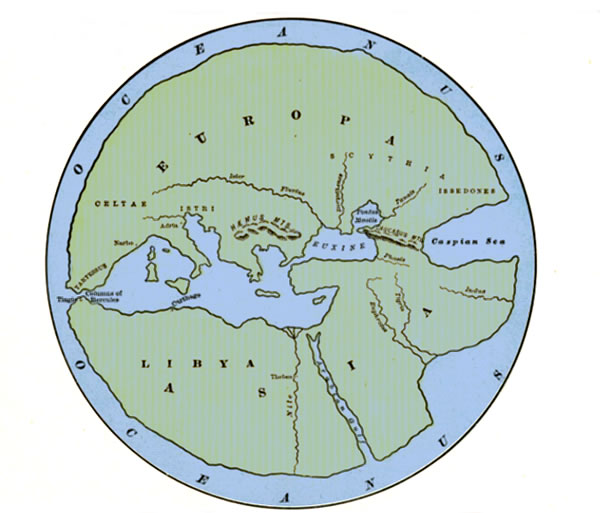
Map of the world according to Hecataeus of Miletus B.C. 500 - Cram's atlas of the world, 1901
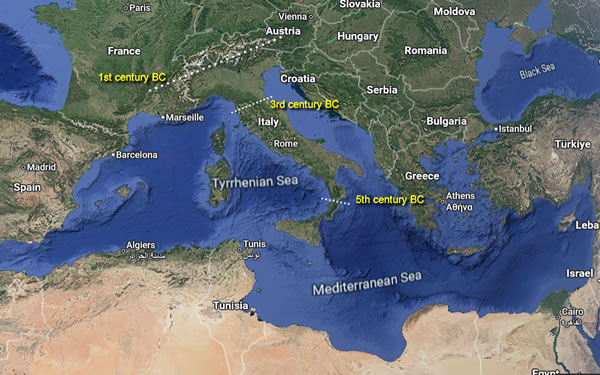
Territorial spread of the name Italy over the centuries
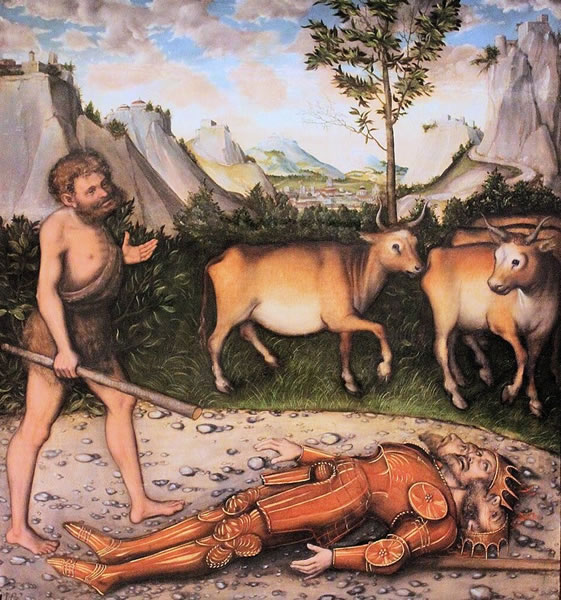
Hercules and the Cattle of Geryones by Lucas Cranach the Elder and workshop (1472–1553), Herzog Anton Ulrich-Museum, Lucas Cranach
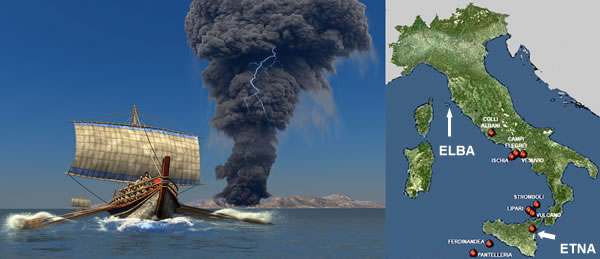
Map of active and dormant volcanoes in Italy, with the island of Elba indicated.
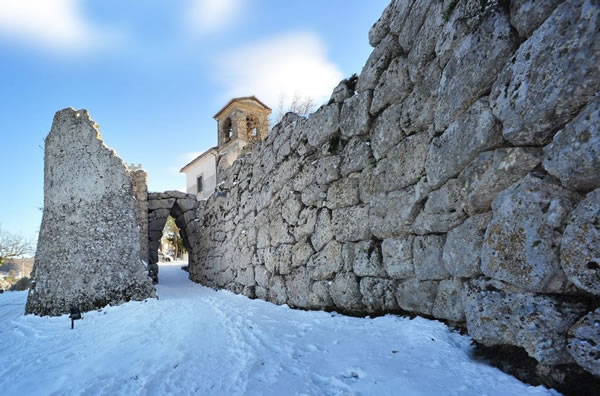
Arpino - Pointed Arch Gate / Polygonal Walls
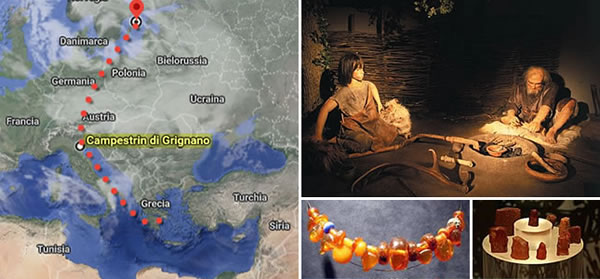
Approximate geographical area crossed by the Amber Route. Reconstruction of a Bronze Age workshop with artisans working amber and artifacts found at the Campestrin archaeological site in Grignano Polesine.
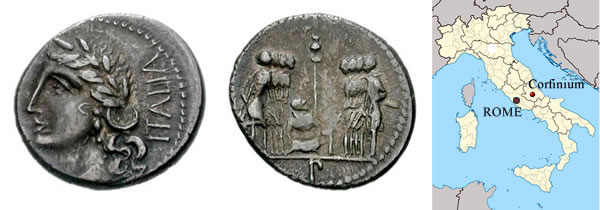
Silver coin of the Italic League, minted during the Social War (91-89 BC), in which the Italic peoples demanded citizenship rights against Rome and on which the name ITALIA was engraved for the first time. - Antonio De Nino Civic Archaeological Museum, Corfinio (L'Aquila, Italy)
This page was last edited on 14 March 2026
© andmorestory.eu - All right reserved