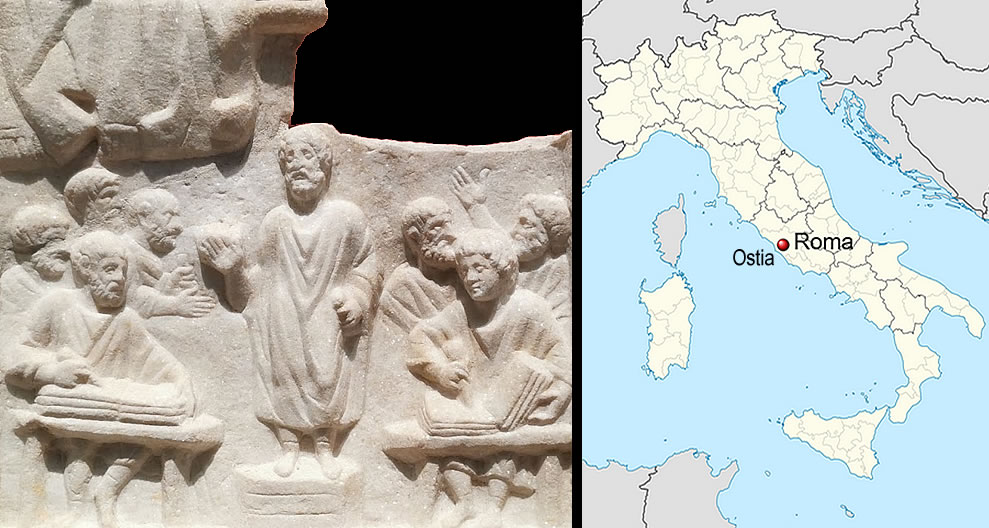
Ostia Antiquarium, inv. 130 - Animated courtroom scene with the lawyer delivering a speech and the clerks recording what is being said. Bas-relief.

The very name of Ostia reveals its original function: in Latin, it means "door" or "mouth" of the river. The Roman settlement at the mouth of the Tiber is very ancient: literary tradition attributes its foundation to King Ancus Marcius, although finds dating before the 4th century BC are rather sporadic. It was precisely in the 4th century BC that the first military castrum was built, intended to control this strategic location.
Indeed, with the expansion of Rome, the site's importance grew rapidly. The new commercial horizons opened during and after the Punic Wars pushed the city to strengthen surveillance over the Tiber mouth, also to protect itself from Tyrrhenian pirates and the threats of neighboring peoples. Thus, between the 3rd and 2nd centuries BC, the settlement gradually expanded, and by the 1st century BC it had transformed into a true commercial city.
Ancient Ostia still preserves numerous cult buildings today: alongside traditional temples built in different eras, we find sanctuaries dedicated to Eastern deities, Mithraea, small shrines sometimes carved out of private spaces, and even rooms interpreted as Christian places of worship. A significant example is the Republican sacred area (I, XV), where the Hall of the Altars (Aula delle Are, I, XV, 3) stands out, arranged in the 2nd century BC to house altars, the oldest of which dates to the mid-3rd century BC.
Around the mid-2nd century AD, Ostia's population underwent profound changes due to an exceptional migratory flow. The arrival of new and popular Eastern cults – such as those of Isis, Serapis, Cybele, Attis, and Mithras – raised concerns about the fate of the old temples and local traditions, stable elements of the collective cultural memory. The dominant elite reacted by preserving this heritage through the creation (or reactivation) of priesthoods intended for young members of the aristocracy, such as the sodales Arulenses and the sodales Herculani, both linked to the cult of Hercules and his altar.
The Hall of the Altars, located in the northeastern part of the Sanctuary of Hercules, is a quadrangular building that houses four small tuff altars. The room is accessible from the square in front of the Temple of Hercules and the Tetrastyle Temple. According to archaeologists, the hall dates to the late Trajanic period. Three altars are aligned, while the fourth is about one meter behind the row. They were placed beginning in the 3rd century BC and remained in their original position until the end of the 2nd – beginning of the 1st century BC, when the area was transformed by the construction of the two temples. Only the eastern part was covered by a roof supported by pillars, and a pseudo-aedicule was attached to the southern wall. This small sacred area was probably cared for precisely by the sodales Arulenses.
Interestingly, the sodales Arulenses are attested only at Ostia and nowhere else in the Roman Empire. They constituted a very ancient religious brotherhood, dating back to before the end of the 4th century BC. It was reactivated in the second half of the 2nd century AD, perhaps in conjunction with the arrangement of the Hall of the Altars, which became their headquarters. In the imperial period, the sodales were usually members of the priestly colleges established for the cult of deified emperors (such as the sodales Augustales), but similar brotherhoods already existed in archaic times, such as the sodales Titii, attributed to Titus Tatius or Romulus.
In 1938, inside the Hall of the Altars, a marble relief dating from between the late 2nd and the 5th century AD was discovered. Its interpretation is uncertain: it might depict a lesson in a philosophical school, a Christian orator whose words are being recorded by scribes, a courtroom scene with stenographers, or a public auction. The original function of the relief is also unknown; perhaps it was the sign of a professional copyist. Two elements, however, are clear:
• The two figures in the lower corners sit at desks and write on large sets of bound wooden tablets (or perhaps parchment or papyrus codices). This would be one of the earliest depictions of scribes working at desks, contradicting the common idea that such furnishings only spread in the medieval period.
• It is not, however, a judicial scene of acceptilatio, since the latter was a purely verbal transaction. Indeed, in Roman law – the legal system developed from the foundation of Rome (traditionally 753 BC) to the Empire of Justinian (565 AD) – acceptilatio was a formal method of extinguishing an obligation. It consisted of a solemn question-and-answer formula: the debtor asked the creditor whether he had received payment (Quod ego tibi promisi, habesne acceptum? – "Have you received what I promised you?"), and the creditor answered in the affirmative (Acceptum habeo – "I have received it"). Initially, acceptilatio extinguished the obligation regardless of whether payment had actually been made; later it became an act of debt remission by way of gift. It applied only to verbal contractual obligations, but through novation it could extinguish any obligation.
This page was last edited on 21 March 2026
Ostia Antiquarium, inv. 130 - Animated courtroom scene with the lawyer delivering a speech and the clerks recording what is being said. Bas-relief.
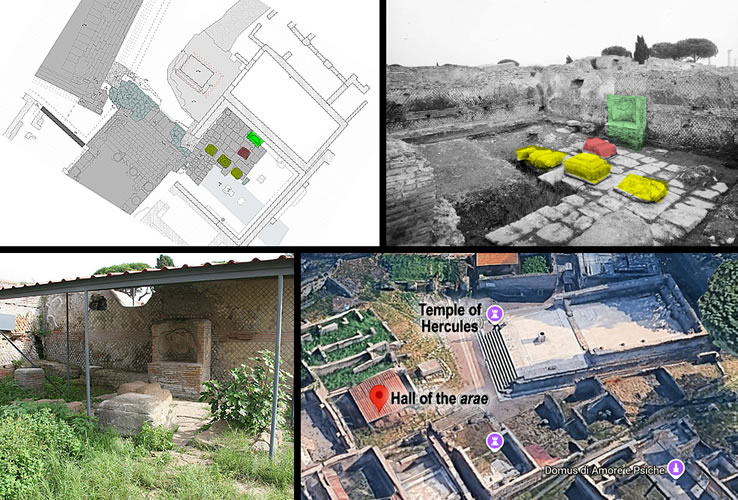
Floor plan of the northern sector of the square, highlighting the phases from the 4th century BC to the end of the 1st century AD (A. Marchello, M. Turci). - Hall of the Altars, view from the south/west (PaOant, Photographic Archive, no. B338). - Regio I - Insula XV - Hall of the Altars (I, XV, 3).
© andmorestory.eu - All right reserved